Part 5 Textile solutions

Reflections on tutor feedback

My tutor had made some very positive feedback for Part 4 which I was really pleased and motivated by. She highlighted strengths and weaknesses and especially my need for perfection which is certainly an issue of weakness but it was satisfying to read that I had done well in choosing Ty Twombly as a challenging piece and that I had finally taken a risk. It is so difficult for me and I do often look at some of my work and feel frustrated by it as it doesn’t match up to work that I have seen on other students learning logs. I know we all have our own particular style but other students work is so flowing and artistic and mine often isn’t, at least that it is how I view it. It is getting better than when I started Foundation Textiles but I think I have a long way to go and I hope in Part 5 that I can show improvements in this area. I was happy that my tutor thought that I have built upon skills that will be an asset to me beginning the degree in Textiles although I will not be applying until next year when I may be able to devote more time to the degree. But I can continue sketchbook work as a means of practising and developing skills which I need to be able to use for the degree. My tutor advised “that you narrow your field to enable a tighter, more cohesive body of work, where pieces sit as a collection. Currently it feels that you are wanting to cover so much, showing so many skills, methods and applications”.

This was when the penny finally dropped about how to complete work. This weakness could rest on my upbringing as I had been raised to work as hard as possible and to endeavour to be better than anyone else, it is a Green family trait! When I was doing an Open University course in Health and Social Care a few years ago, I did not consider any essays to be good unless I had a mark of 80% or more. On one essay I scored 90% and my tutor had telephoned me to congratulate me but he said if I had mentioned one specific area, I would have scored 96% so naturally I was cross that I had failed to do that. It is genuinely hard to get out of that mindset and when I received the tutor feedback for Part 4 I was unhappy that some of the work that I had completed that I had felt was really good my tutor had not talked about but that some of the work I had hated and actually did not want to put in my learning log, my tutor had really liked. This all relates back to the perfectionism and lack of free expression that is preventing me from really letting go as my tutor advised me to “explore; being more; playful, splatter, tear, crush, splash, scrape, etc. to document essences of your journey – rather than being too literal”.

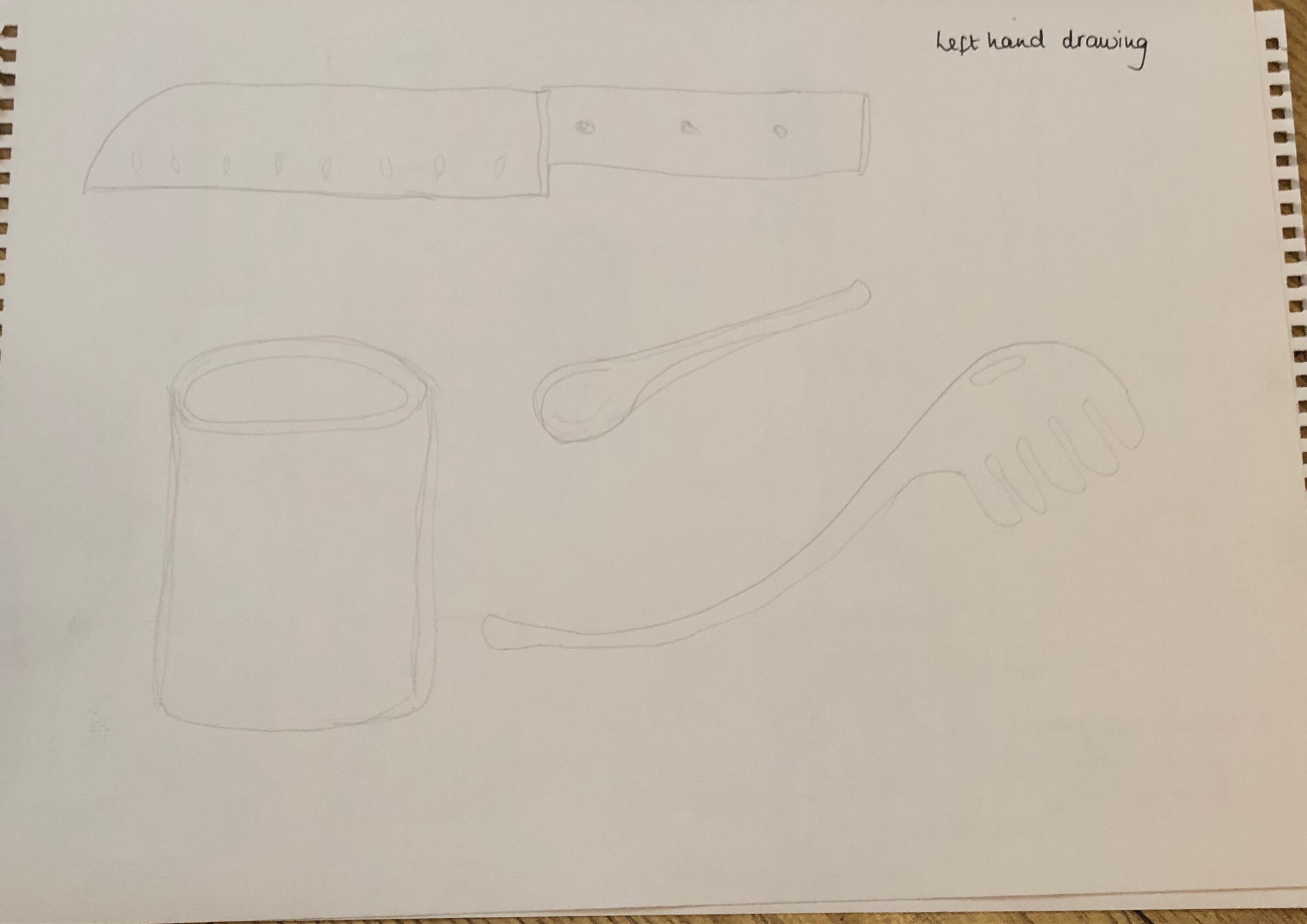
Now I have completed the previous 4 parts of Foundation Textiles I can reflect on what I have learned. I have been able to research and critically examine well known textile artists which I have found fascinating. I have also learned about mark making techniques, using a sketchbook more effectively and most of all I have found skills which I did not know I have, such as that I can draw with my left hand and actually paint better with my left hand too. I have loved being able to use natural dyes on fabrics and also how to use my sewing machine to make marks. I have found out what I liked and disliked within my own work, my strengths and weaknesses and areas which require further development. I will be continuing to produce samples and ideas after this course and I want to keep on learning and to practice wherever I can. I really do want to do the full degree course in Textiles and I do need to organise my time better in order for me to achieve this.

Option 3: Large-scale material manipulation

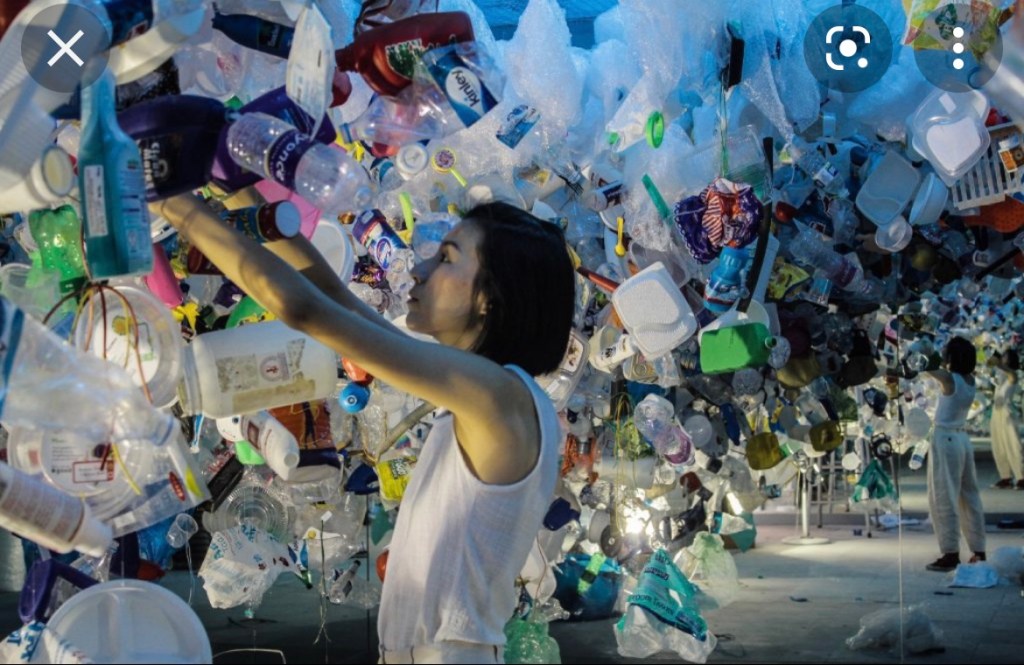
What I do want to do for Part 5 is to produce a piece which reflects something which I am very passionate about and that is the environment and in particular the pollution of our oceans. During the current pandemic I joined a local volunteer litter picking group and it shocked me to see how bad the litter was in our local area and how much could be collected. My 5 year old son has joined me in this and also was in our local newspaper with a large article about how much he endeavours to make a difference and why he helps with collecting the litter. I find the most rewarding part is fishing old plastic bottles and cans out of the local lakes and I was interested in how they were decayed. I have often walked along a beach in the past and have seen the tideline of plastic and rubbish lying amongst the seaweed at the tideline and it has always saddened me. Plastic does not decay, it accumulates and has a far reaching global impact, particularly regarding marine life. Seeing animals caught up in netting or other human created materials gives me a sense of despair so I hope to be able to reflect this in my final assignment.

The downside of litter collecting in the community is seeing all the various items we gather go to landfill. We do not have the capacity to manually separate glass bottles and aluminium cans and armed with only a bag hoop and a litter picking tool, there is no way to carry home what we should be repurposing.

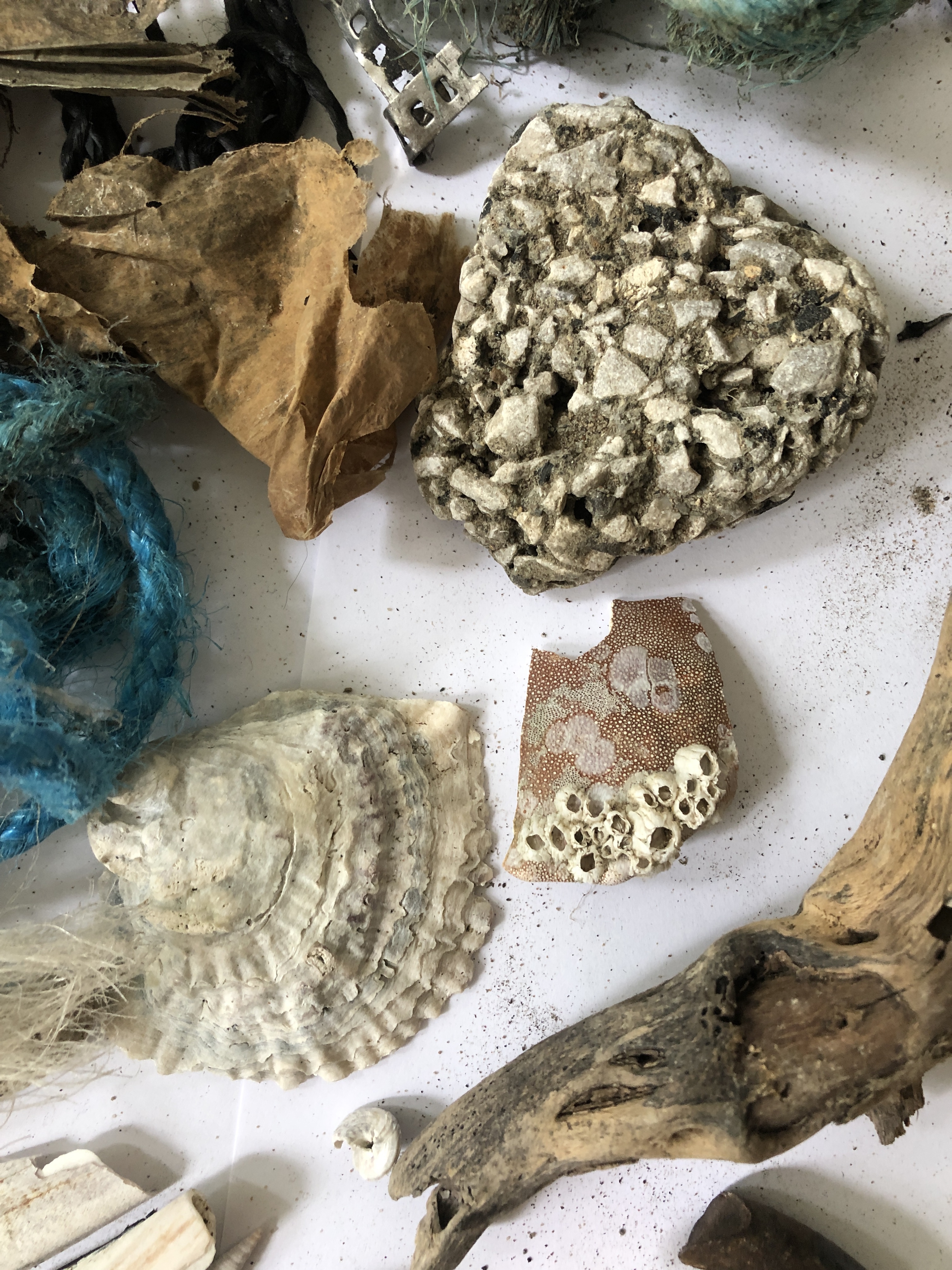
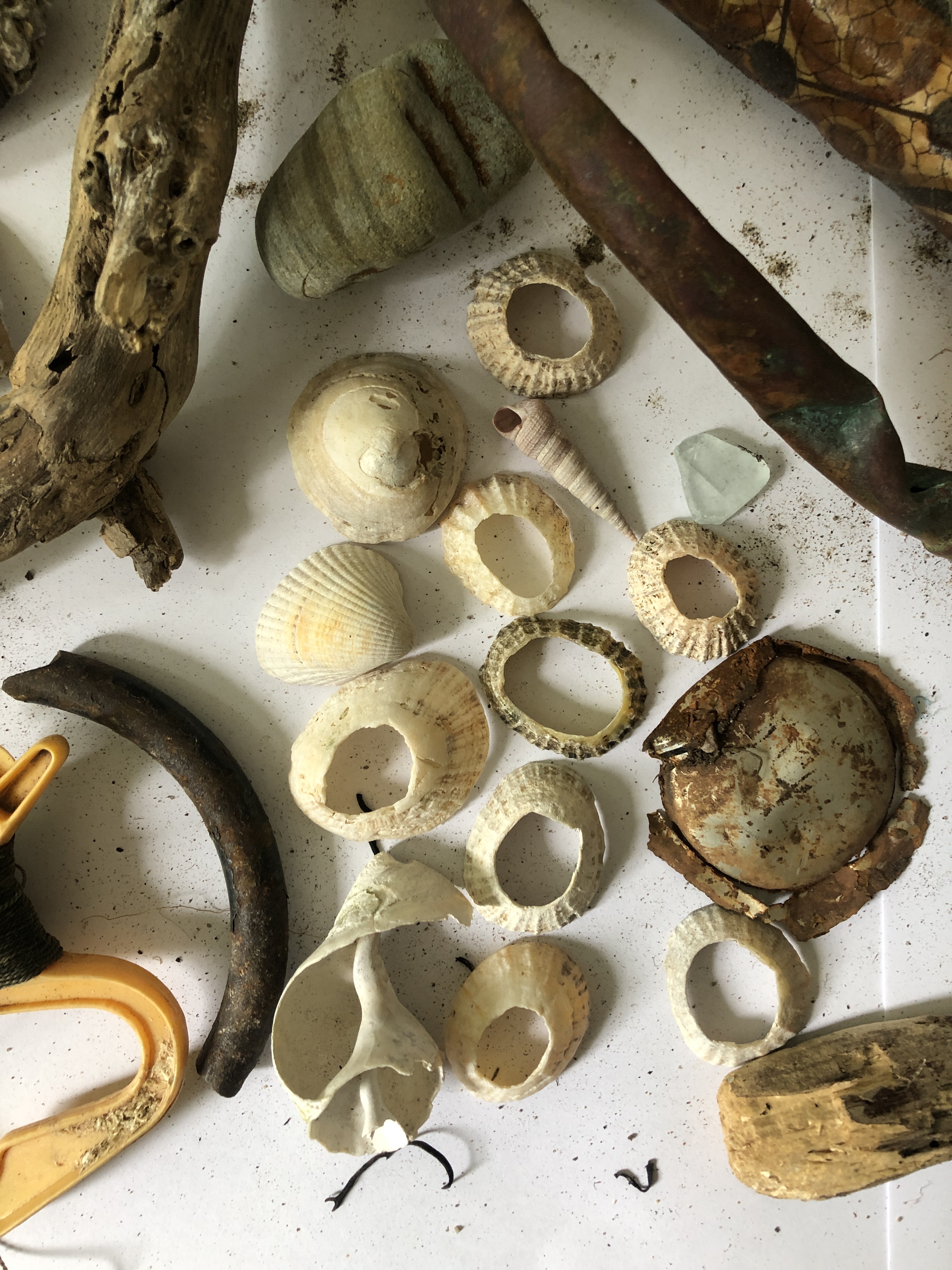
I was able to go on a short holiday to Wales last year in a break between lockdowns and I had the idea of collecting some of the litter I found to use in a piece of work and so I went beachcombing and came home with bagfuls of aged nylon rope, netting, wires and even a piece of copper pipe which I loved due to the way it had aged when exposed to the salt of the sea and also the action of being tossed around against the rocks. I collected shells and in particular some whelk shells which had holes in the top and I saw that I could also weave these into another form.

I had found weaving very rewarding during the Foundation Textiles course and had made tiny looms from small twigs, knitted with strips of black plastic dustbin bags and also liked stacked and layered fabrics. I found I loved to create three dimensional samples and out of all the samples I had made, these were my favourites and I felt they were the most successful.

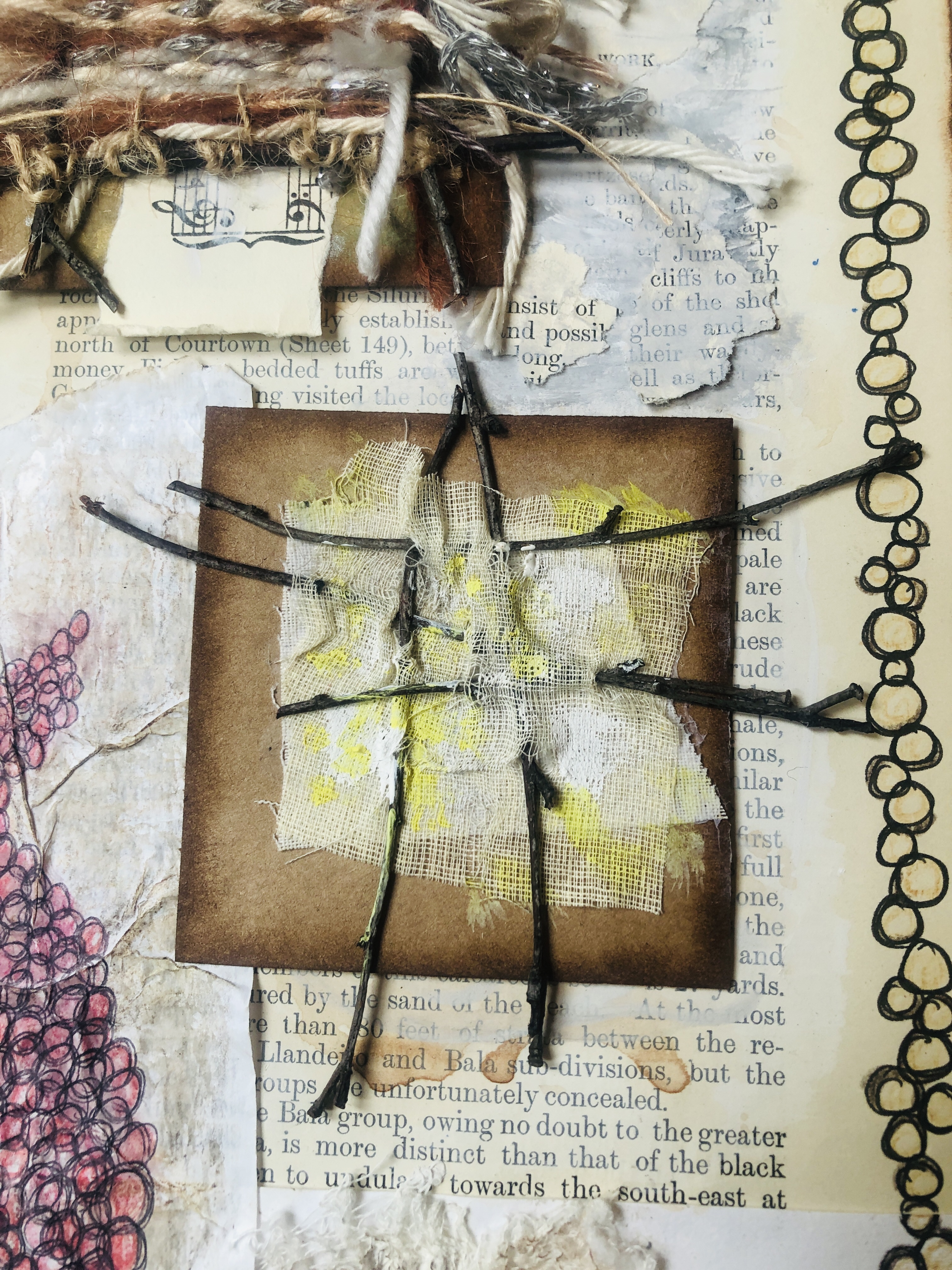
Within my chosen theme I decided I wanted to go for Option 3: Large-scale material manipulation where I will create a 1 metre by 1 metre square panel. I much prefer working on a bigger scale and I am very excited to be able to complete such a piece. I also wanted to choose the option that is the most challenging for me.

I am beginning by researching textile artists who use beach and ocean related litter in their work and with a focus on environmental damage. I have some textbooks which will also be perfect for this theme that I will be referring to for inspiration. The images below really interested me with the variety of colours and shapes to represent marine life and plant life.
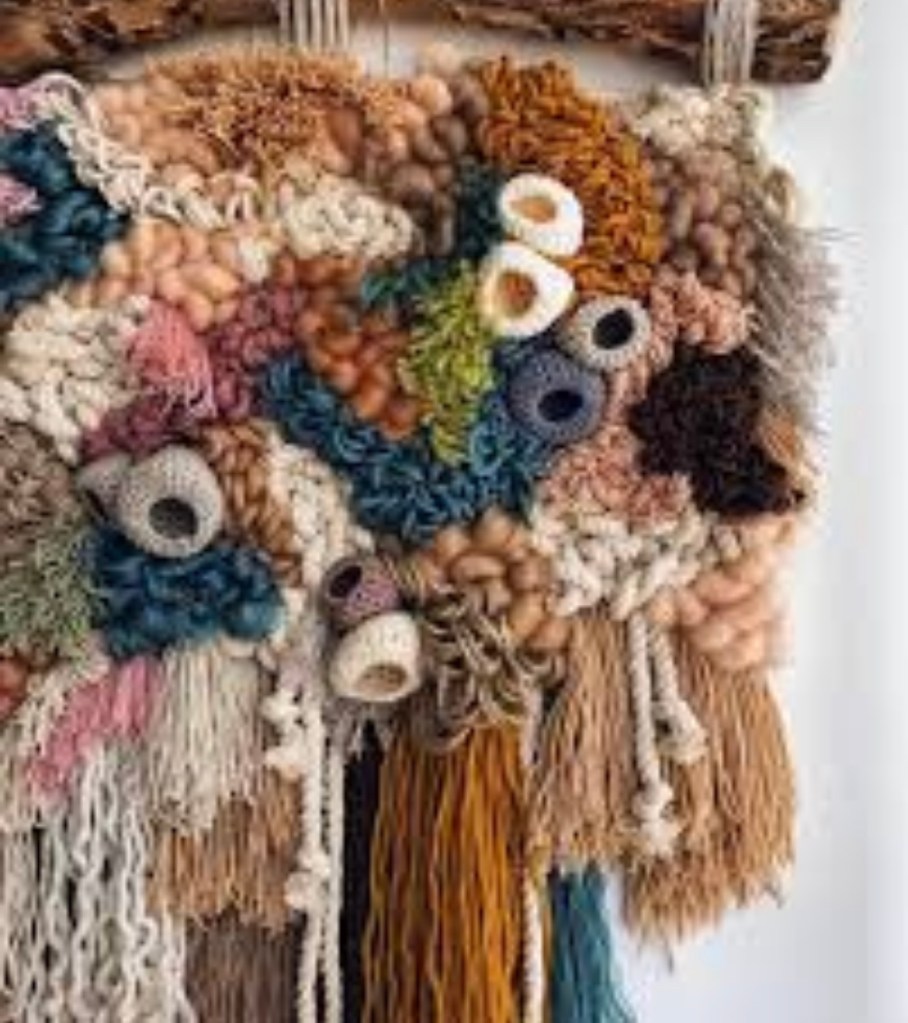
Eva's DOODLINGS Hand Woven aqua coral reef wall hanging | Etsy | Hand  weaving, Weaving wall hanging, Crochet wall hangings

(Source: http://www.pinterest.com) Knitted piece with yarn. Seaweed, shells, coral.

The best website that I found which really encapsulated what I wanted to reflect my theme was http://www.mymodernmet.com as on this website I found many artists who had collected beach litter and created shapes and pieces which was fascinating to look at.

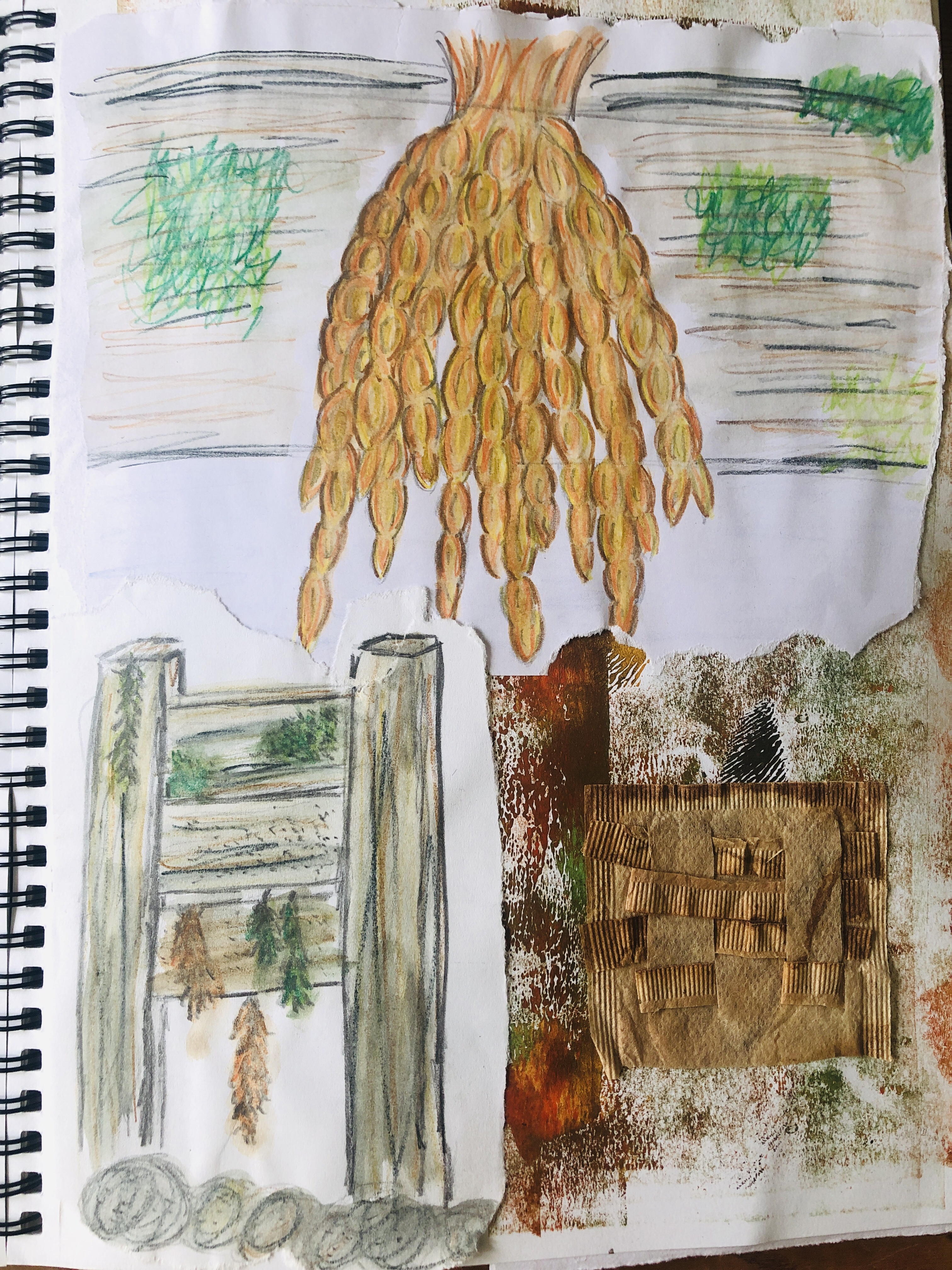
In my sketchbook I made a collage of mixed papers and then using a stick and black ink I drew a basic shape of a rope and then tried using my fir tree needle brush to scrape black gouache paint into it to try and create fibres. This didn’t work very well so I then used a fine black pen to create lines, which I then painted into first with blue watercolour paint and then blue gouache paint. The gouache was used to try and make textured lines rather than flat strokes to see if this would give the impression of thick pieces of nylon bunched together. I felt this was successful but a mixed media sketch of a wooden groyne just did not work well.

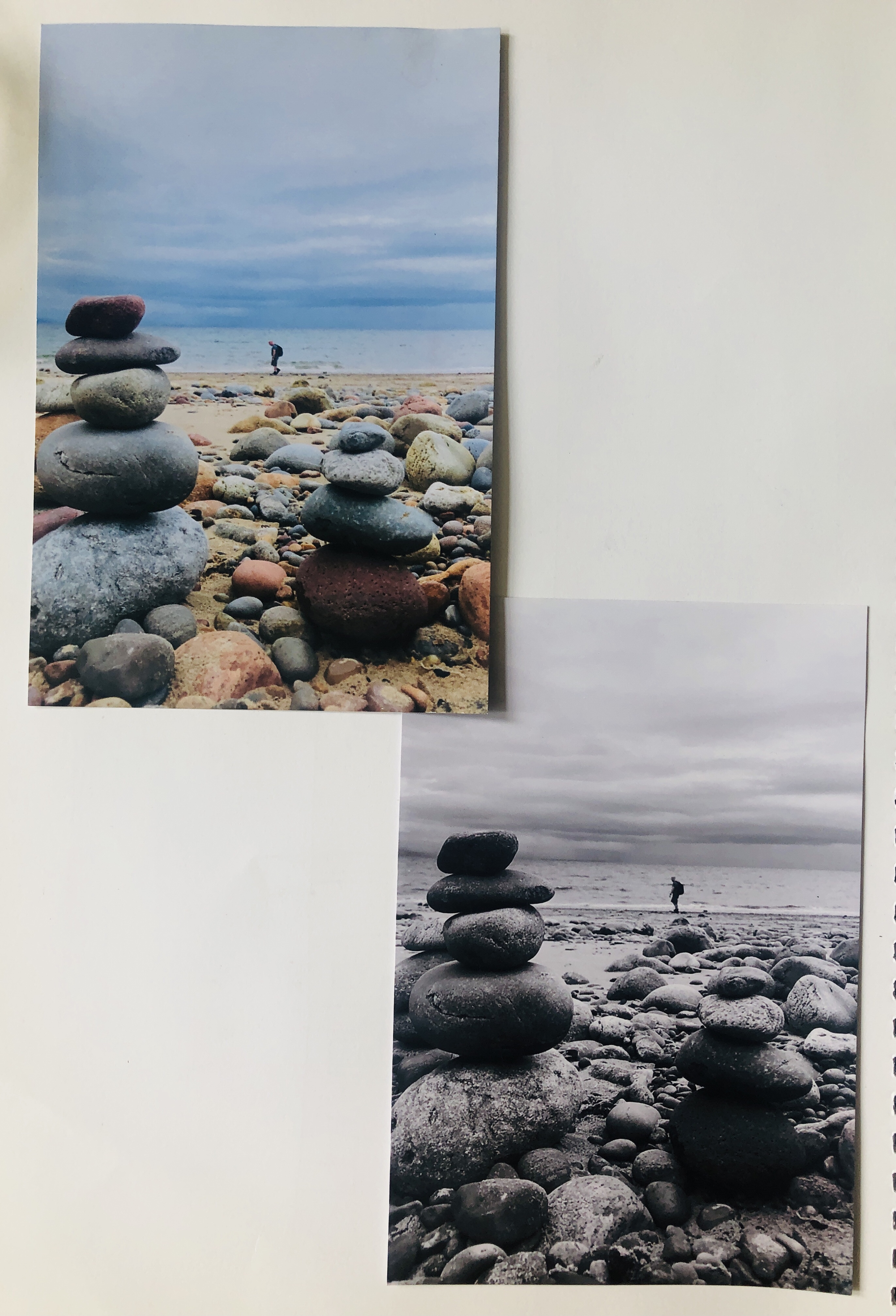
I had listened to my tutor and had put the photos I had taken of beach scenes and plastic pollution next to the sketches that I was creating and this certainly helped but I can also see a real need to be able to sketch in the moment.
It is so difficult to be able to show the details and effects on a small photo but the mark making with sticks and pine needles have definitely proved to be the best way to portray the rope threads. It really brings the fibres to life better than the black pen.
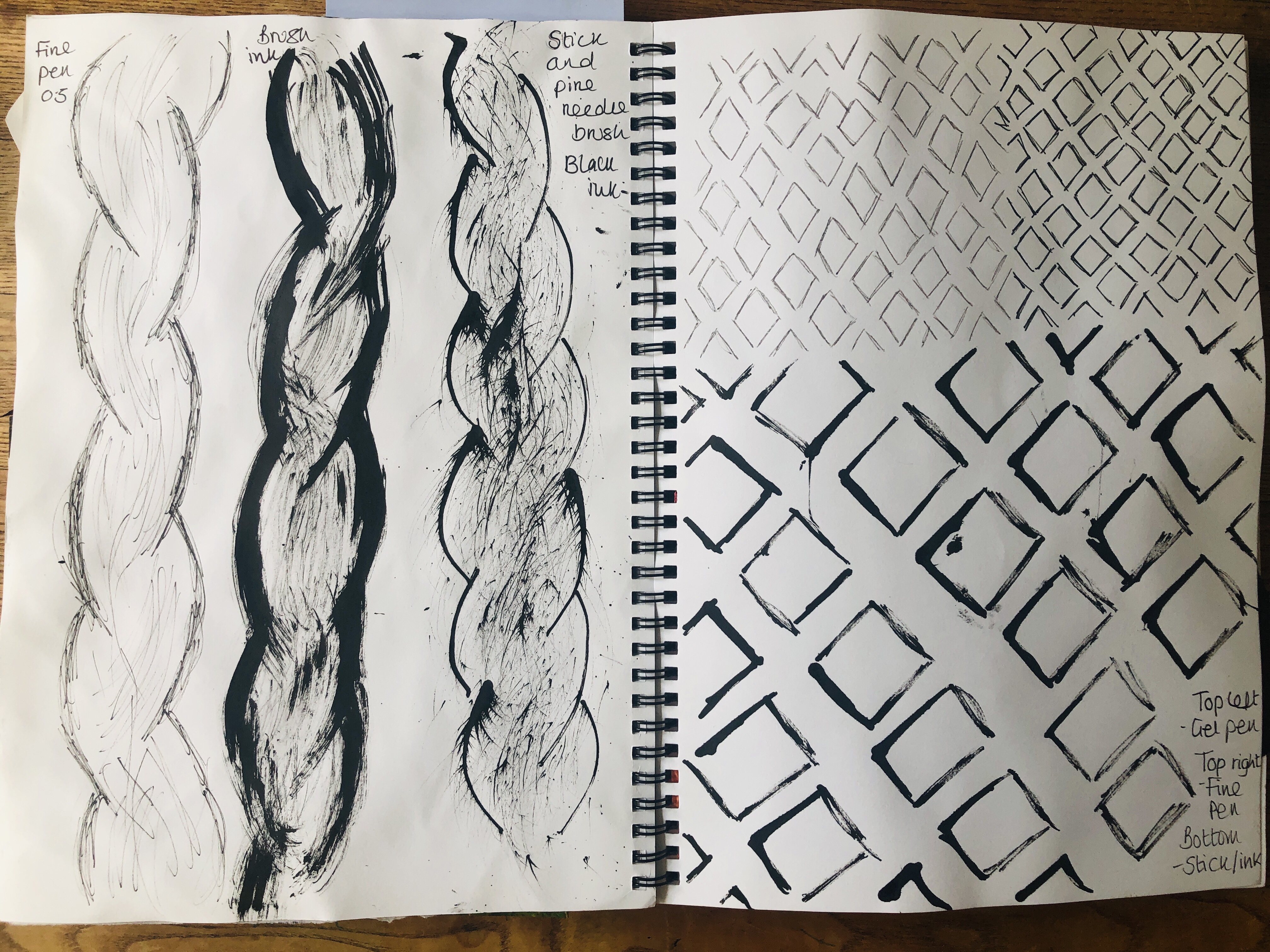
I also really enjoy using black ink out of an ink pot as it gives a much better effect than black paint. As the ink dries very quickly I have to also sketch as fast as possible and spend less time making intricate details, this way of sketching works best for me when drawing subjects such as the rope as I’m finding again that less is more.
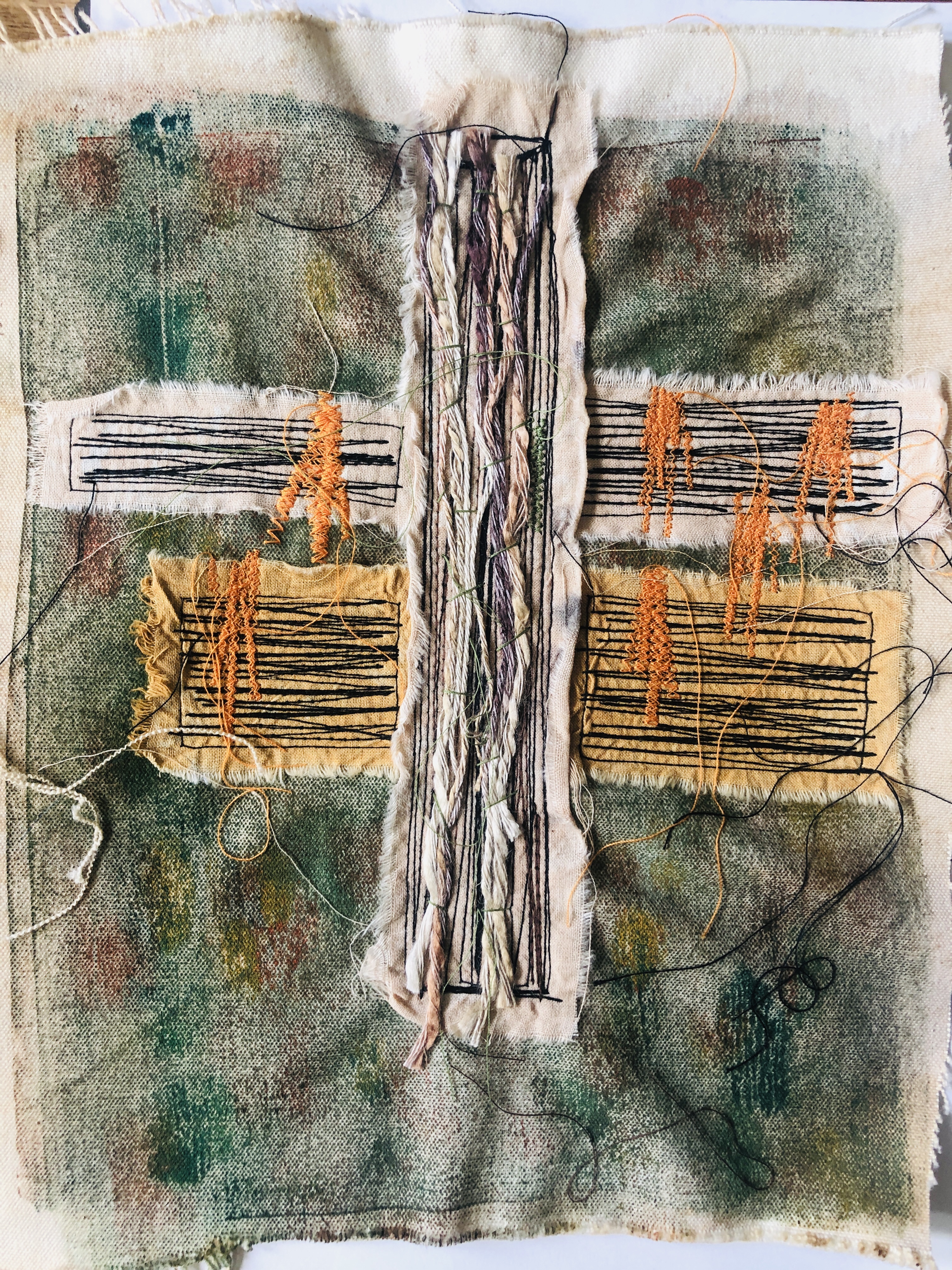
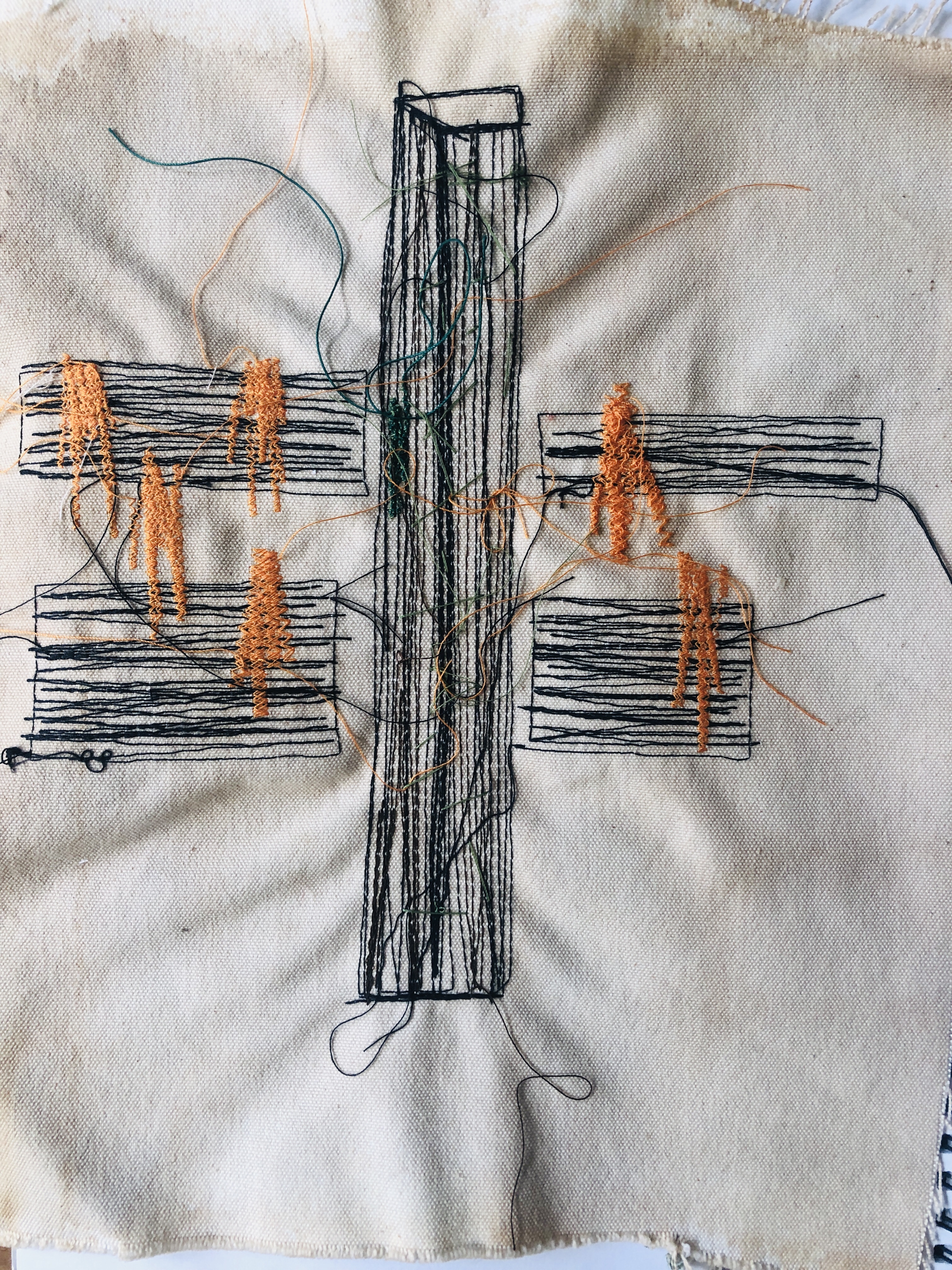
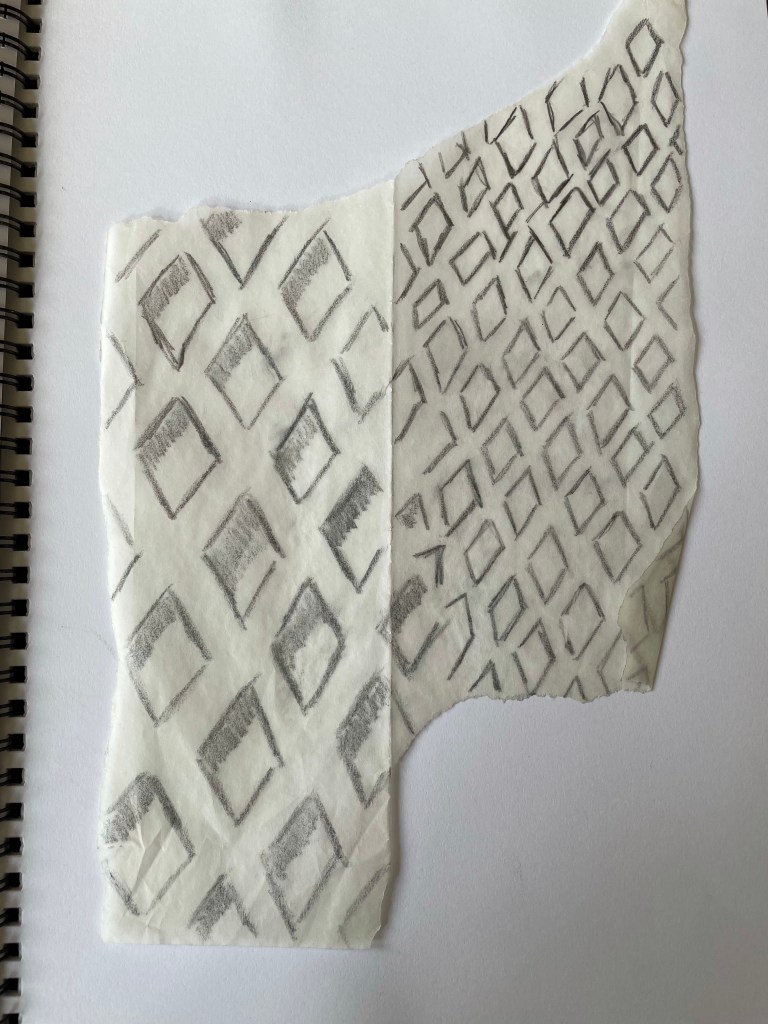
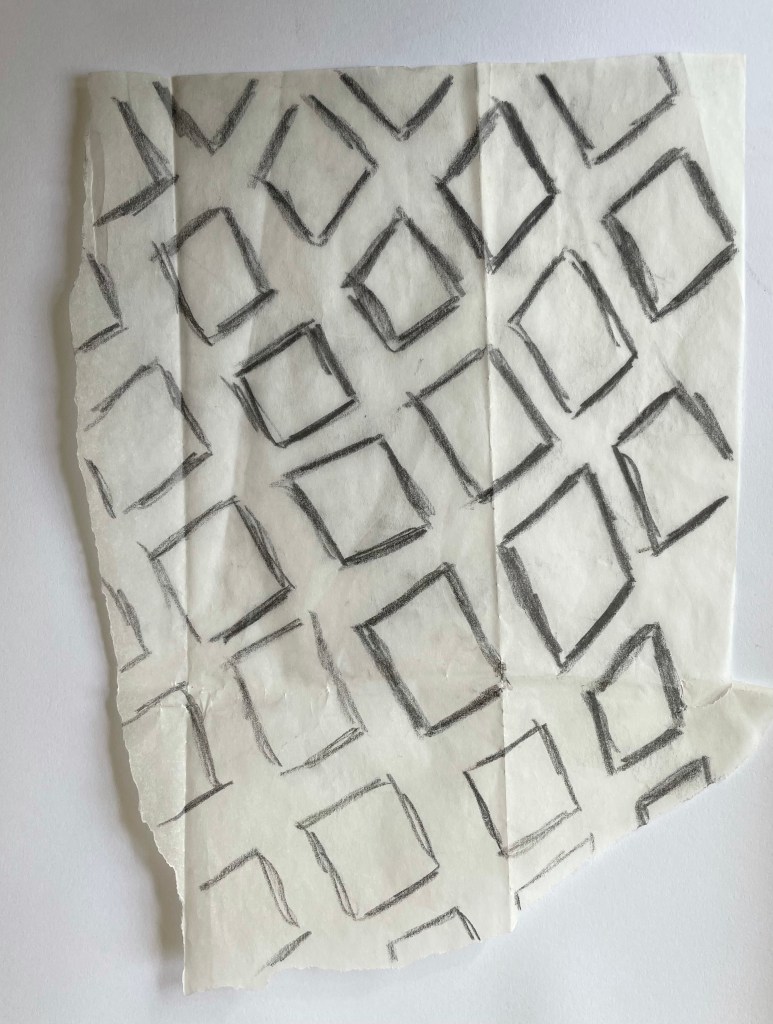
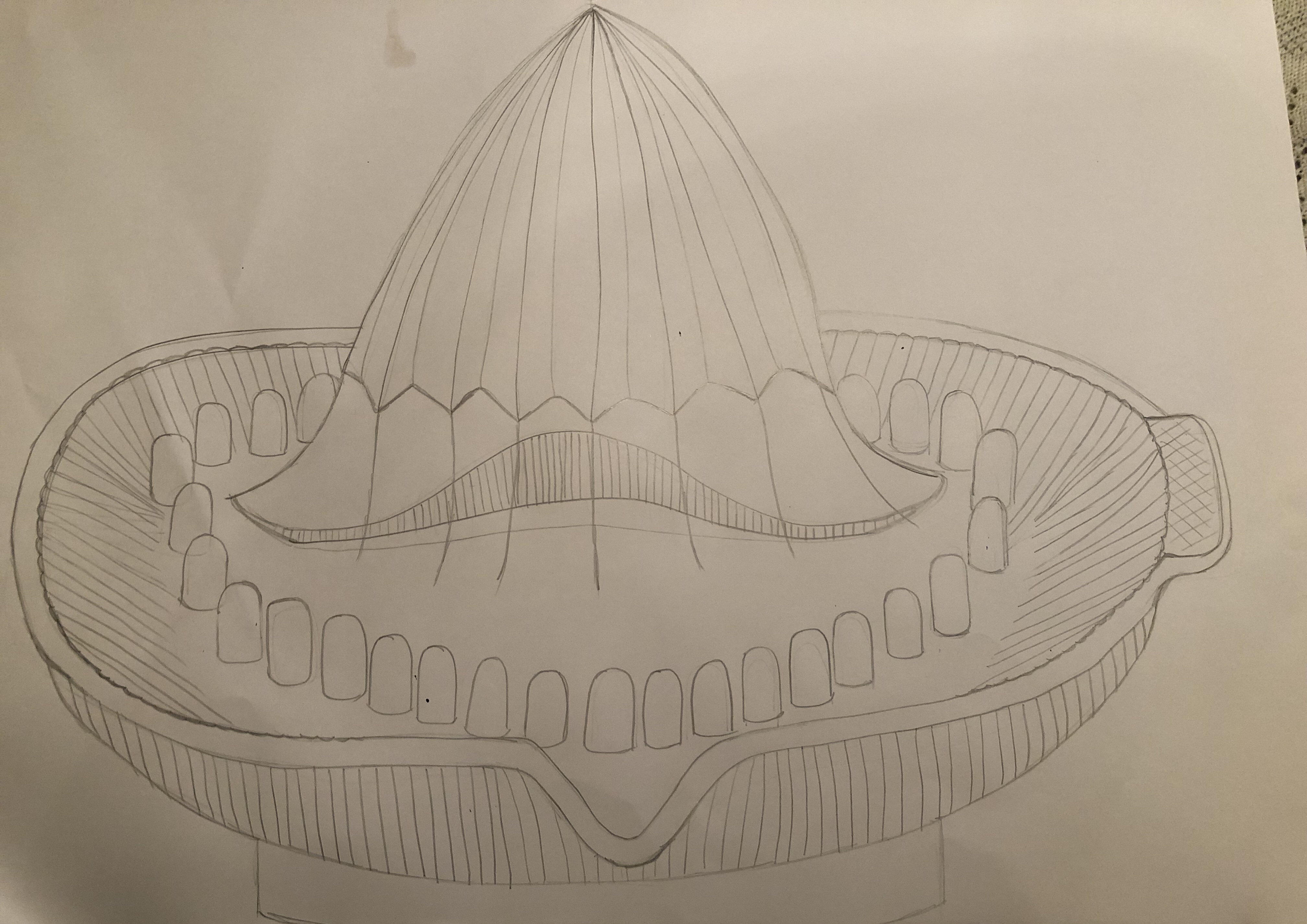
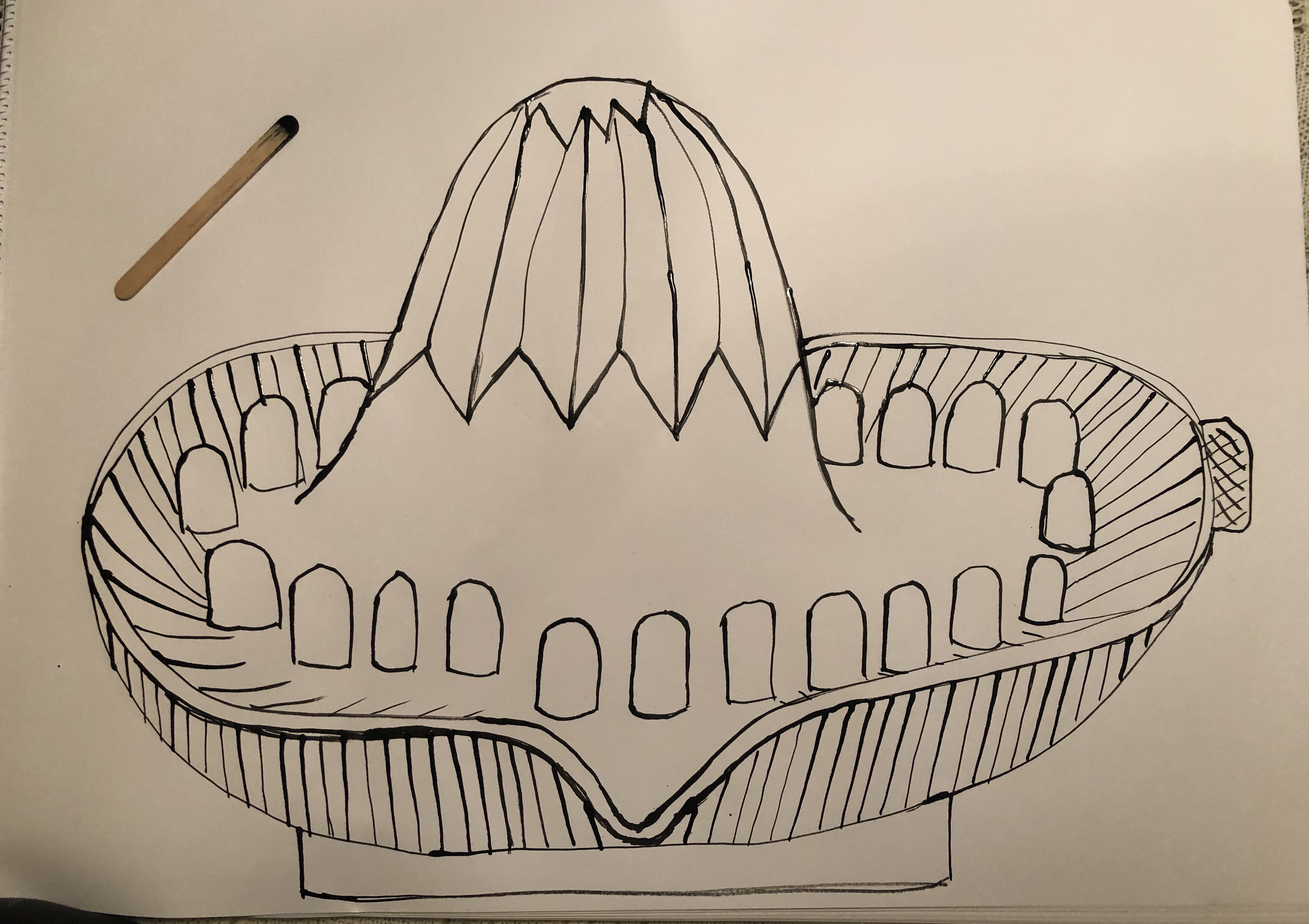
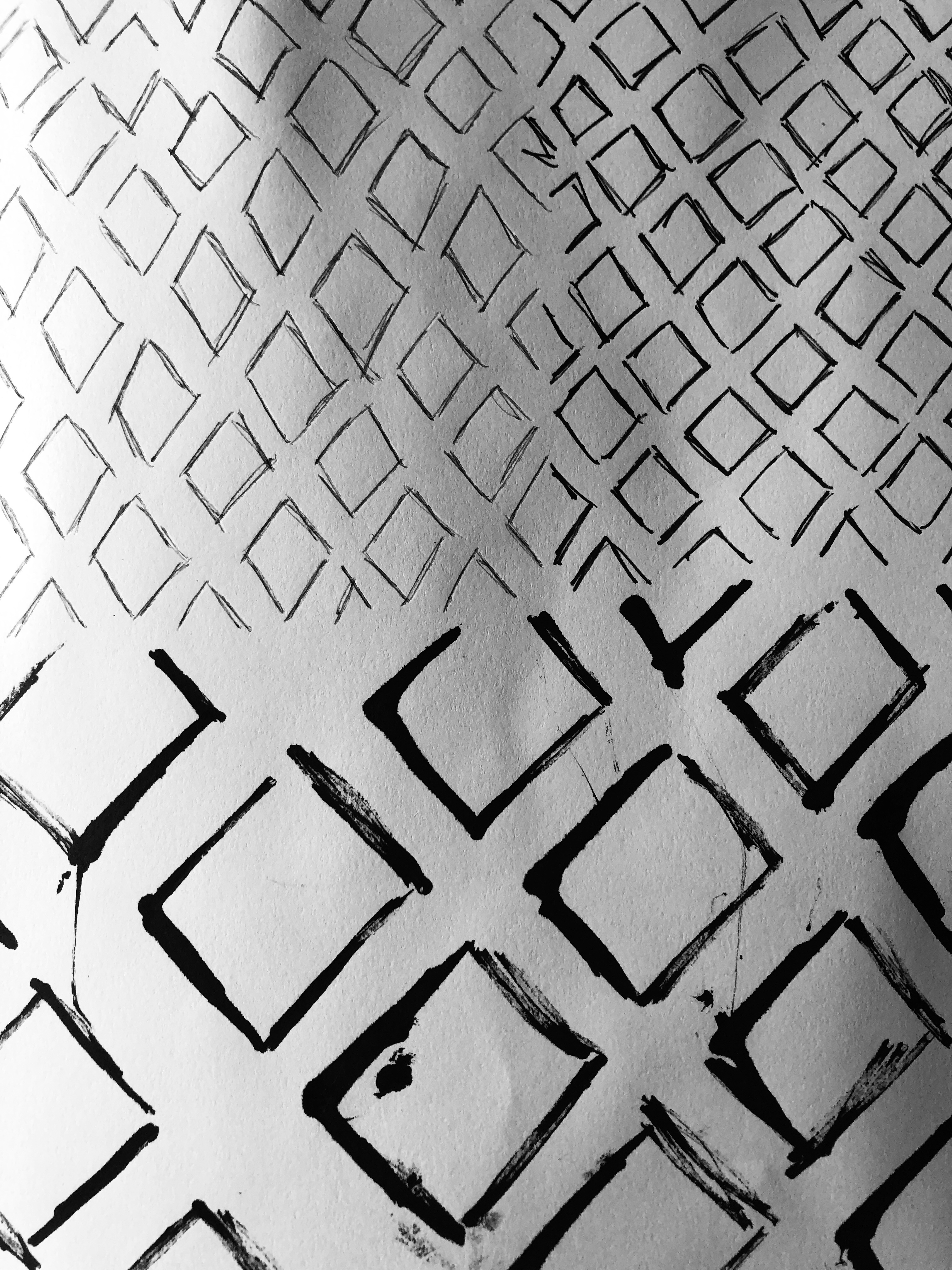
I enjoyed trying to sketch blocks and diamond shapes to replicate netting, the middle sketch had a three dimensional look to it.
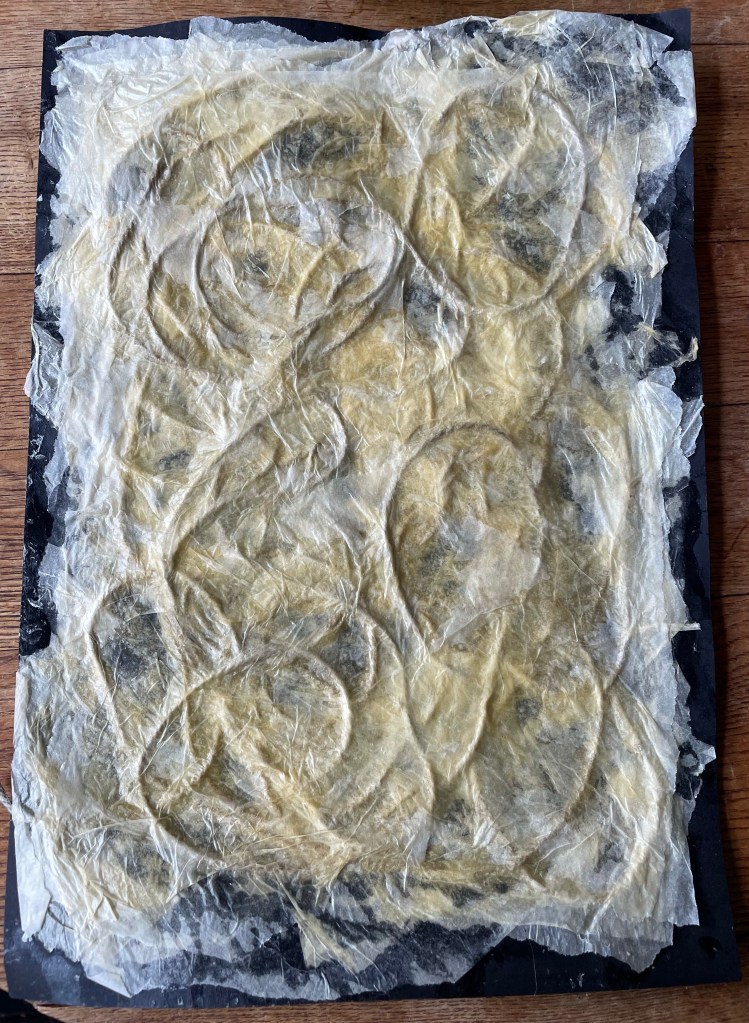
Above: Looped string with tissue paper overlay using PVA glue to mould into shapes, mounted on A4 black card.

I enjoyed getting messy with the above piece as I have done this before on journal covers and it has worked well to give more texture to a plan cover. With this piece it gave a very fragile feeling and reminded me of deep sea creatures skin.

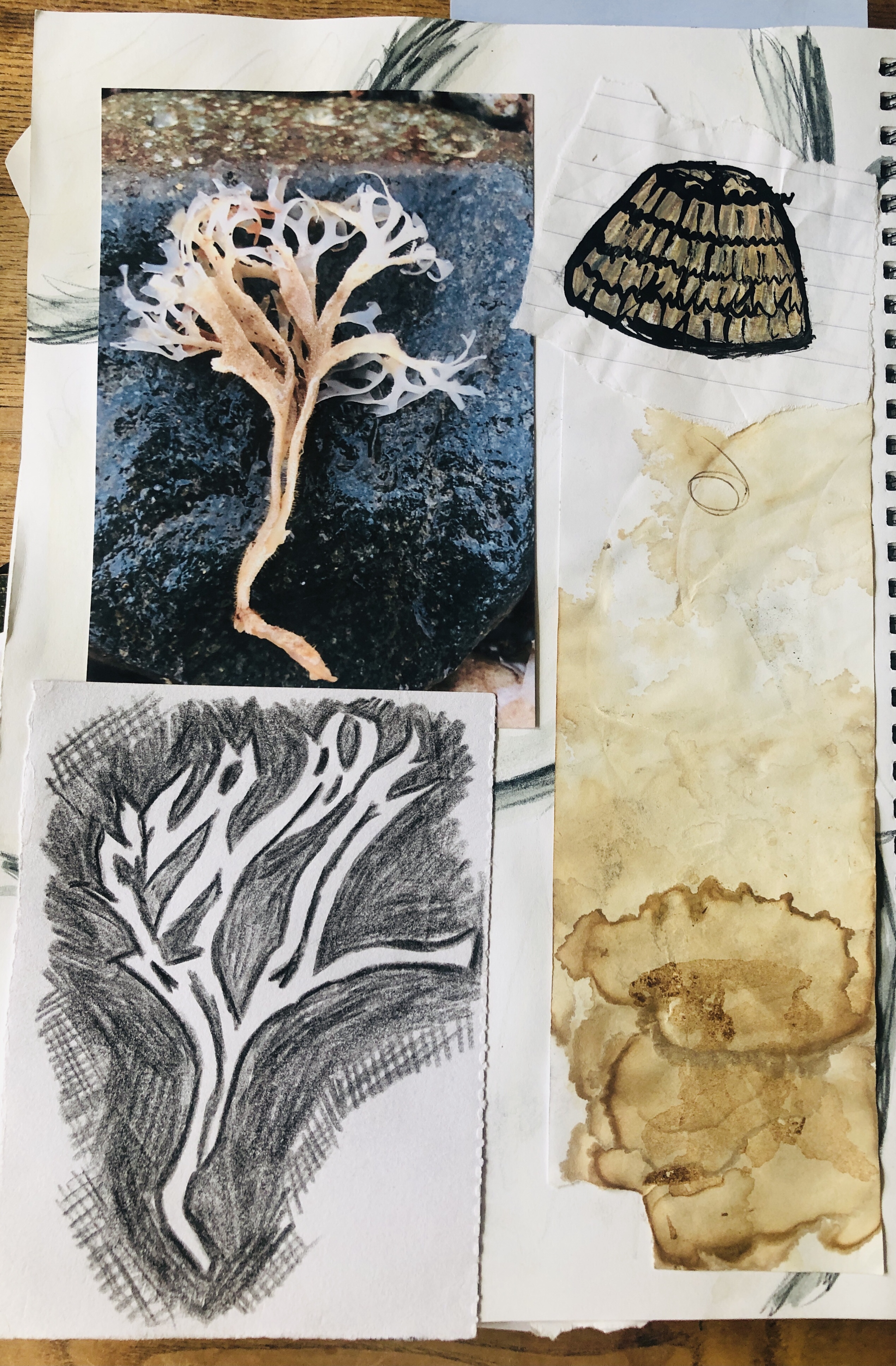
Above: Negative space piece of seaweed frond on A5 card using masking tape built up in layers onto black watercolour paint background.

This piece was fun to make as it was bigger than it looks on the photo and the masking tape layers stood out well against the background.
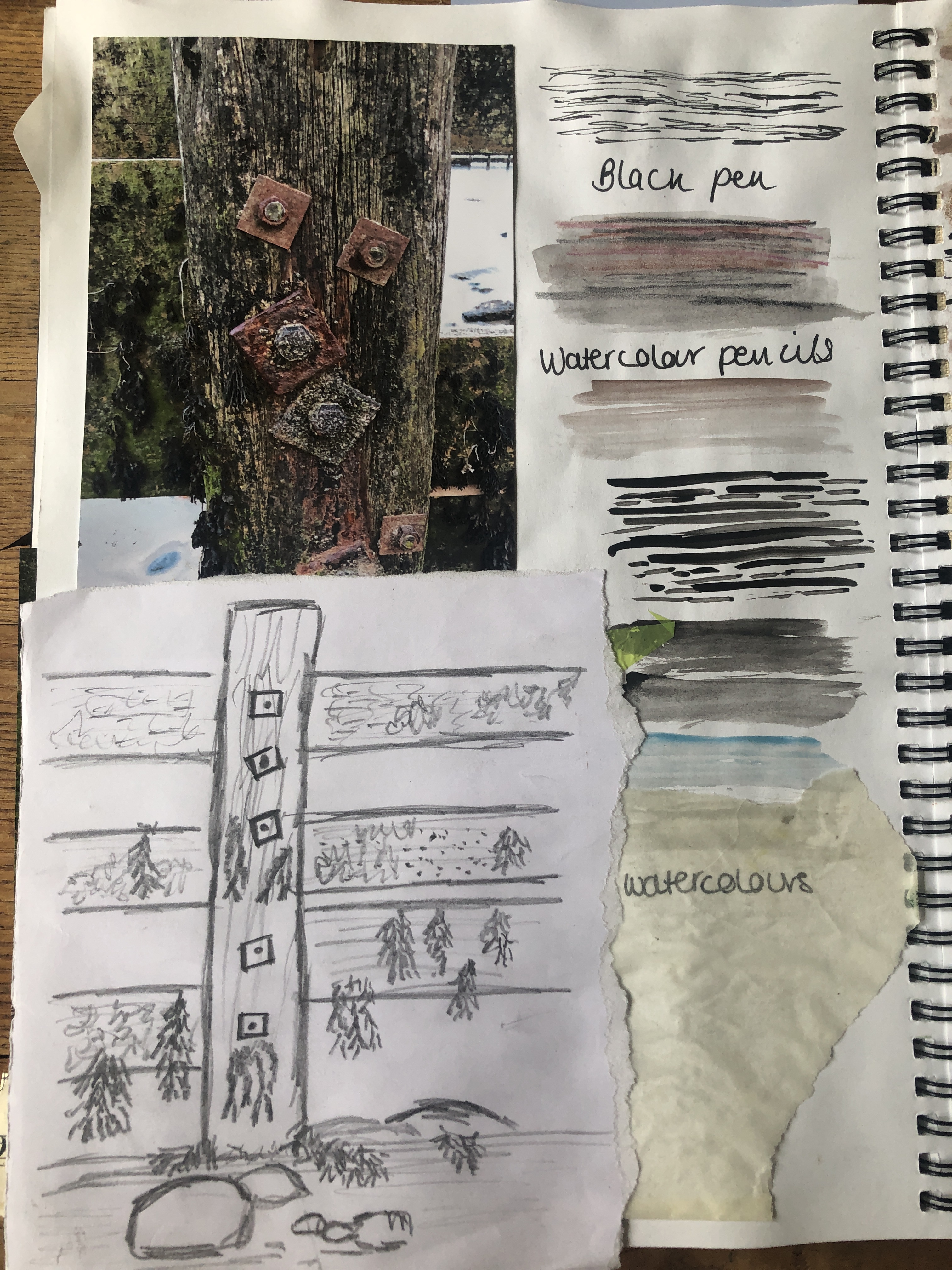
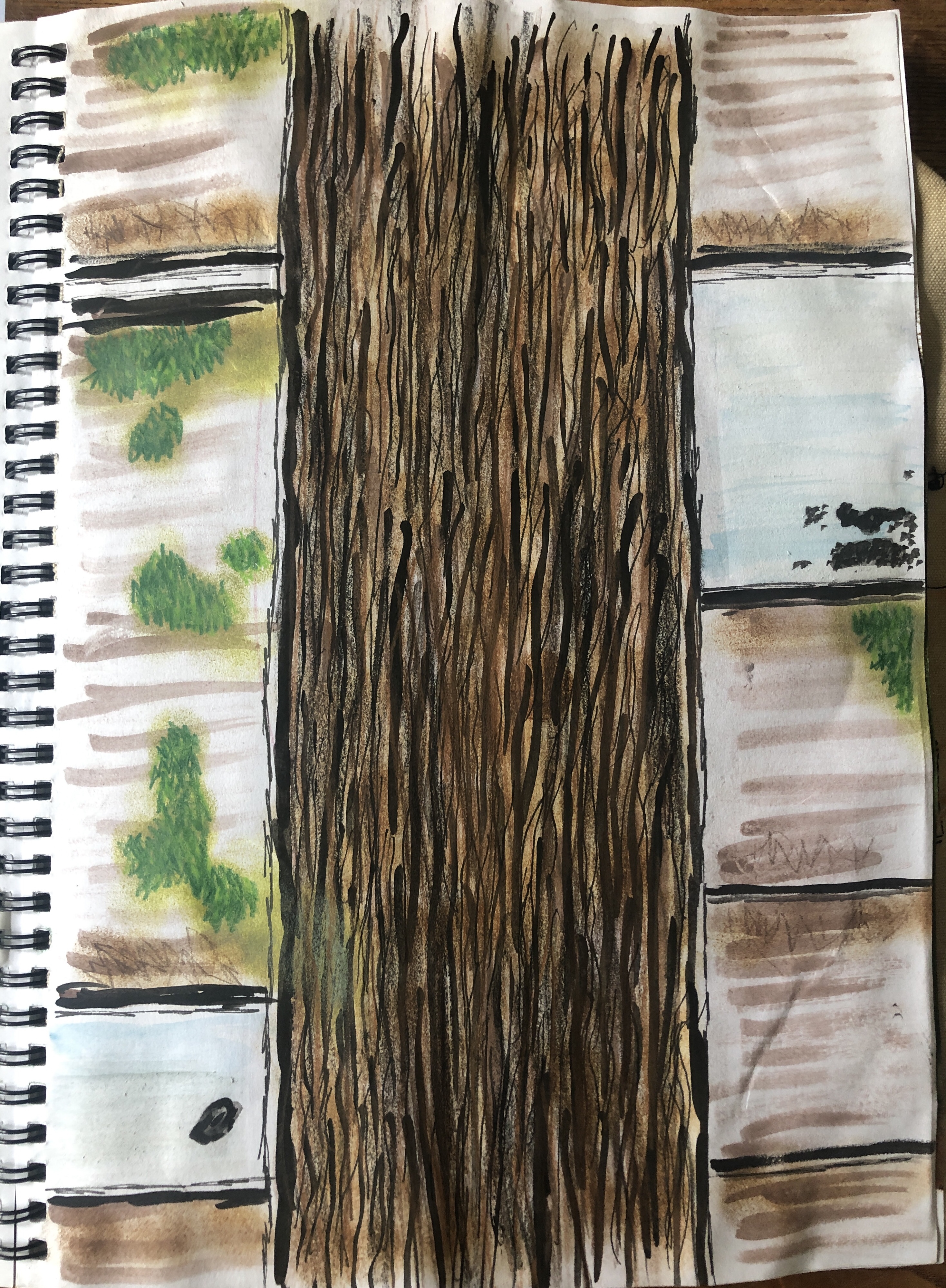
Again, I was over critical of the above sketches, even though my tutor had provided links to an artist who does use the above approach. I did think the close up section of wood did convey texture as I worked into it over and over again with a mixture of mark making tools and colours. I also seem to not be able to sketch straight as all the sketches above were somewhat lopsided. The pencil sketch worked the best, I liked the pencil as it was actually one out of a voting booth, they were all getting thrown away due to infection control so I had to bring a couple home!

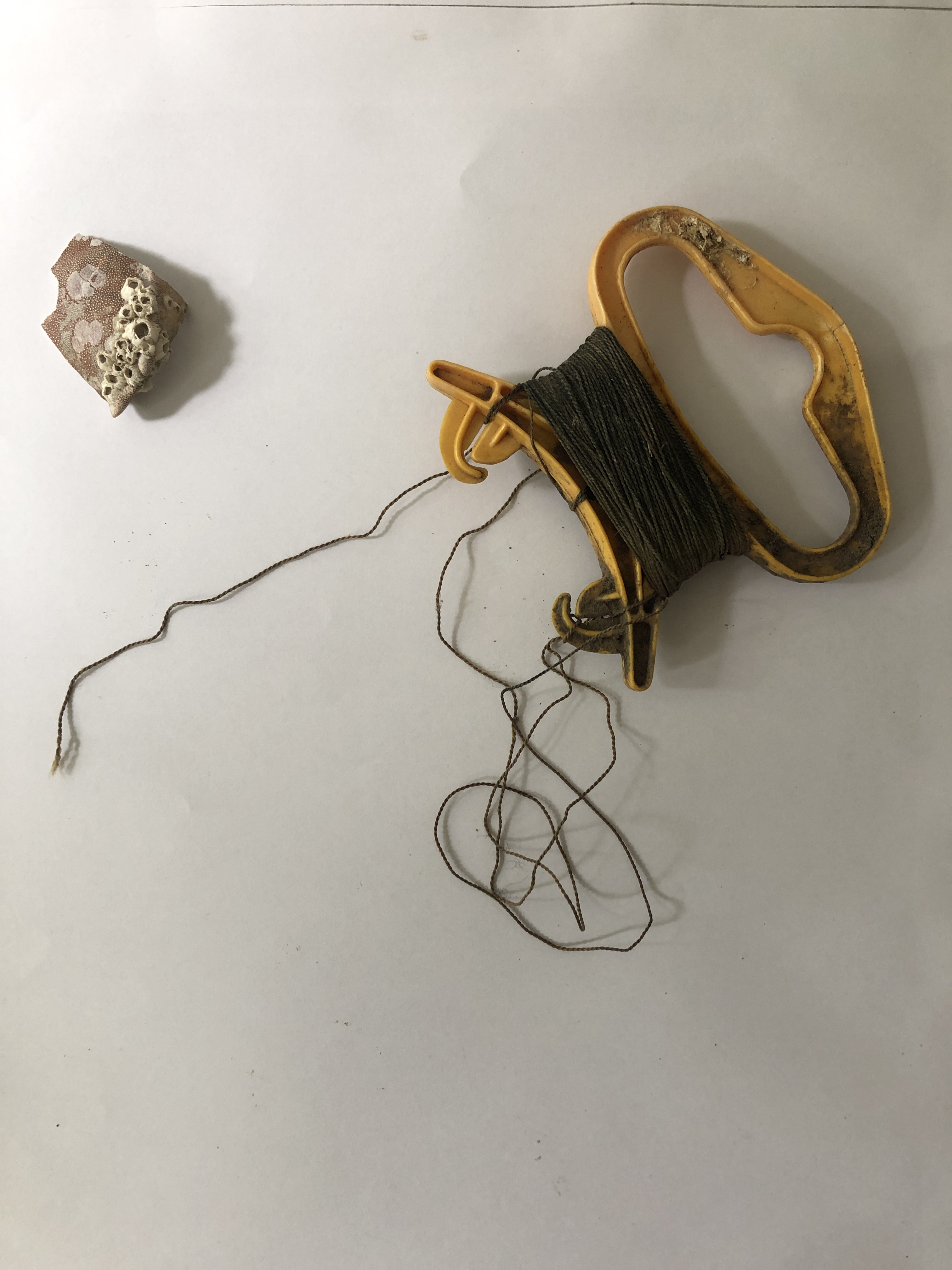
I had assembled some of the items I had collected from the beaches together on several pieces of A2 white paper so I could look at them more closely. As much as I would have loved to draw the whole lot as a group, I instead chose a few items from the collection to study and draw.
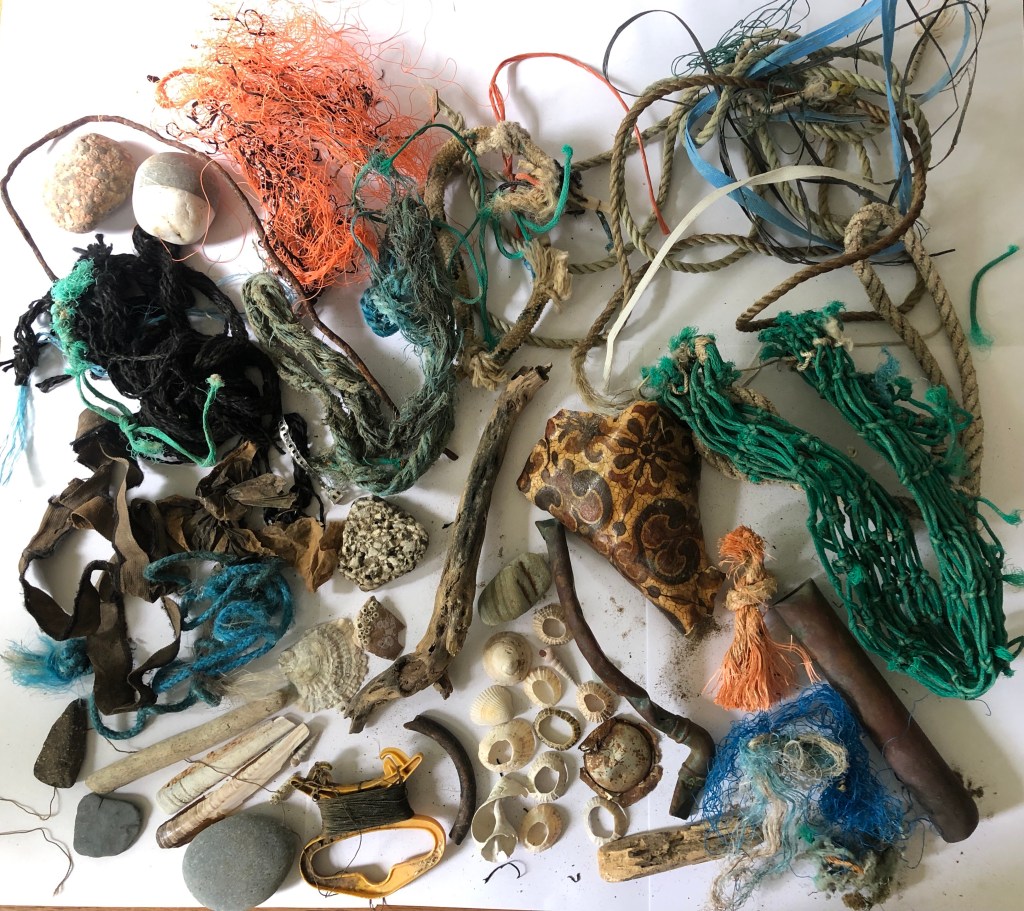
I loved this section of old copper pipe with a its green patina, it was battered and twisted and it must have been on the seashore for a long time as I found it in between two large rocks. I have found rust colours very interesting since making natural dyes as I had put several iron pieces in a jar full of water and the colours it produced when I dipped calico into it were vibrant and bright. I can see how placing a series of rusted items on wet calico could produce images and patterns and I want to carry this theme into the degree level of Textiles.
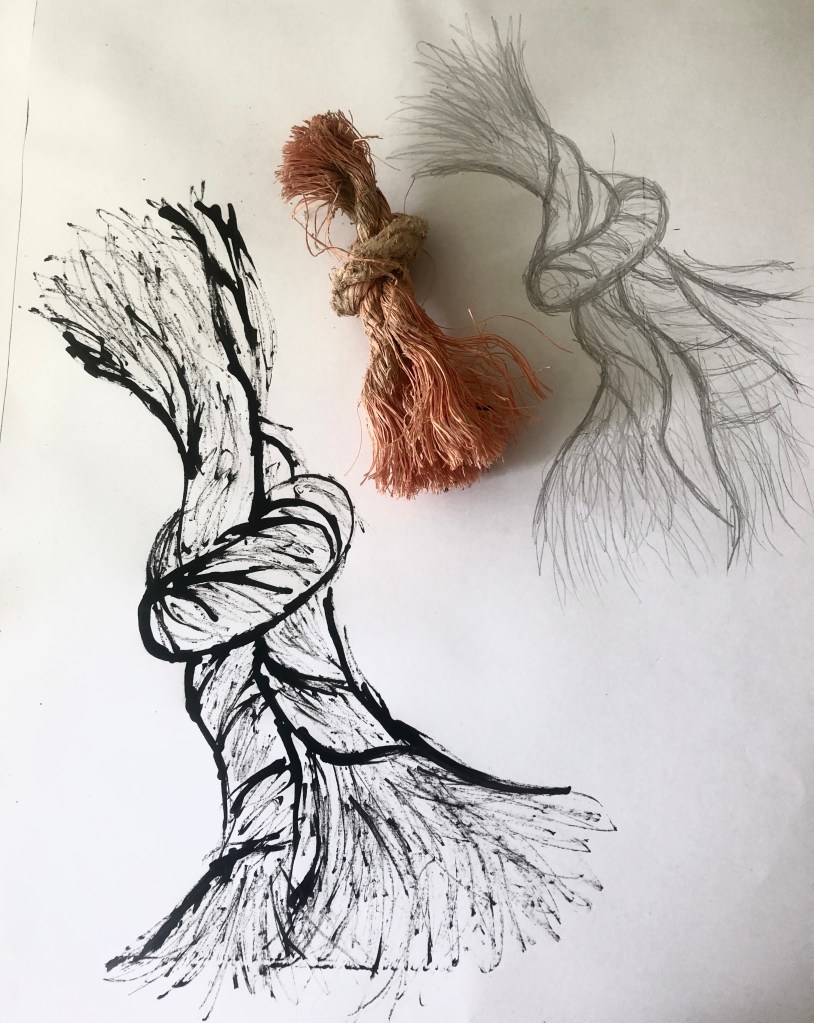
(Above: Rope knot drawn in pencil and drawn again with stick and black ink on A2 paper.) Out of all the sketches I have done in Part 5, I liked this one the most. I did all the A2 size sketches whilst standing up as the pieces of paper were so big. This meant I could reach further out over the paper to work more freely and I really found it a better approach as the amount of pressure I could use to press on the paper was higher, I was able to scribble with the stick to get the texture of the rope strands as well as swish around to make the outline of the rope. I certainly will use bigger sized paper in future. The pencil sketch again was much better as I had more freedom to make bigger marks.
(Above: Copper pipe drawn with black pen and black pen again and watercolours on A2 paper.) I wanted a more accurate sketch of the copper pipe as because it is a very deeply coloured item, it is not possible to see all the bends, dimples and cracks it has by just a photograph. I think I chose the right colours to show the patina of the pipe.
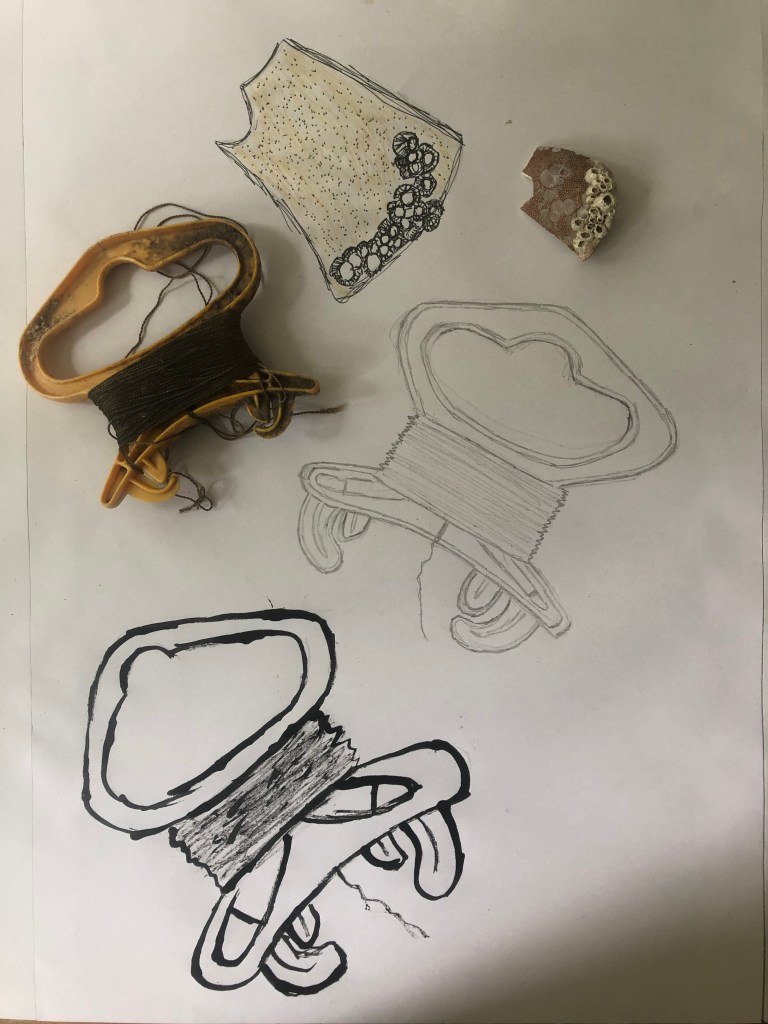
(Above: Crabbing line drawn with stick and black ink and in pencil. Crab shell piece drawn with black pen and watercolours, all sketches on A2 paper).

Having done a lot more sketches and also only added the ones which I liked most instead of adding every last one (!) I began to look at samples for the final large scale material manipulation piece. I had a clear idea in mind and that I did not want the piece to be “flat” or completely the same. I wanted to continue on themes I had often used in previous assignments and for the piece to have texture, movement and three-dimensional. I have gained the most satisfaction from making tactile samples and although I have had success with sewn samples, I wanted to achieve something challenging and sculptural, the most difficult factor was space to work on and store the final piece whilst it was in construction and time to complete it. Another reason was that I wanted to keep some of the ideas I had used in previous sections of Foundation Textiles to use in the degree level Textiles and I did not want to use something I had already been assessed for. Some ideas need to be kept on the back burner for a reason and however good it could have been to do a giant wall hanging of some of the samples over my studies, I almost did not want to waste them.

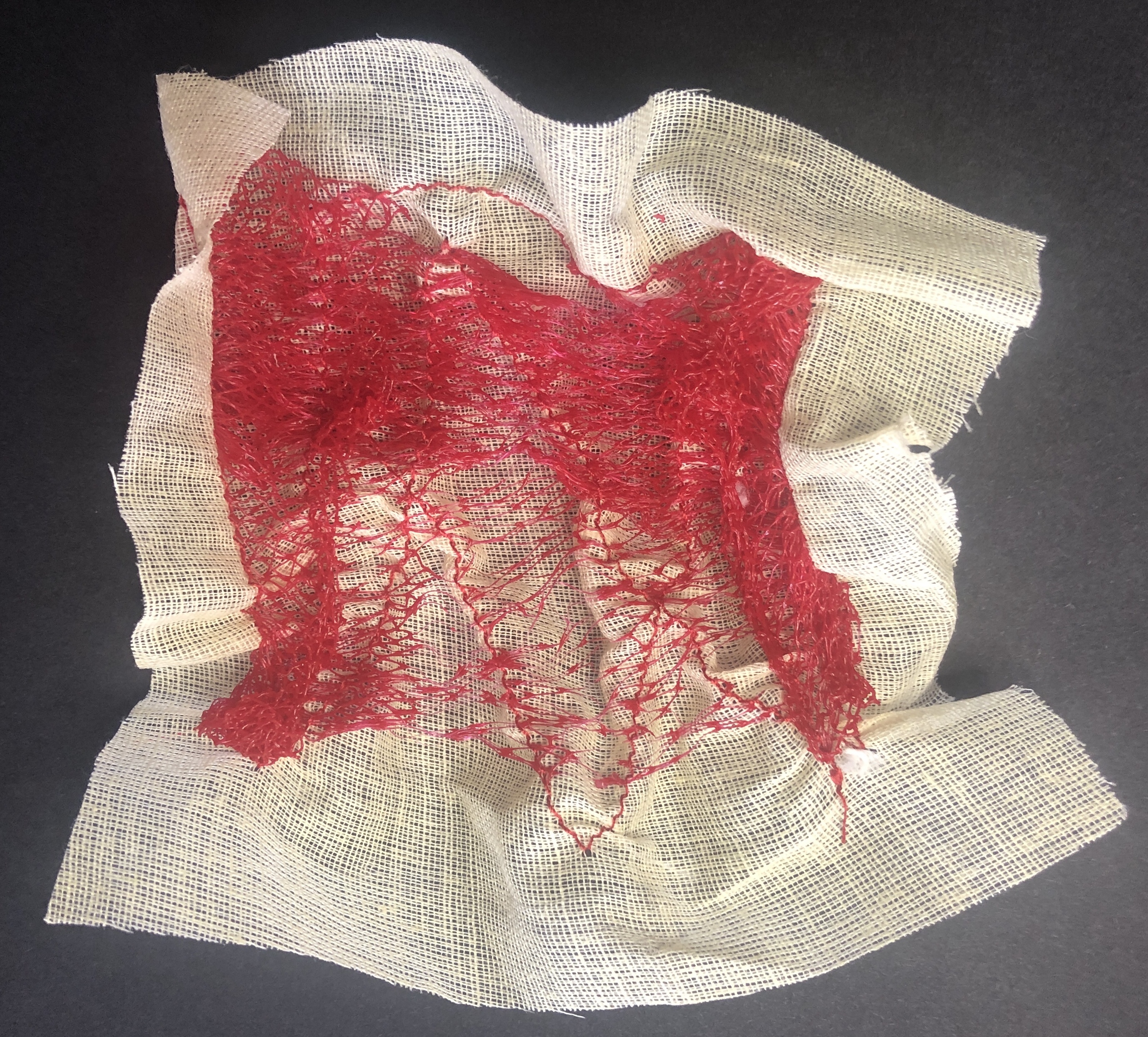
As I had written in the beginning of Part 5, my thought process was around ocean and beach plastic pollution and so I wanted to look at something that would be netting/woven related in its concept. I revisited an earlier idea and began with looking at how wire interacted with another textile source and so knitted up a sample in wire and threaded orange crepe paper twists through it. Crepe paper is so much easier as it is less likely to rip or fragment and I liked the outcome but knitting something the size of one metre squared in wire was not going to be friendly on my finances.

(Above) Netting created using red knitted wire and with strips of interlaced orange crepe paper.

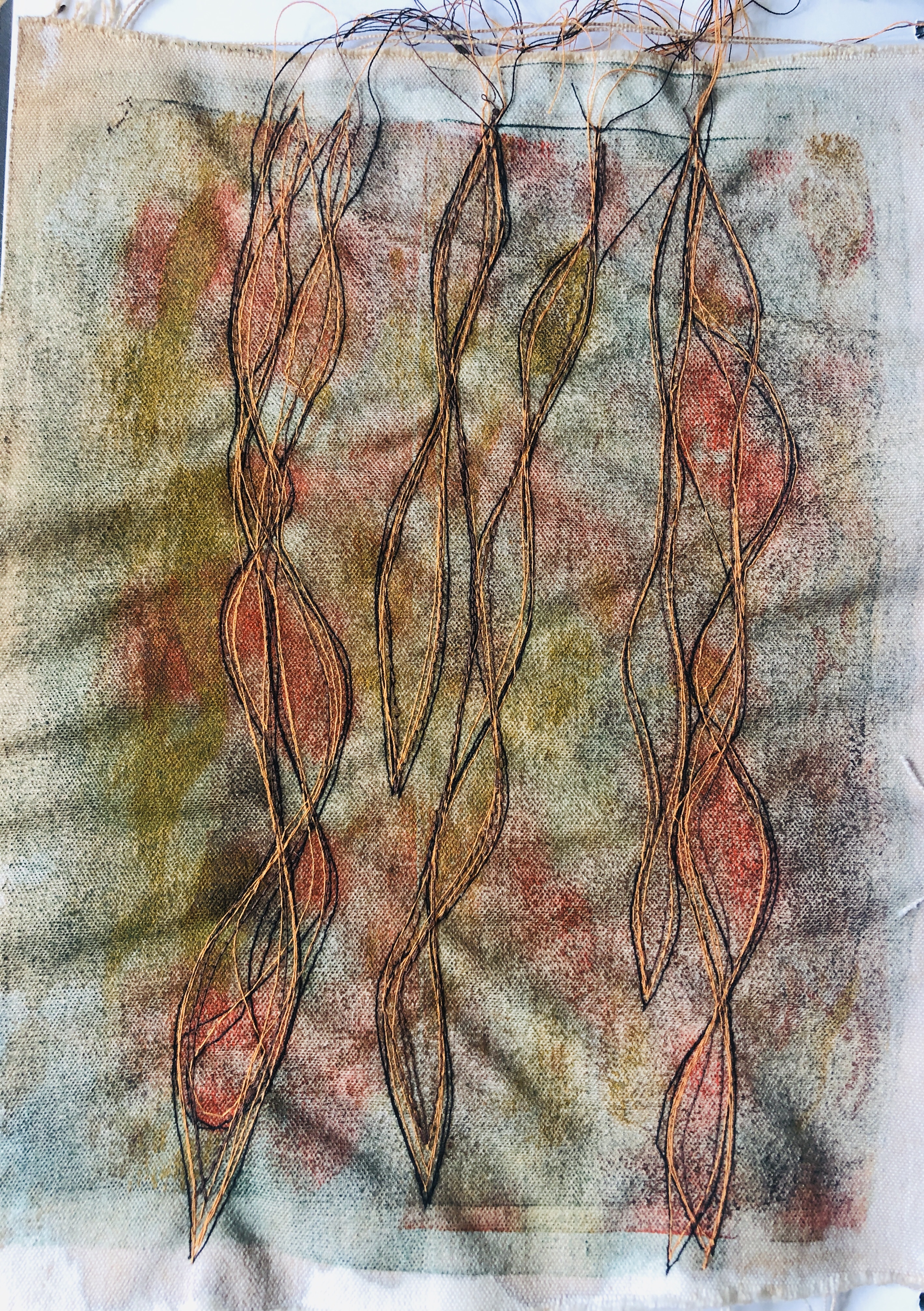
I did like the idea of some form of seaweed in the final piece and I made a fabric sample in calico and free motion sewing to test out the structure of making some form of seaweed. I found both sides of the above sample interesting and successful so I moved onto if knitting could be an option to make this in a physical form. I have made scarves from this particular way of knitting which was in itself a happy accident but I’ve always enjoyed making scarves from fine knit all the way up to the chunkiest yarn I can fit onto needles, so I knew I needed to try it again. I chose seaweed colours to estimate whether the idea would work in practice.
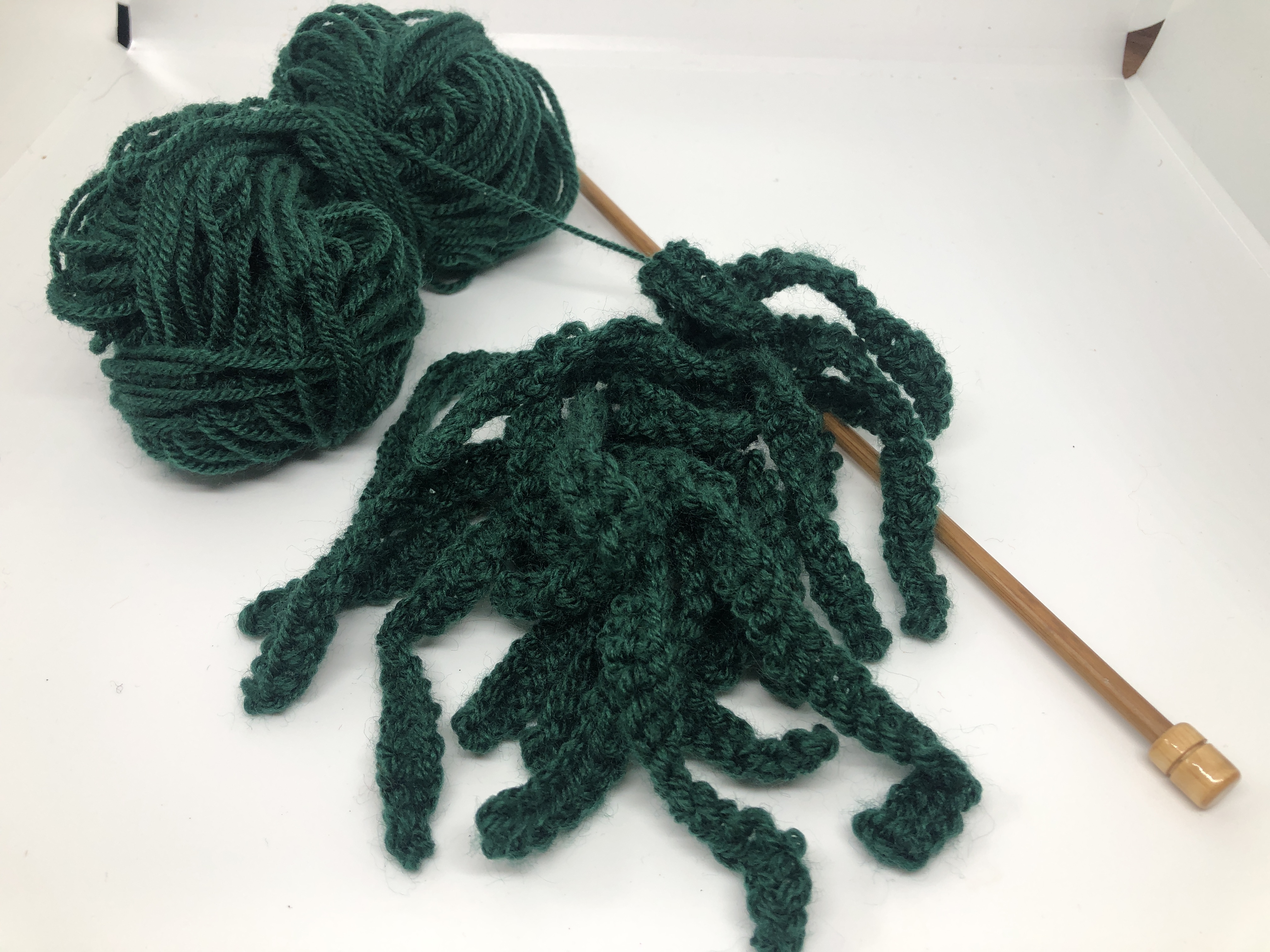
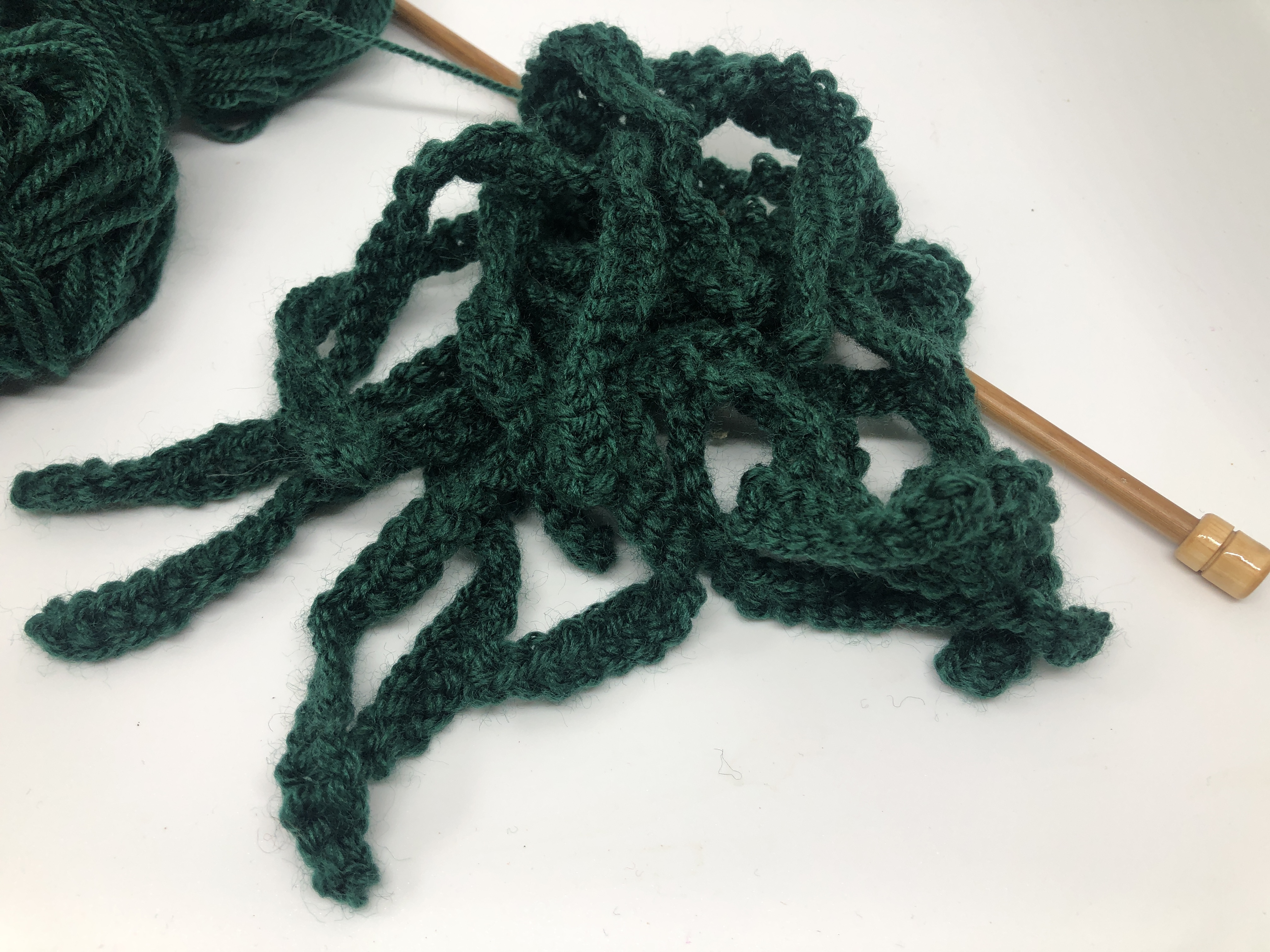
(Above) Seaweed knitted from chunky orange yarn.

Out of the two samples, I preferred the orange knitted piece as it was more colourful and as it was a yarn of blended coloured fibres it did not have such a flat colour as the green one and the blended shades almost gave ripples of colour like real seaweed. I probably could have found giant woollen yarn and knitted the whole final piece from it but it would not have fit in with my criteria of pollution or carried a message as well, personally I wanted hidden meanings as well as a piece which was interesting to look at.
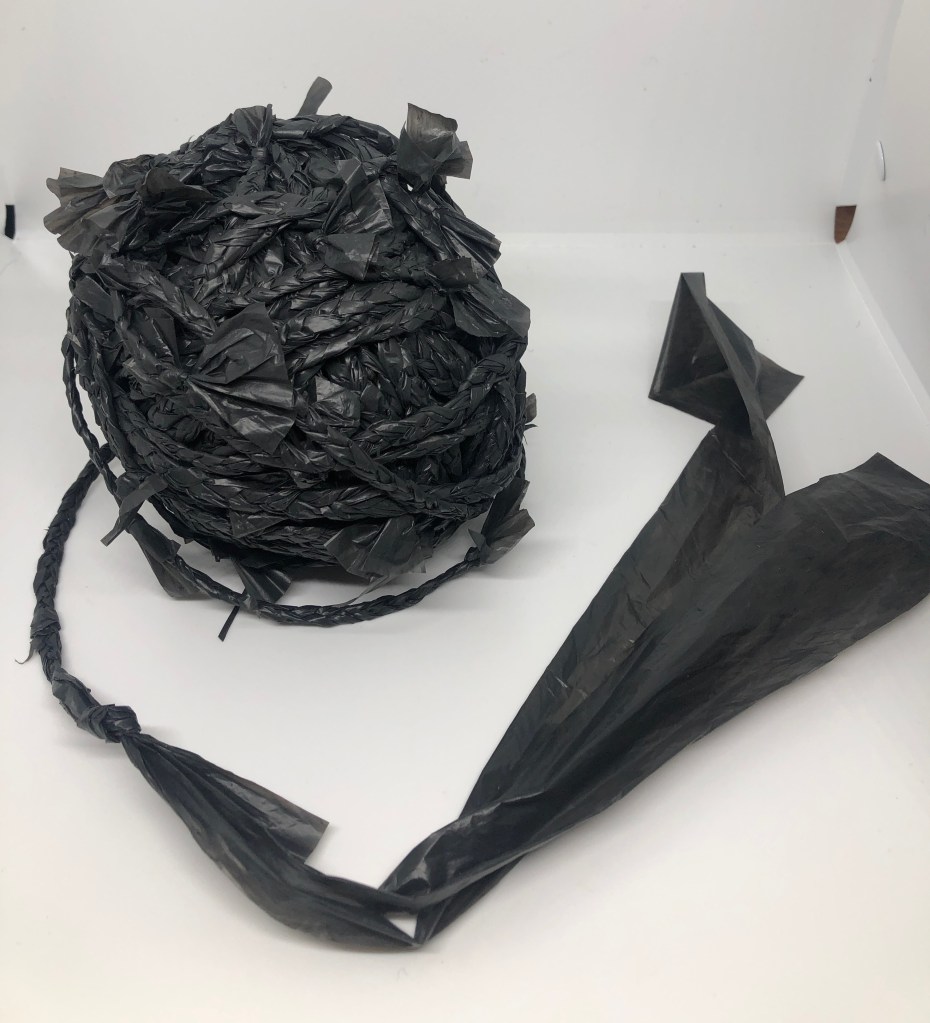
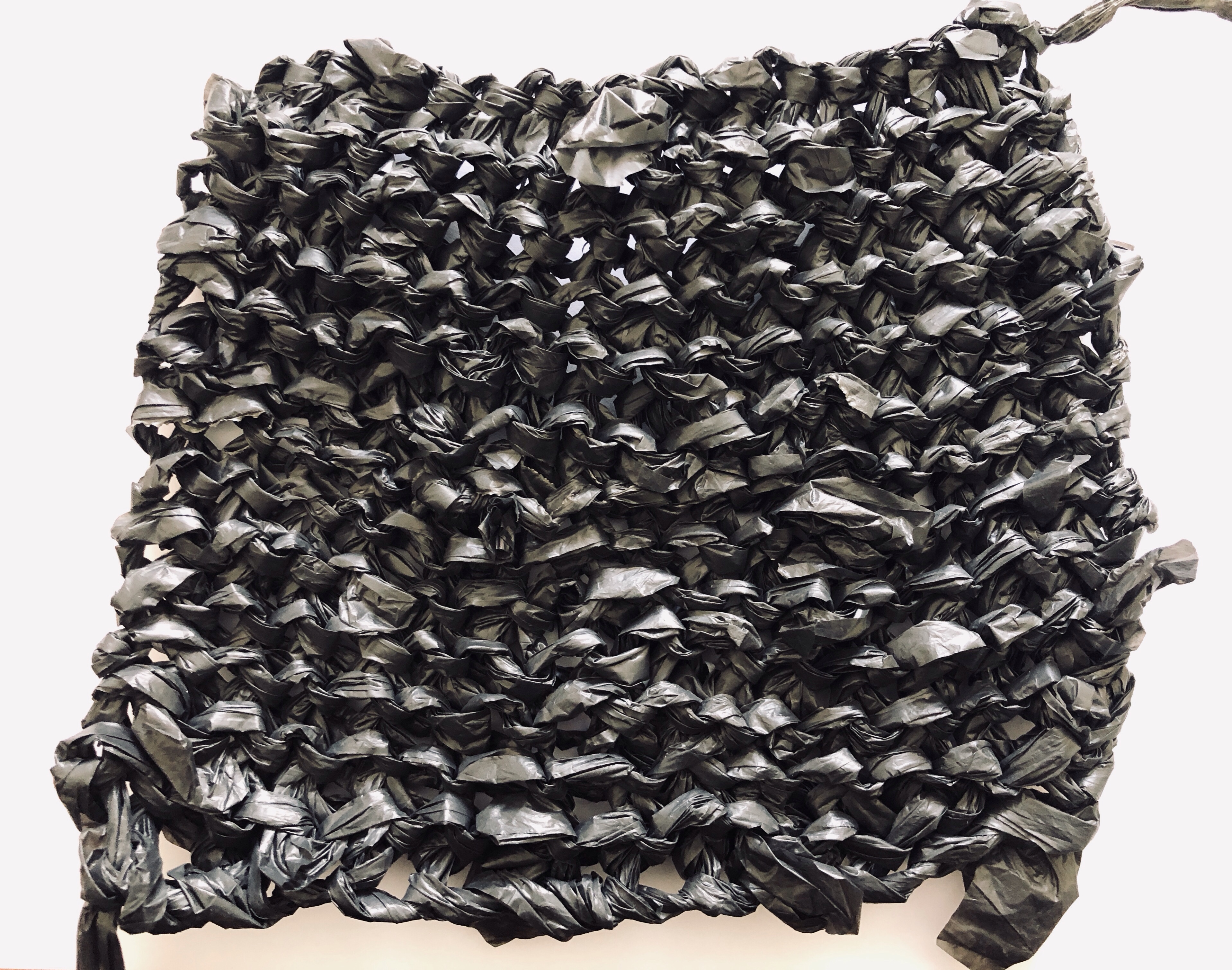
(Above) Yarn made from plaited strips of black plastic dustbin liner.

I had asked my father to make me a pair of giant wooden knitting needles and had already done a quick test of how the needles would work with a dustbin liner as I had done a few rows of knitting with just strips of the plastic and the knitting was just not strong enough on a larger scale as it had been on a smaller scale, so I realised that I would have to make my own yarn. It took so long to make as I was literally sitting and plaiting each evening for over a week in order to produce just one ball of the yarn. I had not planned to have a whole square metre of the same yarn as it would not only possibly be a bit boring and also would not allow some of the woven in items to be seen as if the knitting was too large it would dominate over everything else I wanted to show.

I had a trial piece to see how cardboard and yarn could interact and so had collected and flattened out sections of recycled packing cardboard that I then lashed together using garden twine. The plan was to try threading rope through the lattice but having done this I looked at it from several angles for some time but I hated it! I did like the actual lines where I had connected the pieces together and was surprised by the physical strength of this, I could see that this was again something to remember and keep on the back burner as it could work very well as a sculpture piece but not as a flat material manipulation. It was way too basic for the Part 5 brief and I knew that I wanted the final piece to be something that I liked and was confident about.

(Above: One metre square piece of repurposed cardboard packing material laced together with green garden twine.)

So having ditched this idea, I moved onto looking at my ball of yarn and I decided that I needed to go back to looking at how this could be used better. I bought a reel of garden twine and began knitting with my homemade yarn and then joined it in with the yarn I had made. It was surprisingly easy to knit with and I tied the twine to baling twine from straw bales and then having knitted with this for a couple of rows went back to the garden twine. I then carried on knitting until I had a metre square net and cast off.

Taking the various pieces of rope and other items I had collected, I wove them into the net having mounted the net on two sticks I had found in the garden. The finished piece was interesting but probably not what I had hoped for, it would certainly have been better had I had more rope or materials to weave with but it isn’t actually that easy to find in plentiful supply.
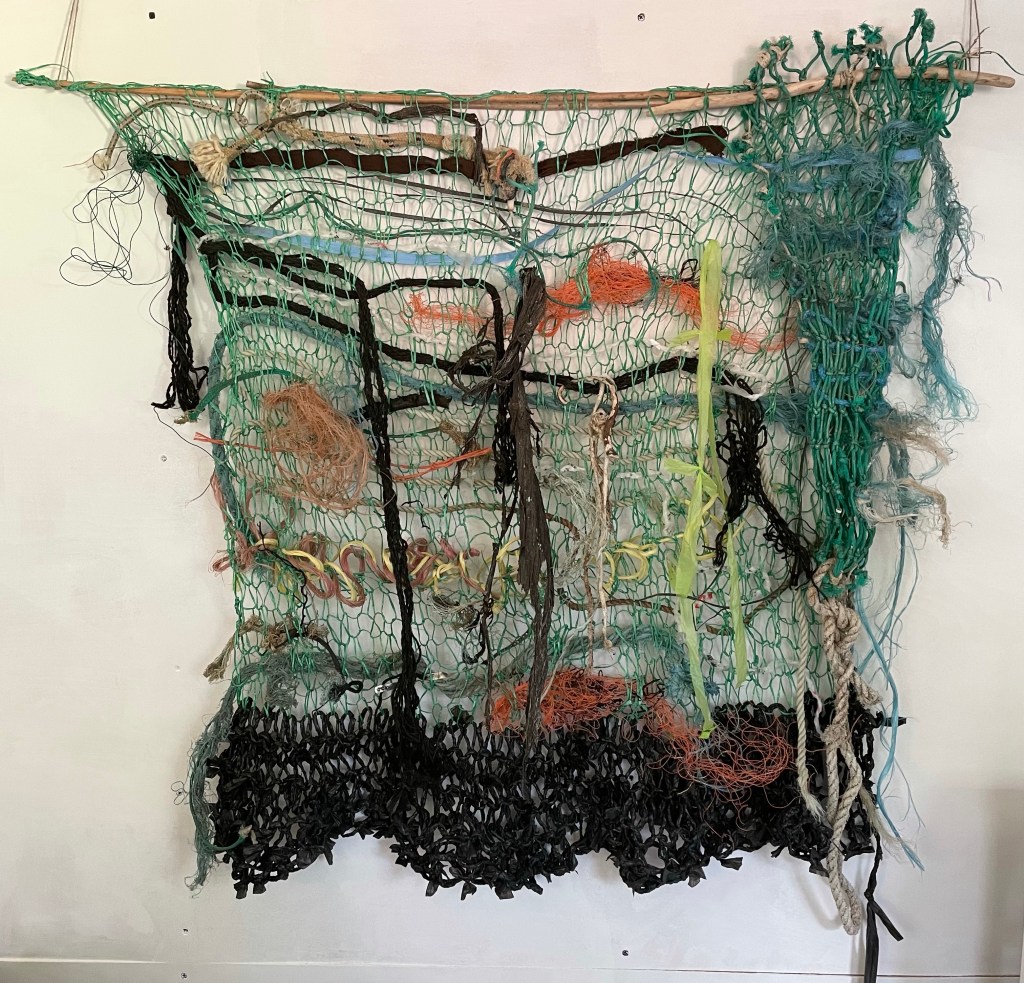
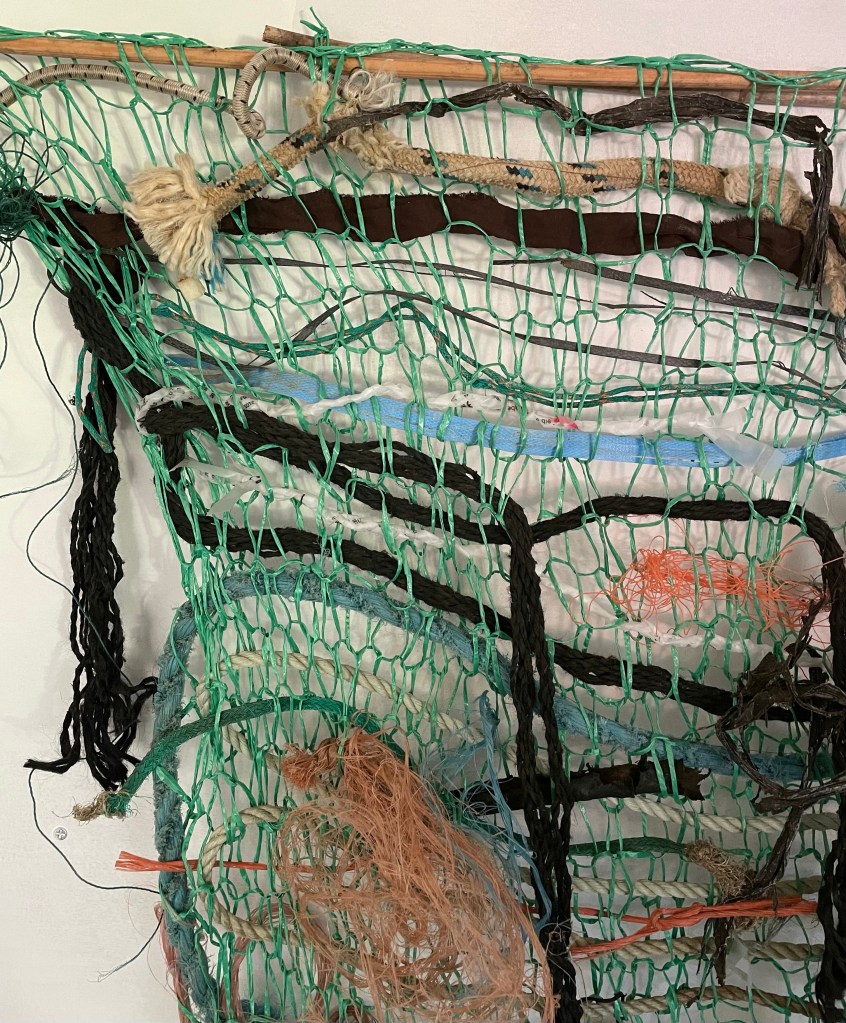
Above: Knitted netting with additional beach found ropes and netting.

The baling twine was the most difficult to knit with as it kept its straight shape so well and so it was hard to re-manipulate it to a different shape. I left the rope ends hanging to emulate the tattered and aged aspect but also the fact that they had not been able to biodegrade.
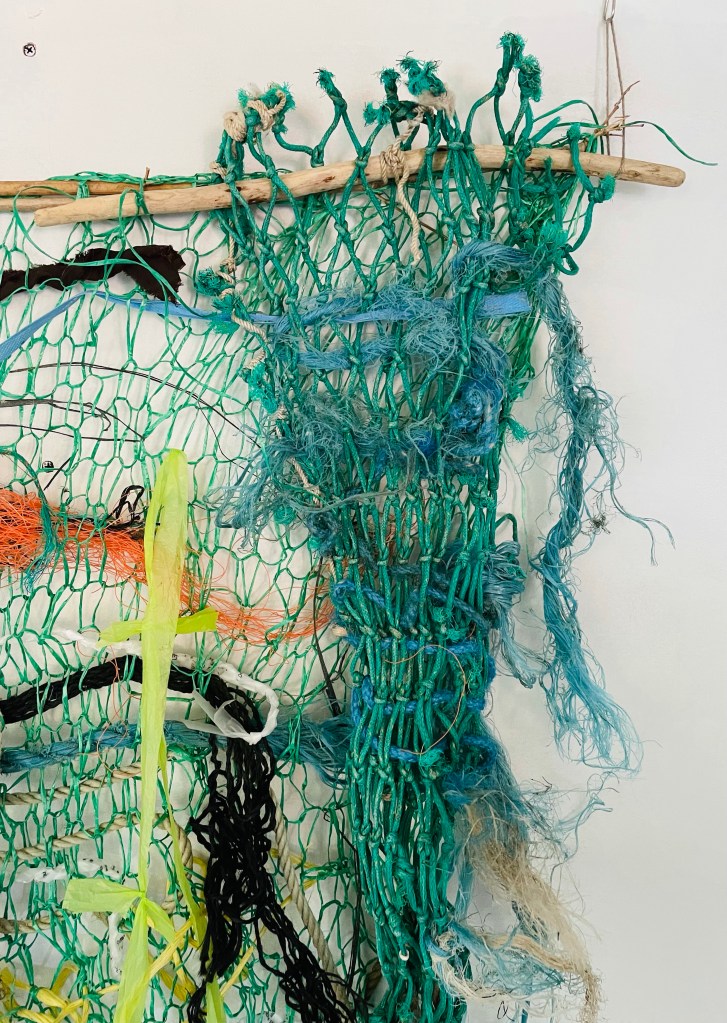
Above: Right hand side of piece showing weaving within weaving on a piece of beach found fishing net.

I particularly liked this section as I had mounted the fishing net onto a section of stick also found on the beaches and then wove further rope into this to again explain that man made textiles do not readily decay and become part of pollution.
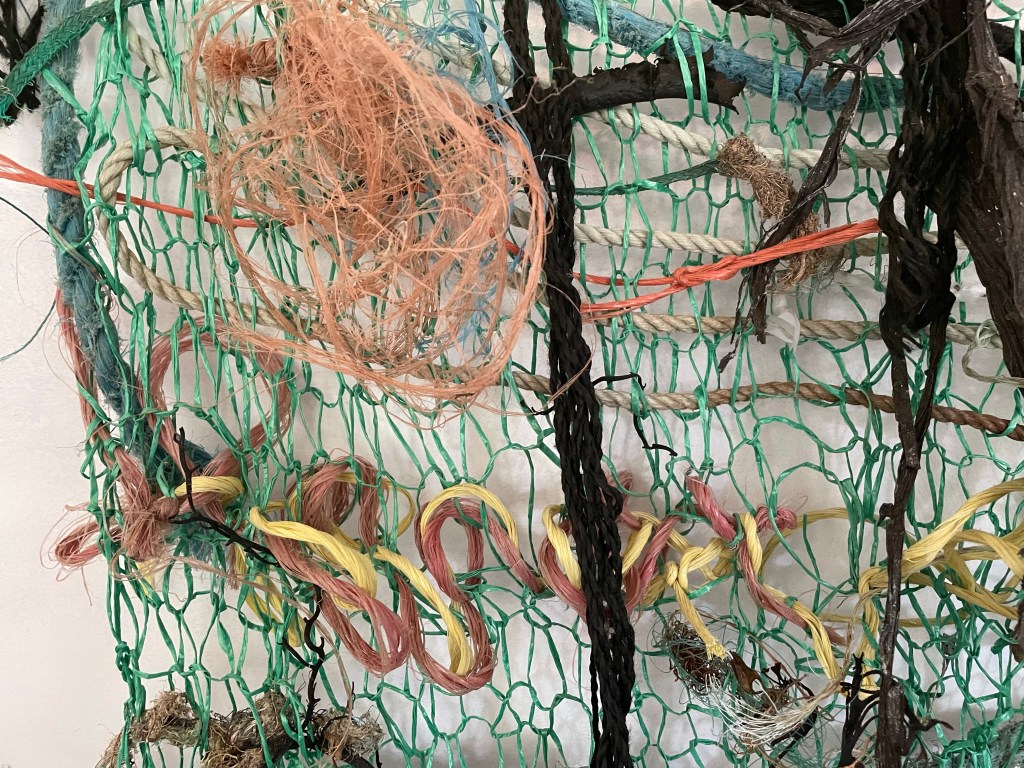
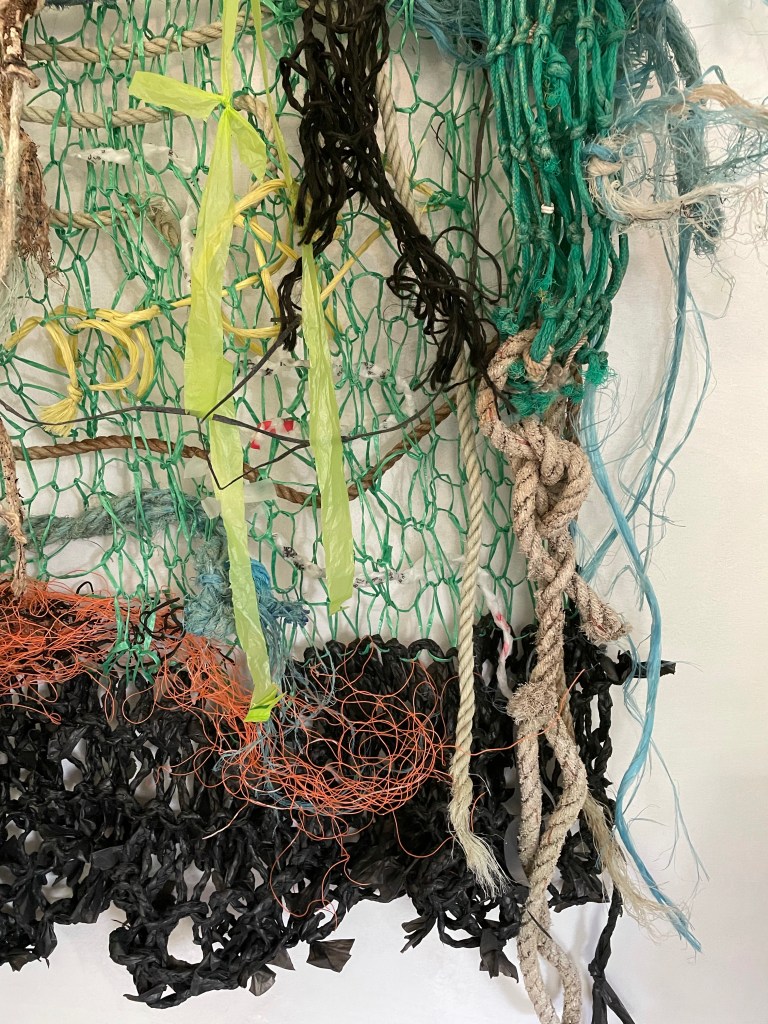
I liked the tactile feel of the ropes and strips of fabric as they were very soft and I also wove in a piece of rubber and some wire.

I felt pleased with the section of the piece made from my home made black yarn, it rippled fluidly and the raw ends added interest. It was incredibly strong and flexible and I think this yarn on a much bigger scale could be a very attractive thing.

This part was my favourite as from a few steps away, the plaits cannot be seen but close up they look far more delicate and almost ethereal.

What I do like about my finished large scale material manipulation is that it is unusual and the homemade yarn was absolutely fantastic to work with as well as being unbelievably strong. It looked like lacework at the bottom of the net and when the wind catches it it literally ripples which is very eye-catching. As it will not decay I may have it as an installation on the end gable of my workshop as if it was evenly pegged out it could be used to grow honeysuckle or sweet peas on and I think this would give back to nature rather than take away. It may not turned out as I envisaged but after much time leaving it hung up and going back and revisiting it, I felt happier with it. I was often too busy thinking it wasn’t perfect enough but less is definitely more as too many items in the knitted net would have made it impossible to see the detail and different textiles within it.

Reflection on Foundation Textiles

I have been both enamoured with and frustrated by Foundation Textiles with OCA. It has taken me far far longer to complete the course than I ever thought it would and whilst I can partially attribute this to the Covid 19 pandemic and its effects on my family and wider society, it is also due to my own timekeeping as I did not always devote enough time to my studies and I would do lots of reading but not enough practical work despite my good intentions.

I have invested in a proper workshop to incorporate my small business and also it has room for me to have a large table of my own to work on and which I can leave my work and tools out on rather than have to pack all my things away ready for mealtimes. I have verbalised enough by now about OCA’s decision to no longer accept Textiles assignments being sent to our tutors to be assessed and although I hope at time of writing that this would be reversed, I somehow don’t think it could be and I will have to improve my digital skills, especially photography.

But what I cannot thank OCA for enough is the lifelong impact of learning so much, not only about myself but in the skills I didn’t know I had. I had no idea about how to draw and that I don’t need to be able to draw to a fine art standard and that making and using my own tools to draw with would be so good and so much fun. These are good skills to build on in the future for when I am ready to start the degree in Textiles and I now prefer to draw with a stick and black ink from a pot rather than a pencil. I have loved creating three dimensional samples and structures, making my own natural dyes and even got more comfortable with my sketchbook. I don’t want to lose those skills so will be continuing to widen them over the following year before I begin the degree course as I have decided to have a break in between the next chapter in Textiles. I am grateful to my family for putting up with me creating so much mess and for the amount of clutter I have created with all good intentions of using found objects in my studies, but once you start collecting found objects it is hard to stop! I am also very grateful to my tutor Lizzy Levy for listening to my tales of woe, for inspiring me and encouraging me and for all the information, guidance and motivation she provided. Without such good people in my life I would not have been able to have done Foundation Textiles.

Part 4 Sketchbooks

Feedback from tutor

I was genuinely very pleased to have a lot of positive feedback from Assignment 3 and I felt I was finally beginning to get to grips with Textiles. I had really enjoyed making the natural dyes and using them within the colour palette I had chosen and my tutor commented that I was “developing “research via making”” via “the experience of making to inform your next steps”. I think it is important for me to make more of “happy accidents” as I would term them as literally spilt dye or fabric falling onto the floor in a random way has actually made me see an idea which could have otherwise been ignored.

I had produced a knitted sample from strips of black bin liners and my tutor had commented that this was “very effective” and that this could be continued on bigger needles. It is certainly a concept that I had in mind for my final assignment as I wanted to produce a large piece of work regarding the theme of plastic pollution in the ocean. I was happy that I am at last “taking risks” regarding my work. I was also pleased to receive good feedback on my use of both hand stitching and machine stitched regarding samples, particularly the hand stitched work as I have had to realise that within textiles it is not important to be neat but more to express freedom.

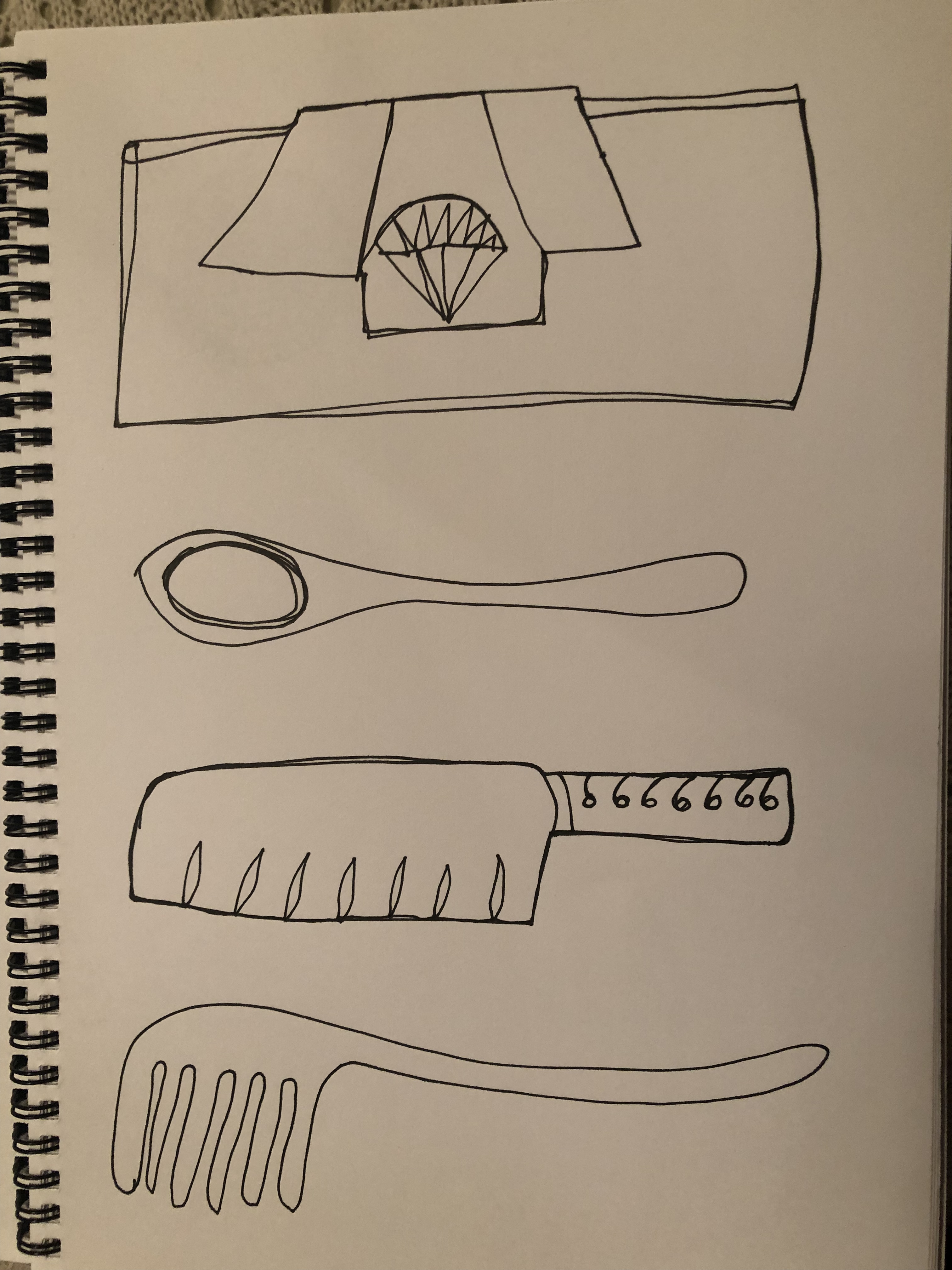
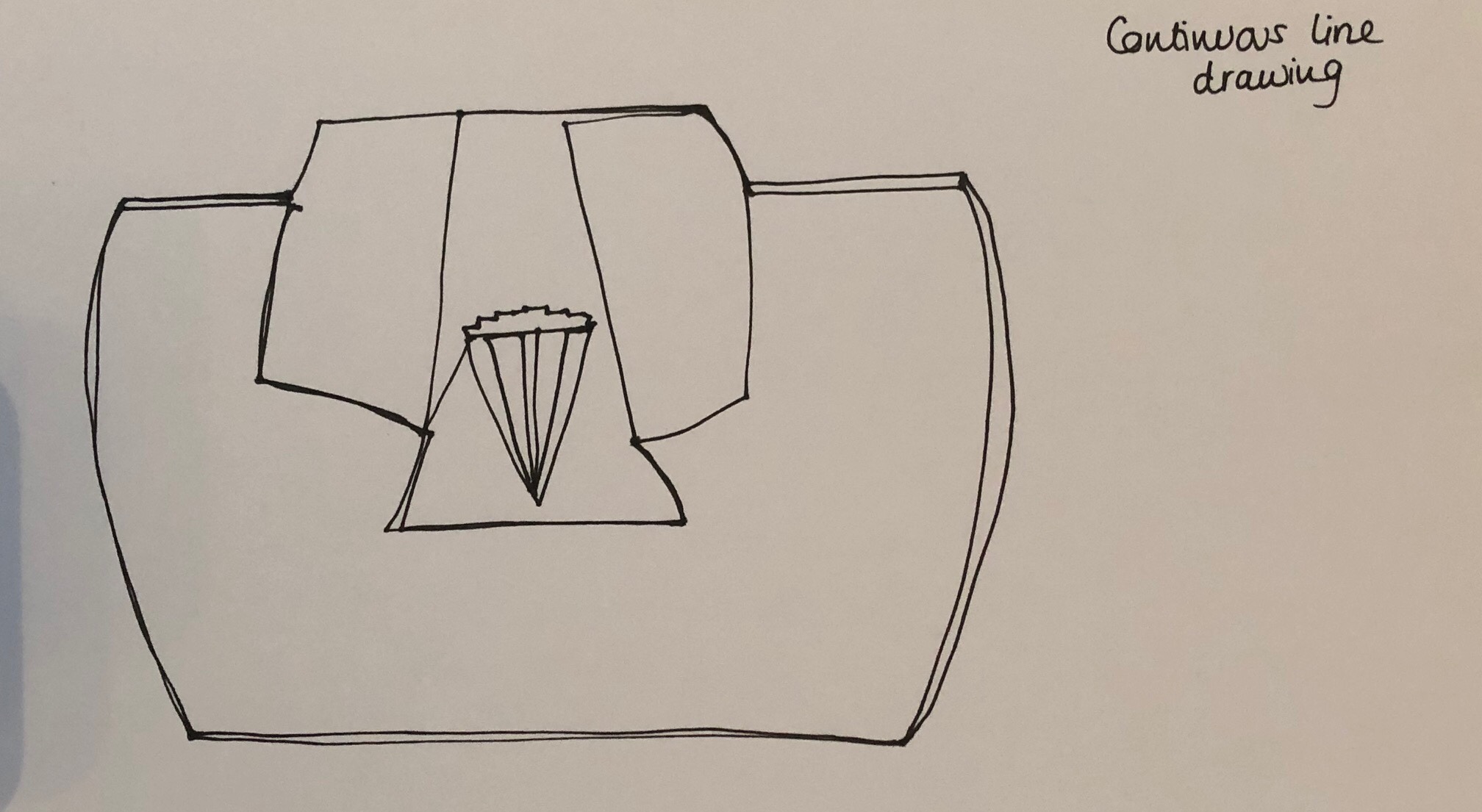
My tutor discussed the need to “develop further the links that you are making with both primary and secondary research enquiries by including images adjacent within your online log and sketchbook”. This is certainly food for thought as I don’t feel I am using my sketchbook enough and of a high enough quality, to me my sketches have looked more like cartoon type drawings and with mostly single pen lines when the sketches need to be graphically more flowing and convey movement and texture investigation. I have found that I enjoy continuous line drawing and I should be concentrating on this as a theme a lot more. Having images next to sketches or samples can be more thought provoking, plus sketching some of the samples does make much more sense to me. I do also need to take my sketchbook out with me all the time to capture things of interest that I often see and only take photographs of. I had visited castle ruins last summer and had taken many photos of the carvings of names and dates in the stone walls of the castle and these fascinated me, as well as where and how some of the sandstone bricks had deteriorated and decayed, a sketchbook and pencil would have produced more insight into this as well as ways I would have been able to convey this into a textile sample, such as drawing with machine stitch some of the carvings and their details.

Exercise 4.1 Making a sketchbook

Stage 1 Preparation

I created the two sketchbooks as required in the course materials and liked this approach. I was lucky enough to have done a sketchbook day course in Kent with Cas Holmes recently and I learnt a lot from Cas about making a concertina sketchbook and how to use it. Cas took us to a local graveyard and explained about positive and negative use of the pens and pencils and also took time with each course participant to give one to one advice. I learnt first of all that I was holding my pencil all wrong and needed to hold it further up and not like holding it to write with. Having drawn on one side of the sketchbook, we then used collage to create different surfaces to draw on and I was surprised by how effective this was. It totally changed my way of thinking and we returned to the graveyard to sketch on our customised work. I quickly found that this gave a very different perspective and a better quality of drawing rather than on a flat piece of paper. I have often been frightened to draw on a page of white paper in case I do it in the wrong way but working on different textures really opened my mind to new ideas and was a confidence boost.

Cas gave me a greater understanding of how to construct and use a sketchbook and so I feel this will be of great benefit for the future, I have a better knowledge now and don’t feel as critical of my style of sketching and interpreting what I am drawing and that it does not necessarily need to be a Da Vinci or perfect to convey a subject matter. I think this can be the barrier when distance learning as it is not always easy to know what is required from an exercise, whereas someone standing next to you and pointing out areas which need more detail or improvement and how to actually hold tools makes such a difference. We were given information to take away and naturally we all demanded to have photos taken with Cas Holmes at the end of the workshop and so here I am with my very favourite artist holding my work.

img_9426

Stage 2 Drawing from memory

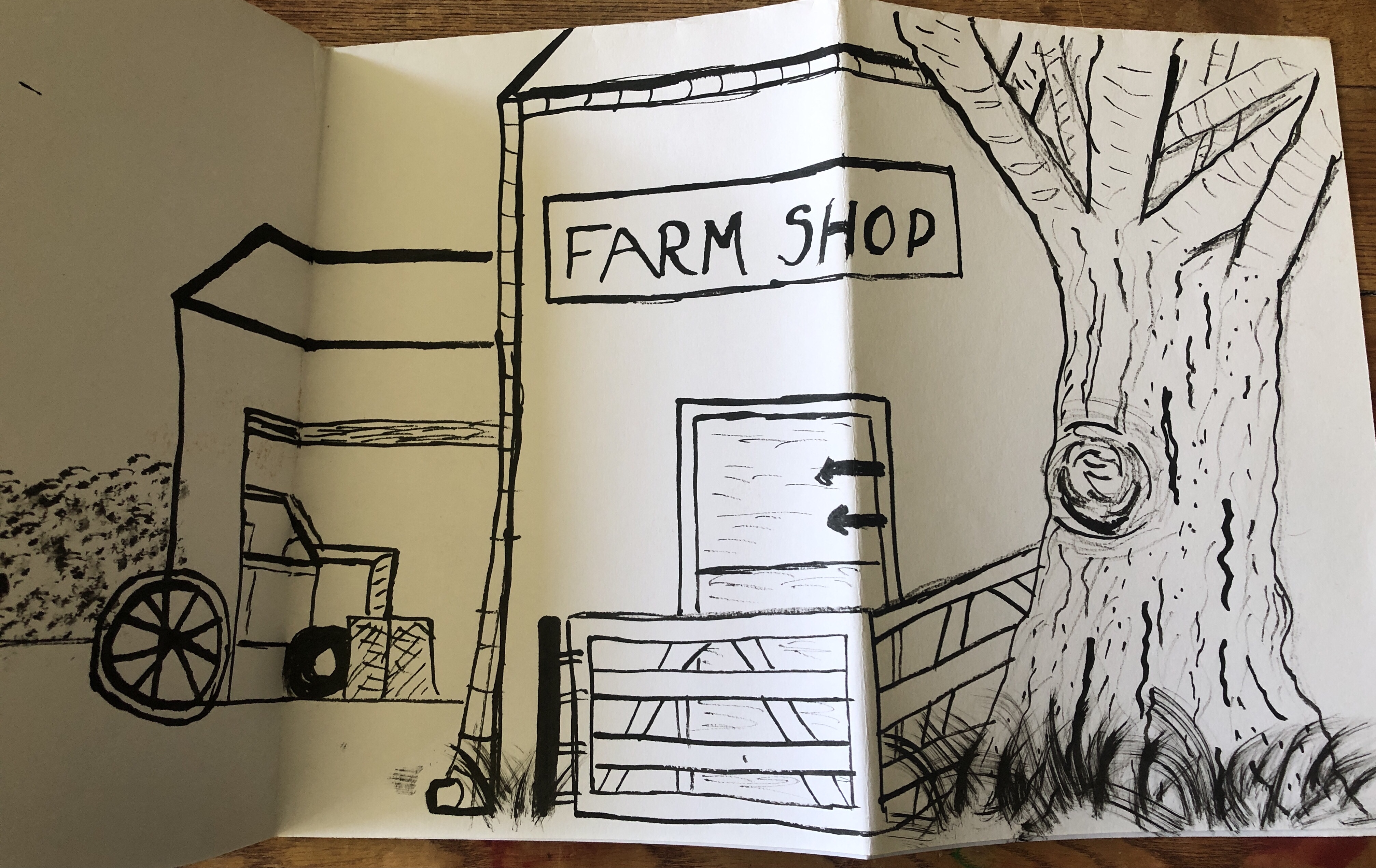
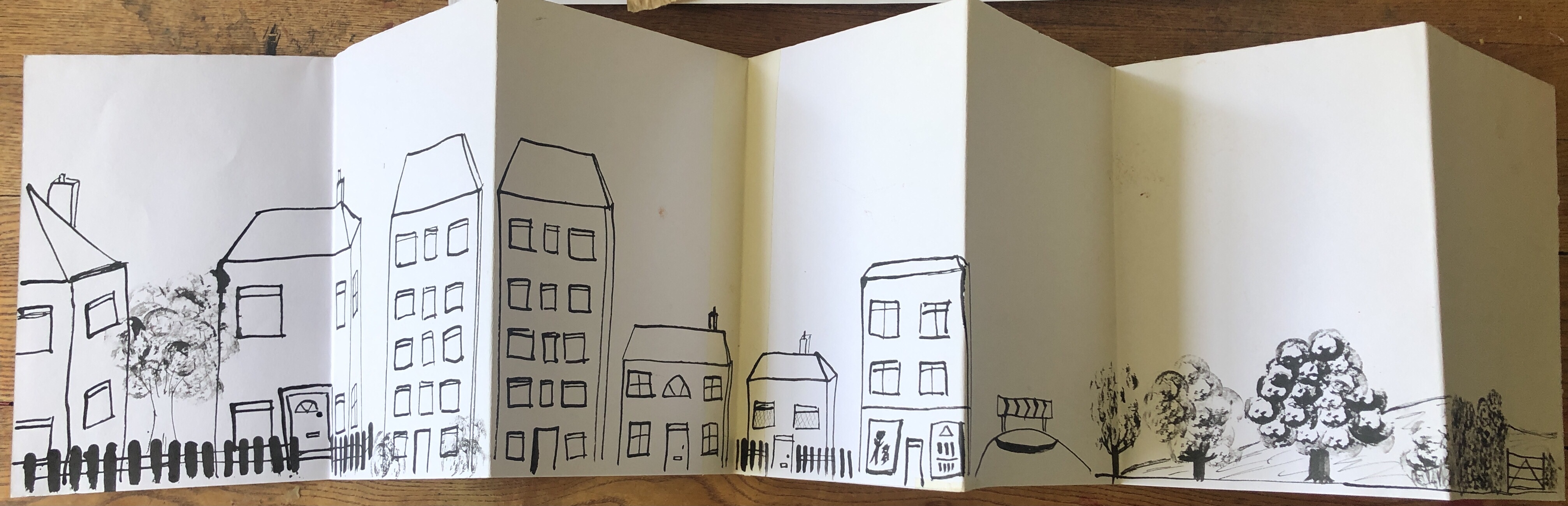
Following the course materials I took my first sketchbook and decided to draw a trip to the local farm shop from memory using a wooden coffee stirrer and a cork and black ink. I drew from several different perspectives to try and show places on the journey that were closer and then farther away. Using the wooden stick this time was much easier as I quickly got used to it and found that I could use it at different angles for very thick and thinner lines and with more control than Part 1. I was happy with the effects for this and it helped with my confidence with drawing, plus I liked drawing a long line of sequences in a scene. I was particularly pleased with the effect that the cork made in the creation of trees and bushes along the route as this was something I would not have achieved using a pen.

img_9429img_9431img_9430img_9432img_9433

I think critically that I was too concerned with the buildings and details looking perfect as the examples in the course materials were more fluid and this attitude of mine does need to change. What was interesting was that as I drew the journey, it was more detailed and actually looked better as it went along. The buildings to start with looked childlike in expression but I think I was holding the wooden stick in the wrong way and that I was getting frustrated if the lines of the buildings were not perfectly straight. I was also trying to keep to the hour long time limit and that the initial part of the journey was too rushed, once I relaxed more the drawing improved. I did have some trouble with the tree to the right of the farm shop but I was trying to depict the surface of the trunk and so the branches were not quite right but if I was drawing the tree whilst standing next to it rather than memory then this would have been improved.

Stage 3 Drawing from life

I then took the second sketchbook and drew the view of the stairs from my dining room where I was working, a wall and objects in my kitchen, my garden gate and an area of the garden where I keep my hens. I used felt pens and colouring pencils along with a black pen to draw with but I disliked the sketches and felt they looked more like awkward cartoons, I much prefer black and white and would like to experiment with watercolours at some point as I would feel more comfortable with this. I did feel that this side of the second sketchbook was a failure.

I then drew on the reverse side of the sketchbook with the wooden stick and black ink again and tried to capture a walk along my local canal where narrowboats are moored. As someone who comes from a family who loves sailing I have a dream of owning a narrowboat some day so I enjoyed this sketch. I wanted it to be less detailed than the trip to the farm shop to show off the lines of the boats and I added a water effect with a toothbrush dipped in the black ink. I felt this was more successful than the coloured sketches even though it was simpler. I experimented by drawing right to left with this and liked this more than standard left to right.

Exercise 4.2 Customising a sketchbook

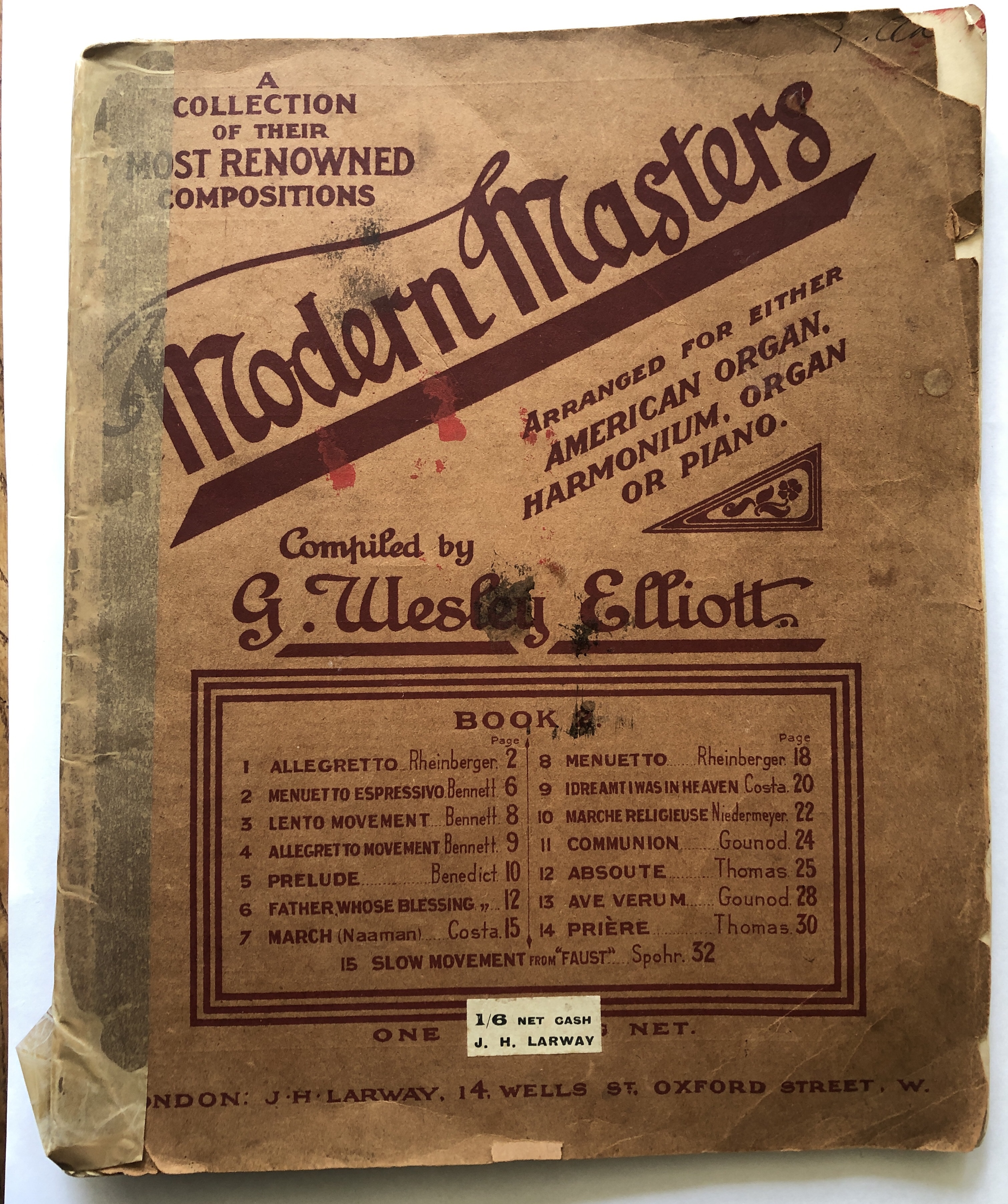
I had been looking forward to this part of the course having found an old music book in a local junk shop. It was priced in shillings and pence and my initial guilt was met with excitement as the book covers were sturdy and I saw that the whole book would hold together well. I have recently got into a new hobby of making junk journals and this involves making a book using ephemera and used pages of books or magazines, the purpose of the journal is to hold favourite memories, quotes and motivational words. Junk journals are usually designed to look aged and vintage, often done using coffee stained water on A4 paper which is then baked in the oven to create a crunchy and aged texture to the paper. The pages of the music book are thick and would be perfect for painting and collaging on to help me grow more used to working with colour. I was however unsure how comfortable I felt about the quote in this section of the course materials explaining how Mr Gillivan-Cartwright found an 1839 edition of Lord Byron’s work and was using it as a sketchbook as to me this is tantamount to vandalism!

Stage 1 Research and preparation

As advised in the course materials I began by researching the following artists: Elizabeth Blackadder, Patrick Heron, Cy Twombley and Ben Nicolson and wanted to add a few notes to my learning log on the artists.

Elizabeth Blackadder

Dame Elizabeth Blackadder is a Scottish artist and alongside her work with oil paints, watercolours and drawing, she also made works using printmaking. Dame Blackadder worked mostly in still life, creating portraits and landscapes which earned her much acclaim and much of her later works were devoted to very detailed paintings of her cats and flowers.

There were a great many of Blackadder’s paintings and artwork online and so I chose four that really caught my interest. The painting below attracted me particularly as it reminded me of the continuous line drawing in Part 1 and how much I like working in black and white.

See the source image

(Source: http://www.cambridgeprints.com)

See the source image

(Source: http://www.gpsarchive.co.uk) Irises

The painting of irises I chose as I do like colourful nature paintings and sketches, the detail in this still life is beautiful and it particularly conveys the delicate petals of the flowers, I also noticed that the stems are less bold so the attention is drawn to the flowers themselves.

See the source image

See the source image

Left: (Source: http://www.mutualart.com) Still Life with Fan, 1991

Right: (Source: http://www.pinkpagodastudio:blogspot.com)

The painting on the left I found to be my particular favourite as it seemed to me to be about negative mark making, almost like a scraperfoil piece. I couldn’t quite decide if it was white paint on black paper or the other way around but it gave me a flood of ideas for work that I wanted to try out in monochrome.

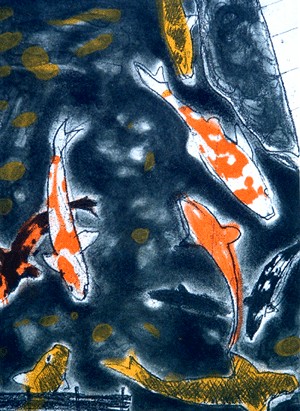
The painting on the right I enjoyed looking at as I liked the colours used and the abstract nature of the piece. I could see the movement and the depth as Blackadder had painted fish further down in the water and rocks beneath them. The deep orange used for the upper fish was perfect and really showed them in detail and the use of white captured the look of the reflections in the water.

Cy Twombly

Twombly was an American artist who produced artwork via painting, sculpting and photography who mostly worked on large scale drawings comprising of scribbled and graffiti type works. Later in life he moved on “romantic symbolism”.

I began by looking at some of his graffiti style work and I have to admit that I am not a fan of it. To my vastly uneducated eye, it is a jumble of colours, circles and lines and it did remind me of a young child’s first attempts at putting crayons to paper. I tried very hard to see what message was within it and emotionally it frustrated me.

Every Day:  Cy Twombly & the rapture (Source: http://www.blogspot.com)

See the source image

I moved on to Twombly’s later work and looked at this painting, entitled “Roses Gaeta”. I loved it straight away for the bold colours and subject matter, I have several types of roses in my garden and I like their delicate petals as well as fragrance and how roses differ in the colour distribution on the petals, particularly where the edges of the petals are a deeper or lighter hue to attract and interest the bees. Twombly’s painting reflects this and to me it also conveyed the fragility of roses, almost with the rose melting away as it fades.

See the source image

This second painting “Quattro Stagoni: Autunno” (translates as Four Seasons: Autumn) is of a similar theme of decay and change, showing the bright colours of summer dripping from the trees and plants to be replaced with brown, rust and spiky bare branches. I have always liked the initial start of autumn with the extensive range of colours such as russet, deep red and gold. As a child I liked to collect handfuls of large leaves to admire their changes and I think there cannot be a person who dislikes kicking their way through a pile of fallen leaves and enjoying the crunch and rustle as well as that earthy odour. I also liked to look at the fragile skeletons of the leaves and their complexity, it is incredible to look at their structure of veins and to imagine how each leaf contributes to the health of the tree.

See the source image

Ben Nicolson

Nicolson has many ways to express his creativity and has worked with oil paints, watercolour, drawing and printmaking. Nicolson works mostly in still life but as well has produced portrait and landscape paintings.

See the source image

This painting caught my eye as it was the bold outlines that I tend to favour and I liked the more sublime muted colours as I felt they promoted the use of black and red. I noticed that the lighter colours had a lot of texture, like I have seen when I’ve been roller painting a wall in my house. It was that almost bubbled look when the paint first goes on and then is flattened more by the action of the roller. I could also see that it seemed to be depicting a china cup which was distorted in a block jigsaw style.

See the source image

This still life painting of pears in a bowl interested me in the angle that it was painted in as it displayed as much of the fruit as possible. I liked the gradual blending of the green, olive and deeper brown hues and the way that the pears did and did not overlap due to the translucent use of the paint. It was like an x ray was being taken of the fruit as I am able to see the inside as well as outside and I thought this was a very compelling and clever take on a still life. I spent many minutes contemplating this painting and I came to my own conclusion that perhaps the overlaps were a visual effect of showing the colours and ways in which the pears would deteriorate and/or ripen. I could well have got that whole emphasis wrong but I have always felt that we interpret art in our own individual way.

Patrick Heron

Patrick Heron is best known for his early works of figurative and non-figurative works and liked landscapes as well as abstract as themes. Heron changed his physical painting approach from painting with his wrist for more delicate watercolour work to painting with his arm for the works to come together through the actual act of painting.

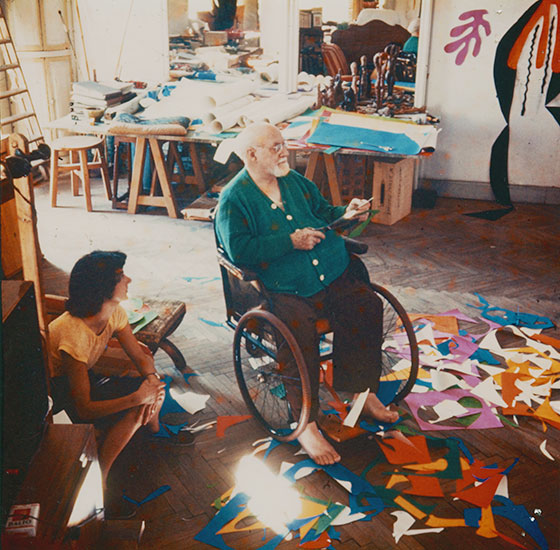
The abstract painting below is entitled “January 1973” and is very bold and colourful, it did remind me a little of Henri Matisse’s cutout abstract art which I am fond of. It is a very psychedelic piece and I found it to not be a jigsaw type piece where the various sections would fit together. I thought this could influence printmaking and collage which I want to try with this part of the course if possible. I would also like to experiment with holding the paintbrush differently to see how this could alter the style.

See the source image

I then chose another abstract painting by Heron as I liked the perspectives and angles in which it is drawn and painted.

See the source image

“Table with fishes” (Source: http://www.pinterest.com)

This painting is again colourful and busy in nature as the objects fill the whole space. It gave me a sense of how still life does not automatically have to be an exact and precise representation of the subject matter like a textbook but that having the items presented at such a different angle gives far more information. In this painting I am able to see the contents on the plates and the chairs do not cover the table and plates but sit neatly around the edge. I also was very interested in the use of what could be a charcoal like effect to draw the lines and then that the colours did not completely meet those lines as it gives a greater impact that way and this approach for me defined the whole painting. As before, this was a technique that I wanted to try with my own work.

One notable point of interest for me was that by completing the initial concertina sketchbooks prior to doing the research on the artists mentioned in the course material, I would want to consider doing the sketchbooks again and to use some of the ideas and techniques I have seen whilst doing the research. My tutor did highlight the concept of “stealing from other artists” and signposted me to a book for further information and I can now understand why this is not a negative attitude but a way of further developing skills and ideas. I have always wanted to come up with my own ideas rather than ride on the coat tails of someone else’s but this way of thinking could be holding me back.

Stage 2 Painter-inspired translation.

 I decided to go with my third favourite artist from my research, Cy Twombley as I saw this as much more of a challenge to see if I could like his style more and also to take me out of my comfort zone by experimentation. 

img_9447

 In my customised sketchbook I began by mixing paint for the colour palette. It took some time to try and find the right gradient of colour of the gouache paint but I did like the way that the paint was thin enough to still see some of the detail of the pages I was working on. I also made a mood board to try and get my mind into the theme of the artist, with yarn wraps, photographs and fabric swatches. 

img_9428

 I began by using opaque paper to trace the dark areas of the rose and then I painted onto the reverse side to try and gauge how to try and paint the image. I then painted the rose in monochrome having taken a photo of a rose in my garden and I used this to try and get inspiration on construction of an image. This was made using masking fluid and black ink drawn using a toothbrush. 

 I then did a warm up paint and texture test, creating a rose beginning with dark red paint and then light red over the top using a small twig. It did convey the “melting” aspect of Twombley’s rose but it looked too flat and not as expressive enough as I wanted it. I painted a second rose using the end of a cork and again built up the darker hues behind the rose before moving onto the lighter red and yellow details. I felt this was an improvement on the last piece but it still lacked the details of Twombley’s rose. 

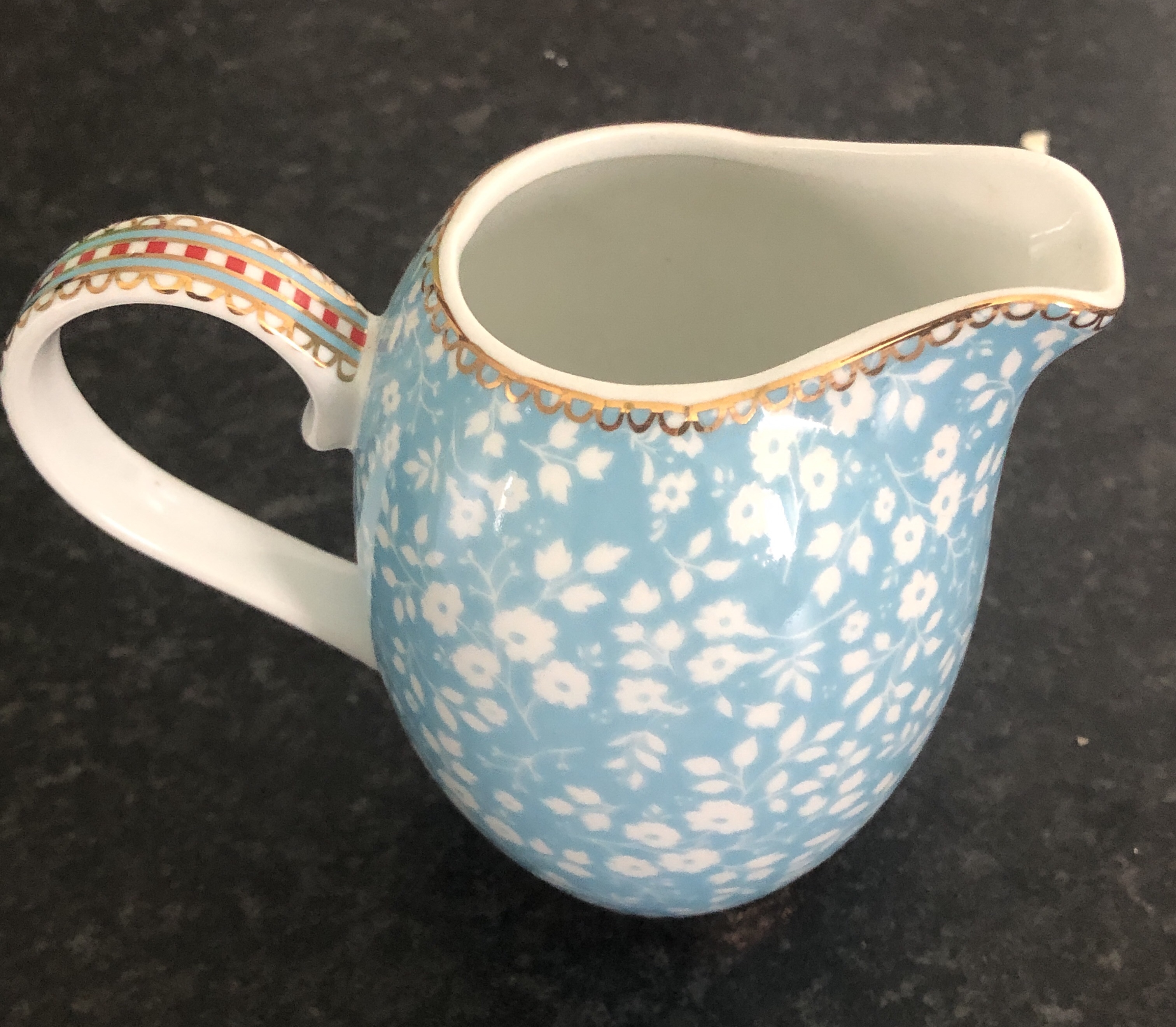
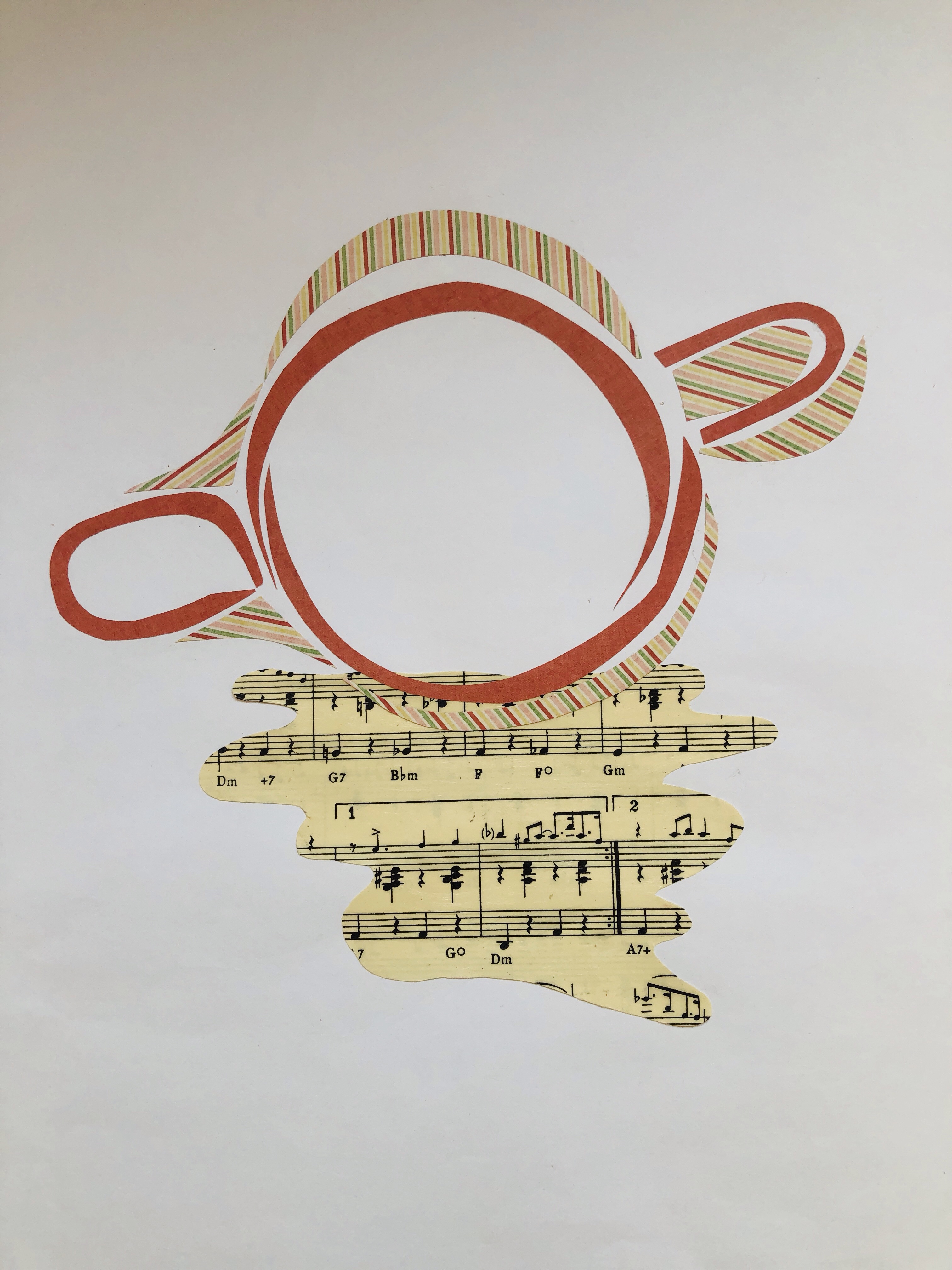
 Using the art deco jug I have drawn before and tried to collage, I began trying to paint in the style of Cy Twombley. I used the same colours as I had used for the roses. Working in series, I painted the jug with my left hand and used a brush, again I worked in layers from dark to light. However the jug was not “messy” enough in my opinion. I then painted the jug again and this time with my left hand, keeping the paint wet so I could blend the colours. I liked this jug painting much better and it was a much more abstract piece. 

I painted the jug again and this time used a stick, this painting was my favourite as it had the “melting” aspect of Twombley’s rose and it looked more textured and almost three dimensional. The fourth painting of the jug was painted using a cork and although I liked the way that the hues were distributed, I did not feel it was successful. 

The next work I undertook was to paint the rose again. I used a roller to give a dark layer of ink in the background and then used a cork to push paint around to create ribbons of texture and I felt this piece was more successful. On the following page I painted the stacked bowls that I had created in collage exercises to see how they would look using the colour palette but I wasn’t sure that they looked like bowls. 

img_9459

img_9460

For my next working in series I again painted the background using a roller and black ink and tried something new, I dipped string in the different red hues in the colour palette and used the roller to crush the string to release the paint. It was however very difficult to see the different colours and lacked the vibrancy of  Twombley’s rose. 

img_9461

I then tried to work in negative and made cut out forms which I placed on the sketchbook page, I then rollered black ink over the top and let it dry before removing the forms. I wanted to try something completely new and so dripped red candle wax down the sketch to see if I would be able to represent the bleeding rose. I didn’t like the finished work and felt it was too childlike. 

I finished the sketchbook exercise by using the string dipped in paint and I mixed it with PVA glue to try and create texture and depth. I also created a messy background as a border for the finished piece. I liked the effect but felt it was too simple and not the look I had been hoping for. I felt it was time to move on to the next exercise as I had exhausted most of my ideas here. 

Exercise 4.3 Collating a sketchbook

Stage 1 Research and preparation

 I began this exercise by looking at the work of the textile artists suggested in the course materials and I chose Suzumi Noda. Noda visited inner Mongolia to educate herself with wool produced locally and also was aware that she would be able to incorporate junk ,such as packing materials or literally rubbish and stated “I use junk materials but I think we should not make light of junk materials. New ideas, new thinking emerges from new ways of juxtaposing junk materials which have lost their value, with exclusive materials” (www.transitionandinfluenceprojects.com). This was so important to me as I see things that have been thrown away as having a second use, possibly I am a Womble in that respect. I have spent much time accumulating materials when out on country walks and also on beaches last summer. Not only is it beneficial for a beach to have old ropes and nets removed but to have them repurposed in some way will also combat landfill and reduce carbon footprints. I was delighted to find old sacking material in a stream as it had aged and decayed so beautifully and it gave me so many ideas for slow stitching or weaving into it, or incorporating it into a fabric sketchbook or an art piece. 

  The photos below show some of Noda’s work that I found particularly interesting and something I wanted to replicate and sketch. 

This slideshow requires JavaScript.

I printed off the photos of the above textile garments for me to reflect on and began collecting some materials such as thin wire, sari silk ribbon, thin yarn, tissue paper, chiffon offcuts, old string, matchsticks and bubble wrap to start with. I liked the fact that knitwear was part of Noda’s textile art as I particularly like knitting with very thin yarn and have made a large shawl from black mohair.

I wanted something special for this Part 4 assignment and chose to make a sketchbook out of fabric to incorporate some sewn or knitted samples and also to house other sketchbook pieces on paper and card. This was an A4 size with a concertina effect so as the pages were turned then it was easier to look at each item as a whole. The sketchbook was two sided like the initial sketchbook was in Exercise 4.1 to enable me to utilise the space within to its maximum.

This was where I felt very disheartened and disappointed by OCAs decision to no longer send work to tutors to assess and for students to photograph their textile work and upload it onto the learning log. I had worked so hard on this piece and I do not see how a photograph can convey texture and movement. It has made me rethink whether I go on to do the full degree should the new way of submitting work for textiles continue. I really wanted my tutor to see it!

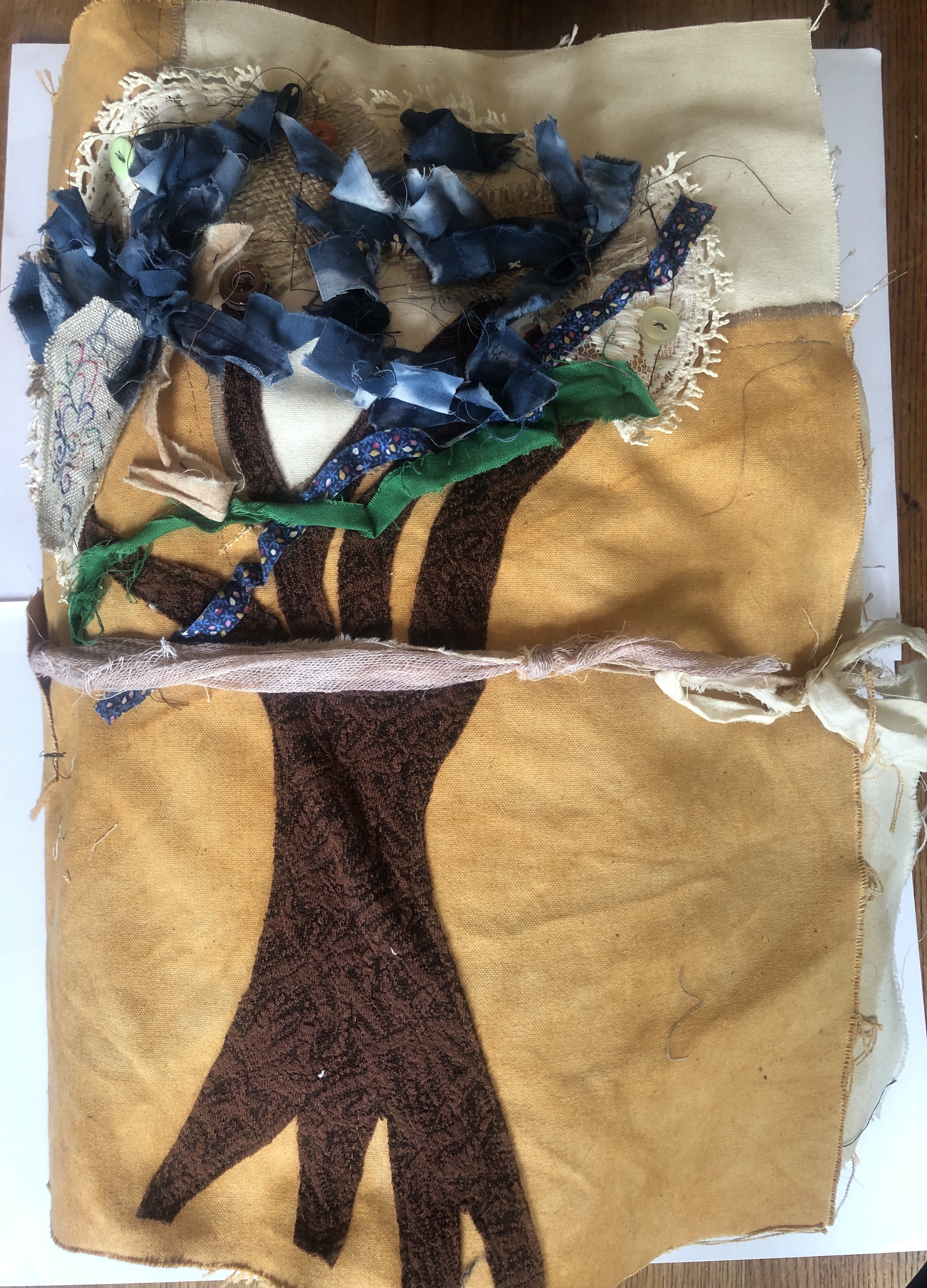
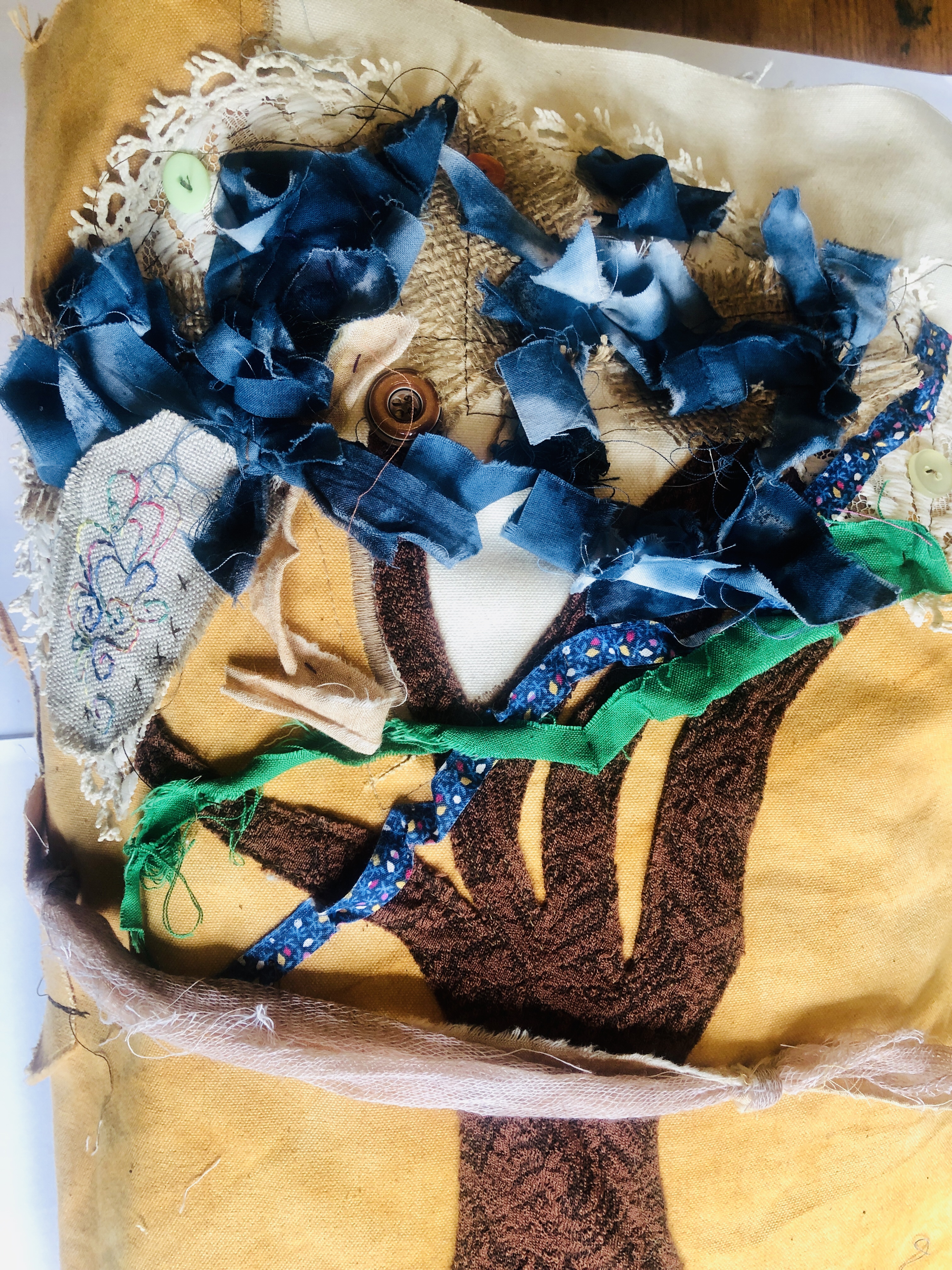
So here is the full sketchbook when closed, it fastens with a cheesecloth rope which has been dyed with beetroot juice and it is a very heavy piece. I made the covers and most of the sections from calico which has been dyed with natural dyes, my favourite colour being the rust dye as it is bold and distressed looking. I did an applique tree on the front using fabric scraps to add interest.

One thing that I wanted to do was to try new materials and ways of working with paint so I bought a Gelli plate printing set. A Gelli plate is a silicone block which is fully reusable and paint can be applied to it to create different shapes and textures on paper which is pressed to the painted plate. I also bought some Luratex fabric (known also as Polyproylene) which is a heat resistant fabric but can also be altered using a heat gun and some Luratex sheets which can be moulded into shapes using a heat gun too. Alongside this I bought some shrink plastic which can be drawn on with felt tip pens and then is put in the oven which makes the plastic smaller and thicker and can be used in jewellery making.

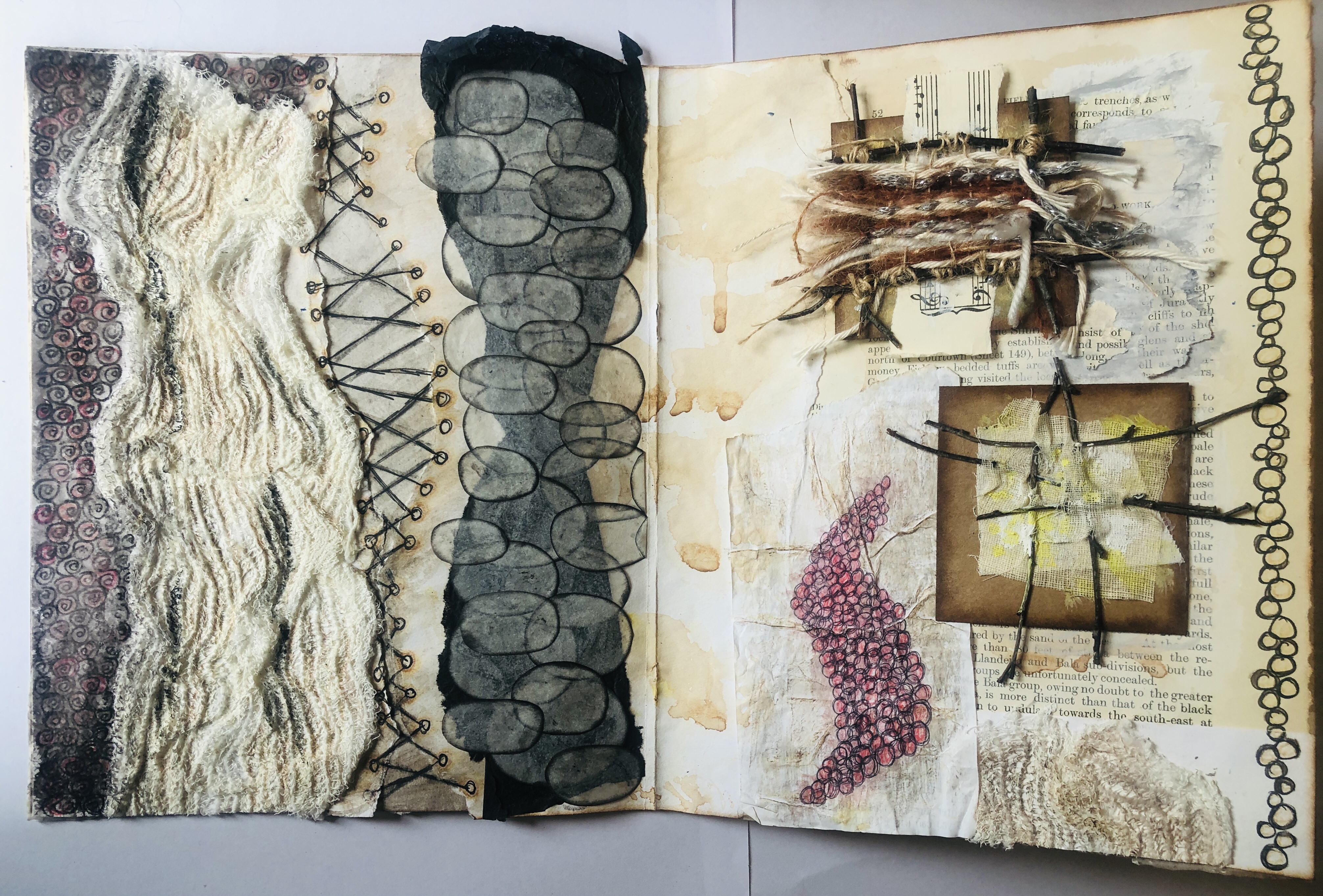
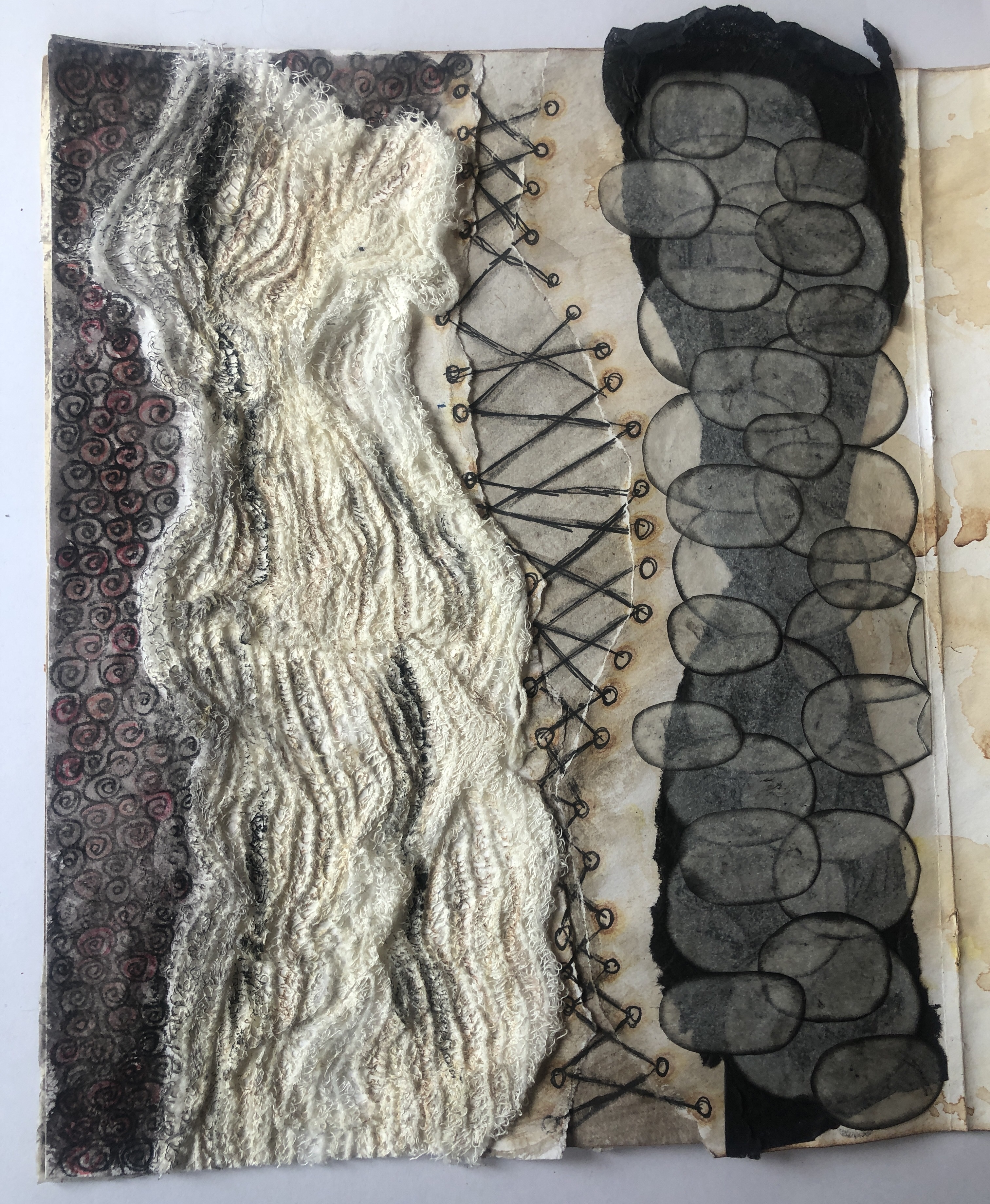
I began with some initial sketches using black pen and mixed media as I wanted to incorporate as much as possible to reflect some of the themes of Noda’s work. I made a tea dyed small A4 booklet and the front was made from old music sheets, some burnt Luratex fabric and cut out pieces of silver paper.

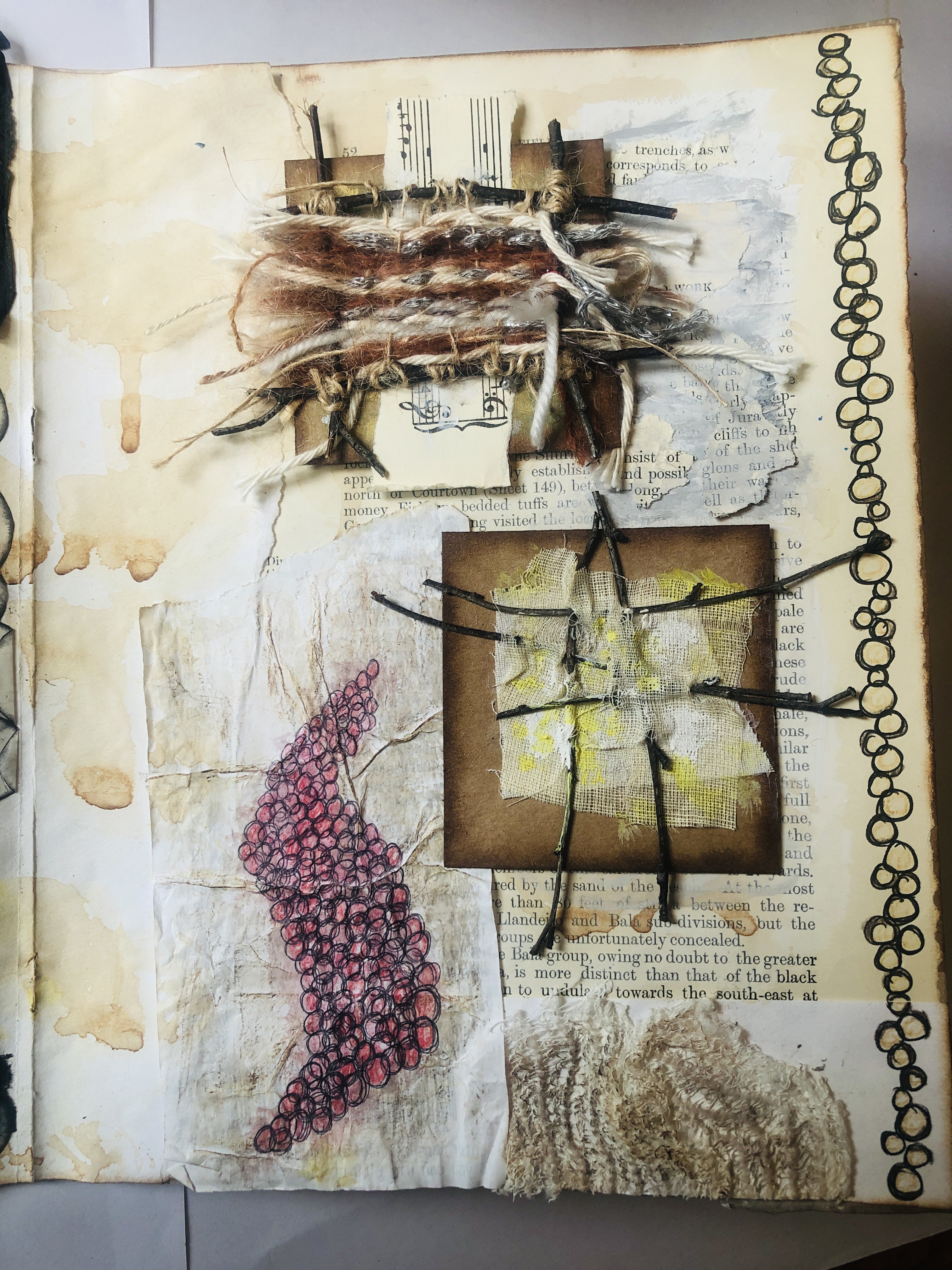
Inside this I drew with black pen and coloured pencils and used a section of old bandage, torn paper and cut out circles of parchment paper to create images to interpret Noda’s knitted pieces on the left hand page and on the right hand page I made a collage of distressed paper with small drawings stuck on and also two raised squares. The mounted squares comprised of a small knitting loom made from twigs with yarn threaded through it and with the second square I had pierced a small section of thin calico with twigs to create a three dimensional weaving loom to which I added yellow paint to add interest.

I enjoyed making the small loom, I had tried making a bigger loom using branches from a tree but I was not able to get the strings tight enough to be able to weave into. I do want to explore this further as I realised there is huge potential in weaving on a much larger scale and it is what I have in mind for Part 5 of this course.

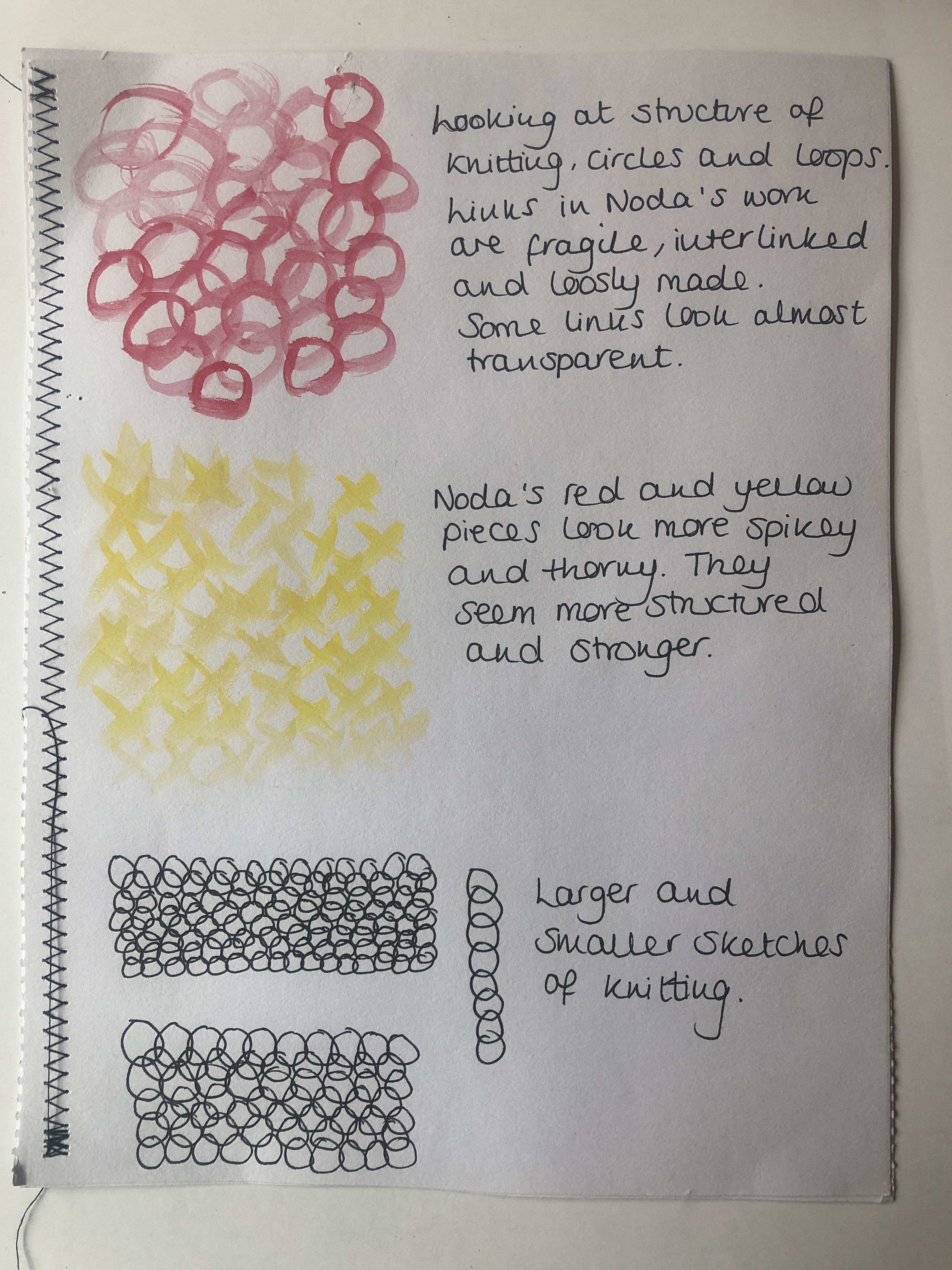
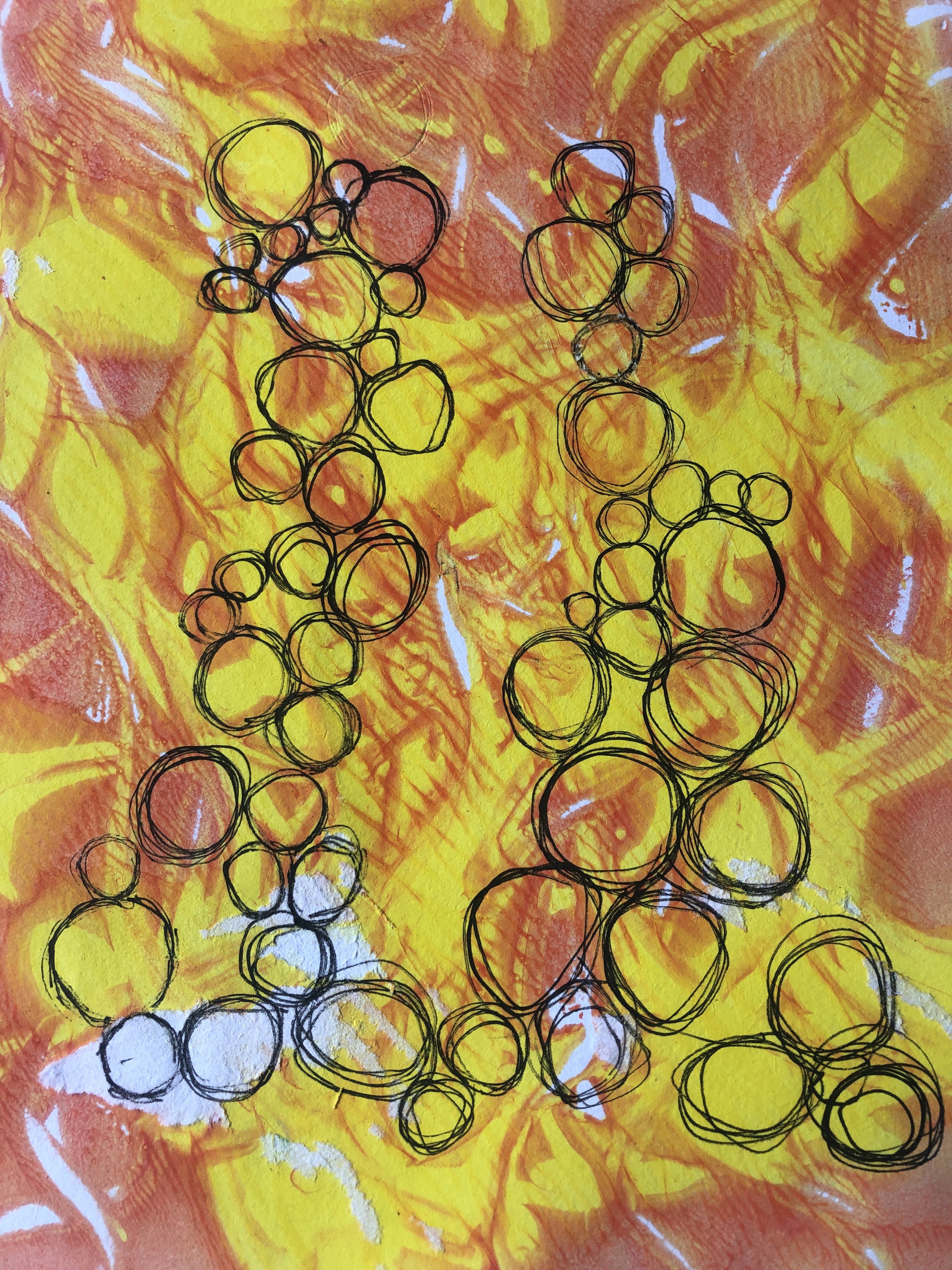
I began looking at mark making and to try out sketches of Noda’s knitted work, I used black ink to test out different media and used twigs, a turkey feather quill, a cardboard straw, a quill made from a fir tree twig and a wooden spoon handle (see left image). I then used a paintbrush to try and replicate the knitted sections of Noda’s work. I was looking at the structure of knitting, circles and loops as Noda’s work is fragile, interlinked and loosely made and some of the links look almost transparent. I had seen that Noda’s red and yellow pieces looked spiny and thorny and that they seemed more structured and stronger. I also did a black line drawing looking at the interlinking of small and large circles.

I completed further work on this and looked at how different fabrics interlink and painted a piece of hessian to show better to how the hessian adapts to colour and to show its strength against a piece of naturally dyed cheesecloth. I used a piece of sequin waste to show its preciseness and again how strong it is. I think this could be very effective if different yarn and strings were threaded through it.

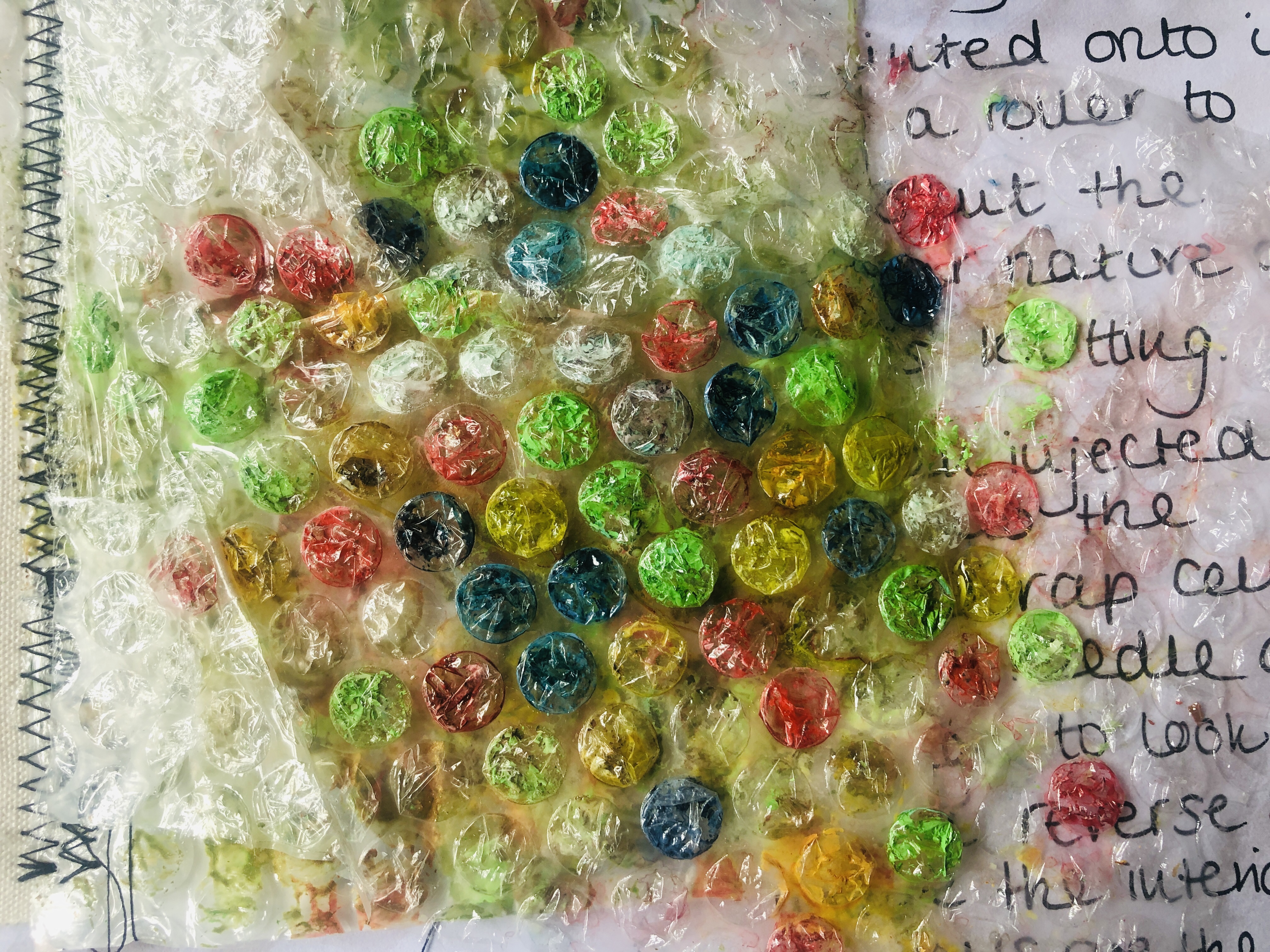
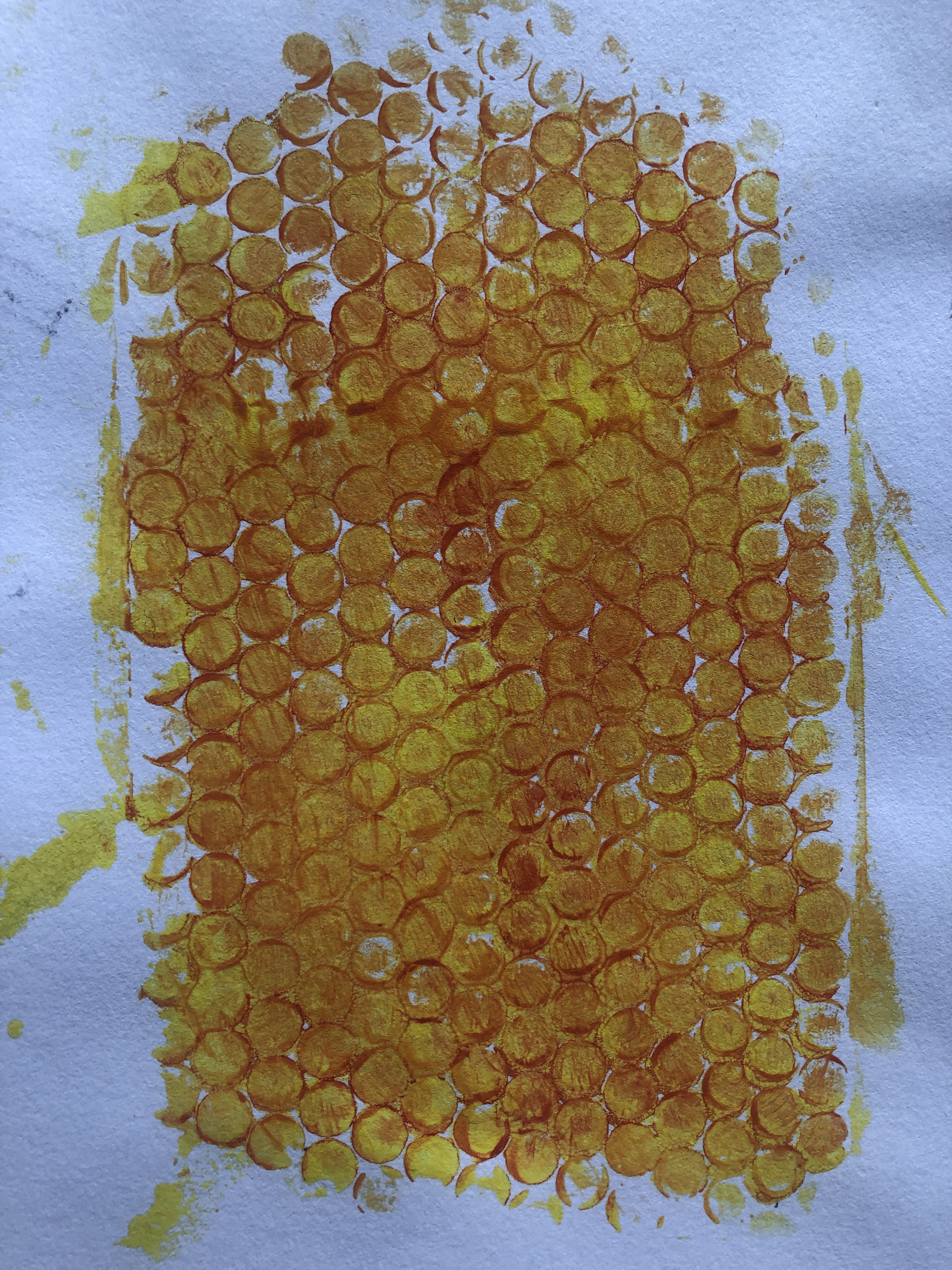
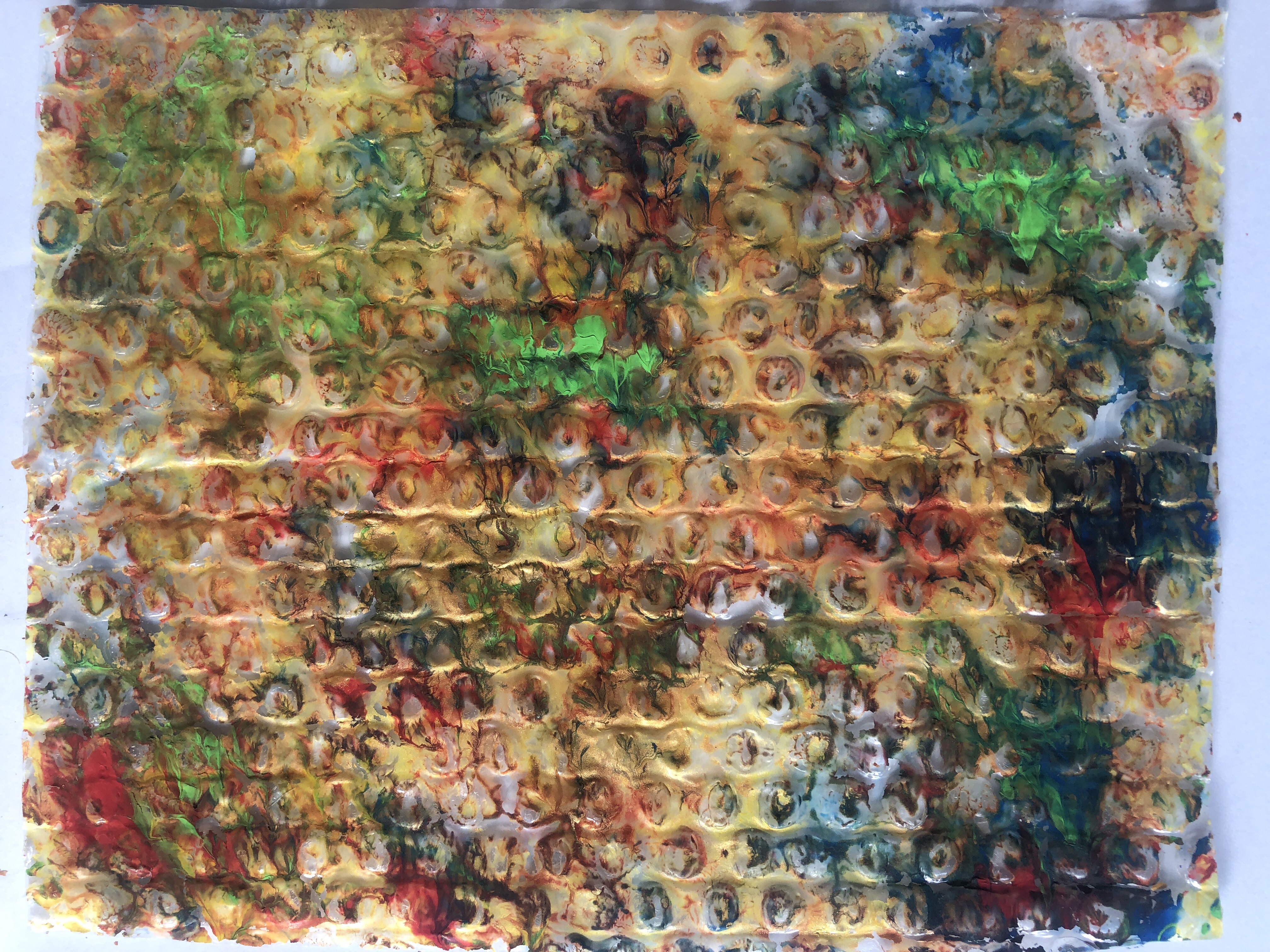
I moved onto bubblewrap as I planned to use this in my Gelli plate printing and painted onto a section of bubblewrap from a padded envelope and was interested on how the colours showed up the pattern. I also obtained a hypodermic needle from my local vets practice and injected thinned paint into the bubbles on the more flexible wrap and I really liked this effect although it was very fiddly to do.

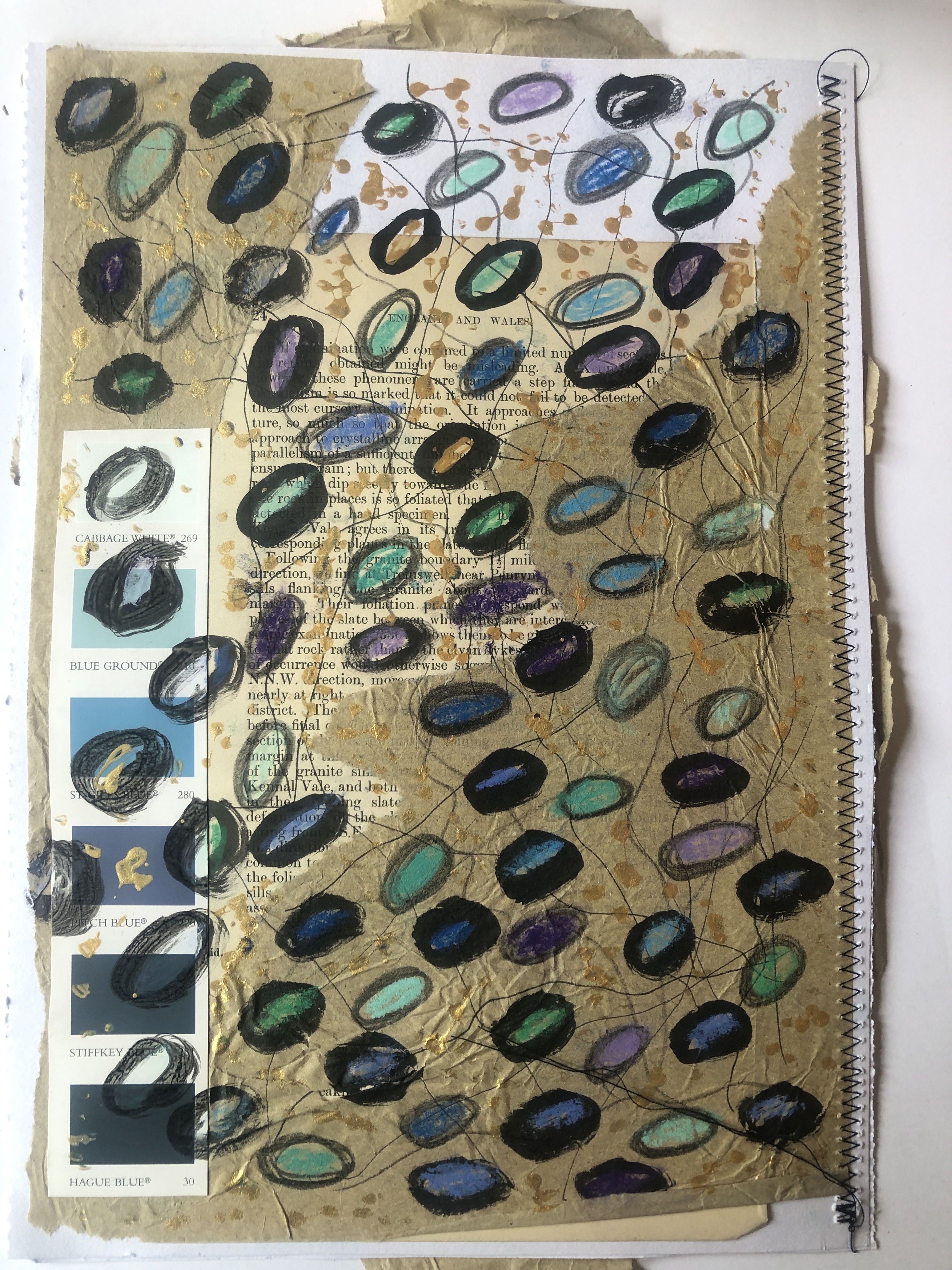
I then drew circles using a brush and black ink and used a cork to stamp different colours of paint onto a piece of card and I wanted the colours to semi blend together to create a more structured look, I used some gold paint too and the reflection of this was highlighting areas of the piece. On another piece of paper adapted with some brown packing paper and a book page I drew loops and added drips of gold paint which worked well when I had added chalk pastel inside the loops.

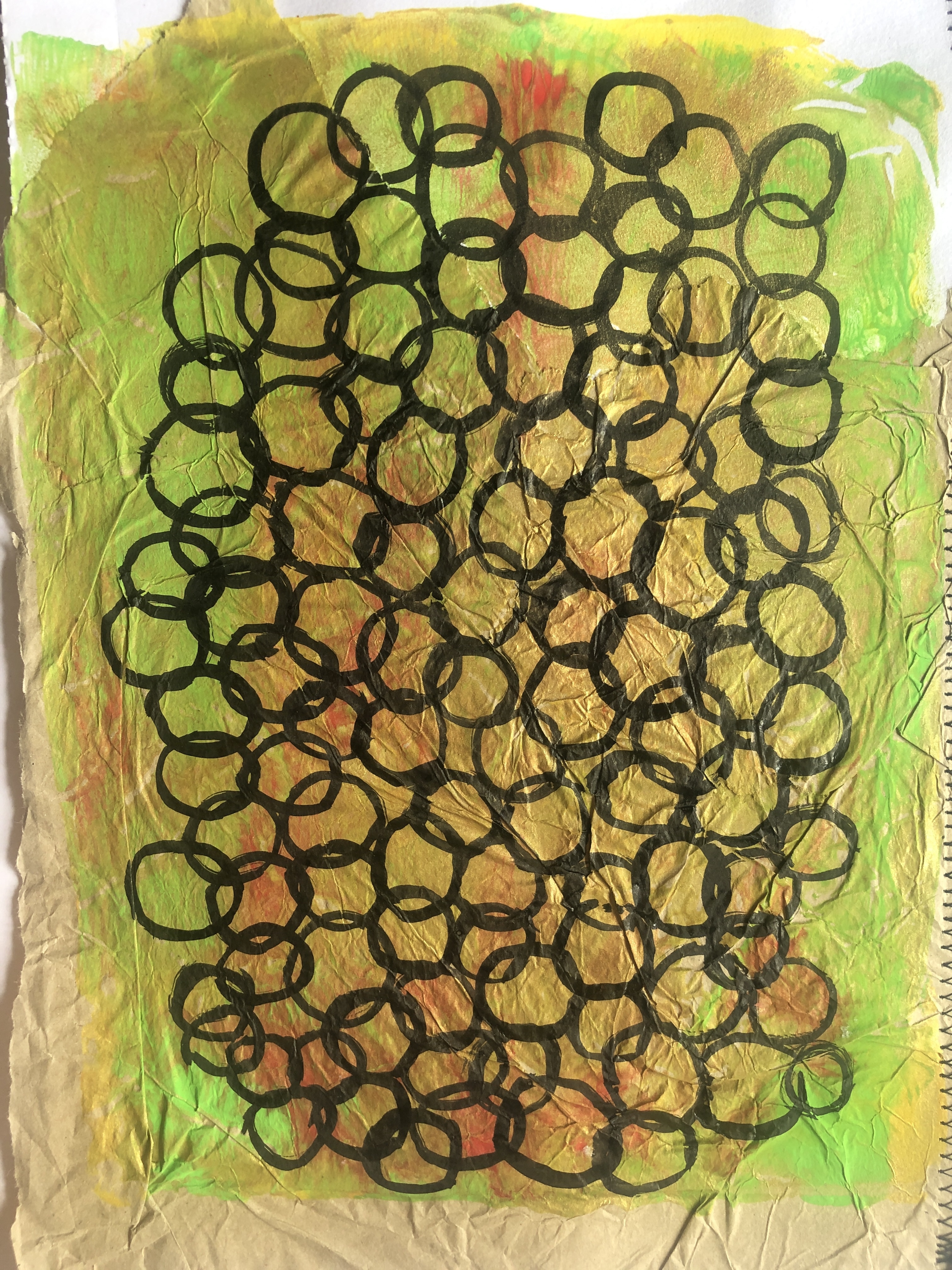
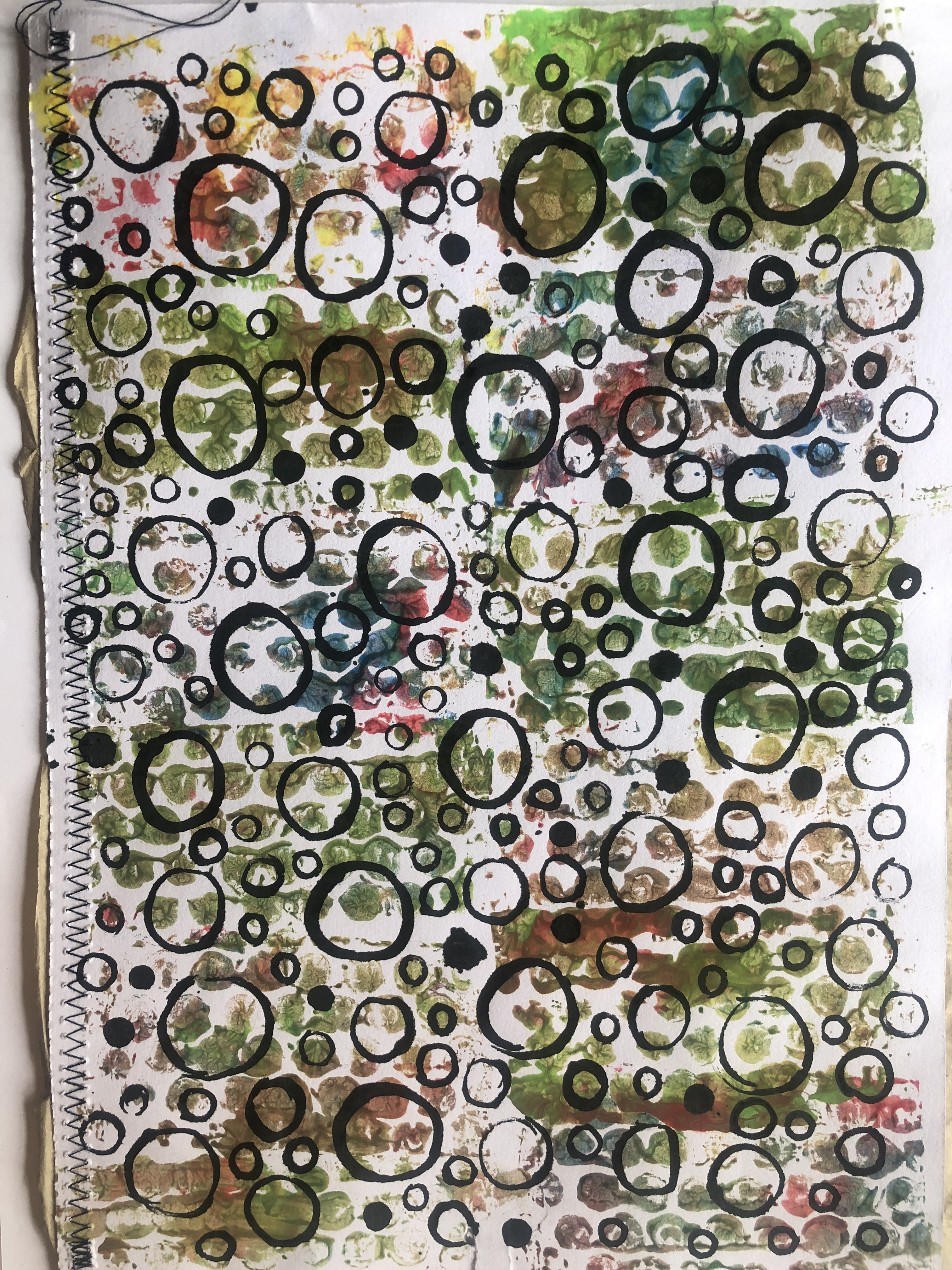
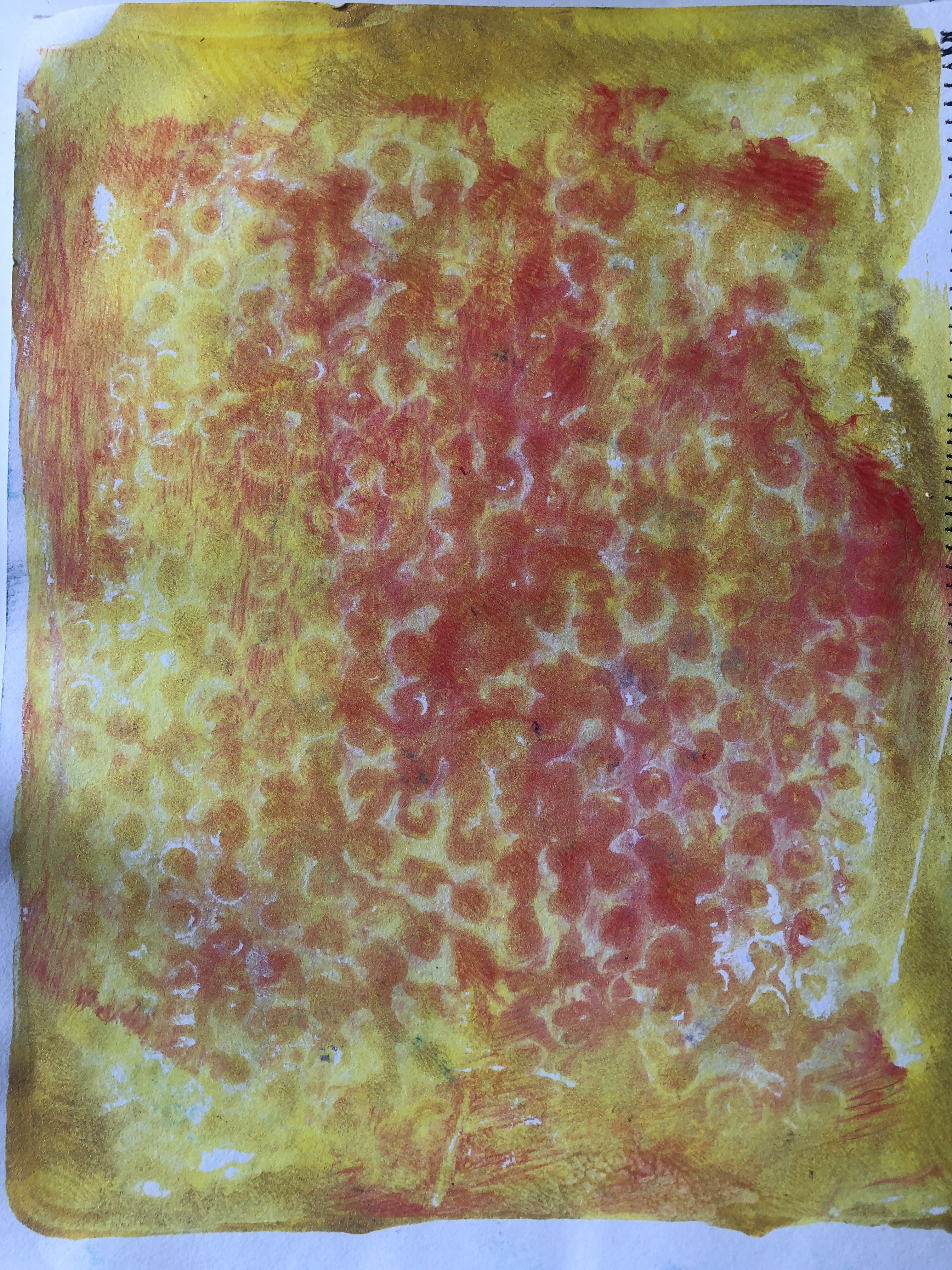
I moved onto a new page and this time painted a background onto brown packing paper and then drew a lattice work of circles over the top, I felt this was more successful than some of my other sketches as it looked bolder. Then I rollered a mix of colours over bubblewrap and used it to print onto a new sheet of paper and drew circles over it. I liked this one better as it looked more like Noda’s jumper.

I decided it was time for some sketches from the other examples as I needed a fresh approach and using the Gelli plate I rollered on paint and pressed paper on it to see how it would interact with colours. I then did a continuous line drawing in black pen. To me this sketch looked less like a cartoon than the other ones, I think I am often too rigid in the way I draw

I moved onto a different way to draw more like Noda’s work and again using my Gelli plate. I rollered more paint onto the plate and this time looked at a more simple approach and used the paper to make a series of plainer images.

I liked the image on the left as it looked fragile and like distressed fabric. The second left image was made using bubblewrap again and it did resemble a knitted pattern but in the form of a negative pattern. The image on the first right was again made with bubblewrap and gave a more honeycomb effect as did the second right which was made by painting again on the Gelli plate and this time pressing the bubblewrap on the plate.

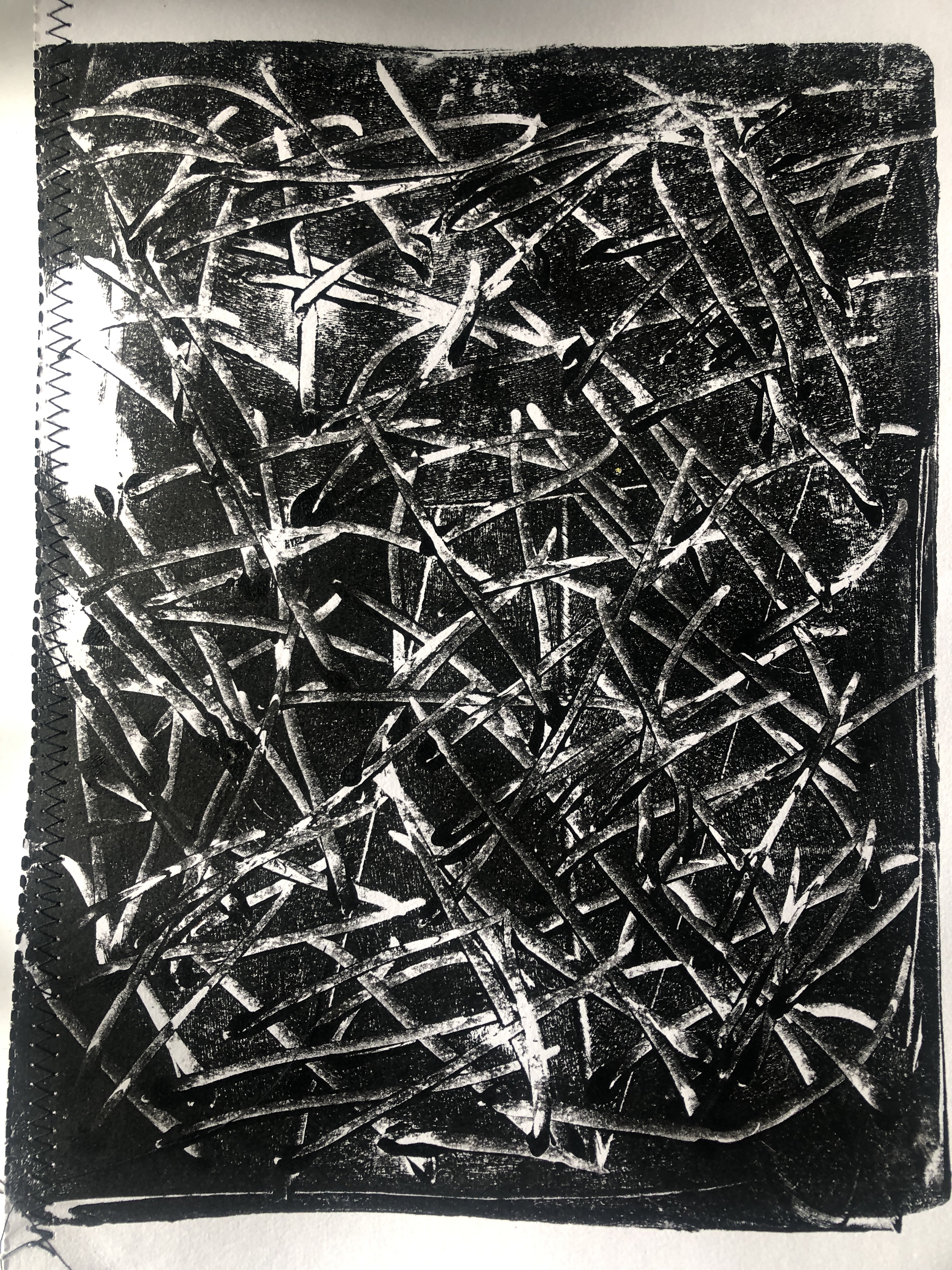
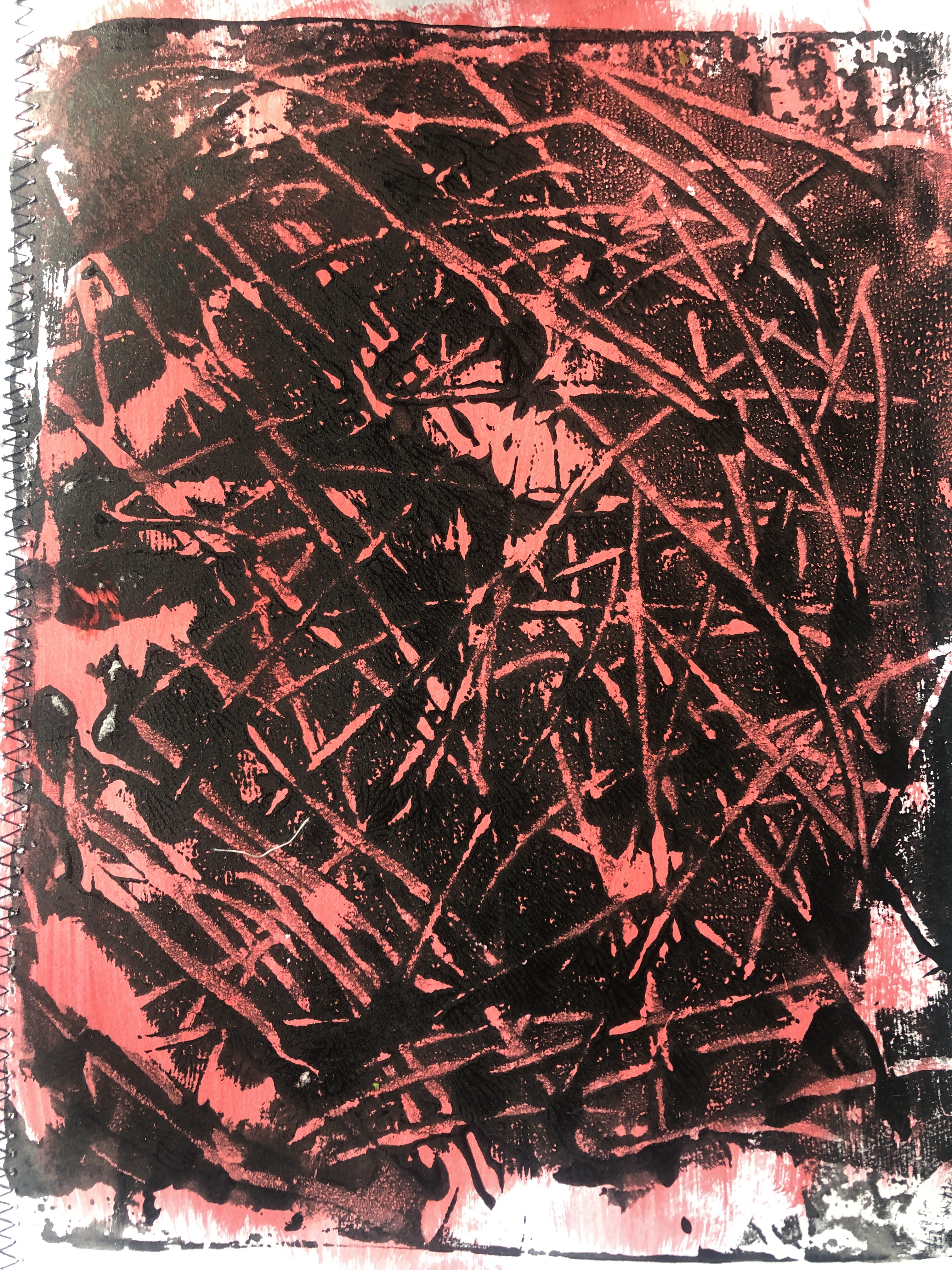
I wanted to make a more “spiky” image and having added paint on the plate I drew into it with a chopstick, I repeated this to create a series with different colours to try and find out which looked the most like Noda’s blue and green jumper.

My favourite was the monochrome image as it was negative mark making which I like to do. I thought this was bolder than the other two but I would have liked to have then used blue paint to colour in the marks.

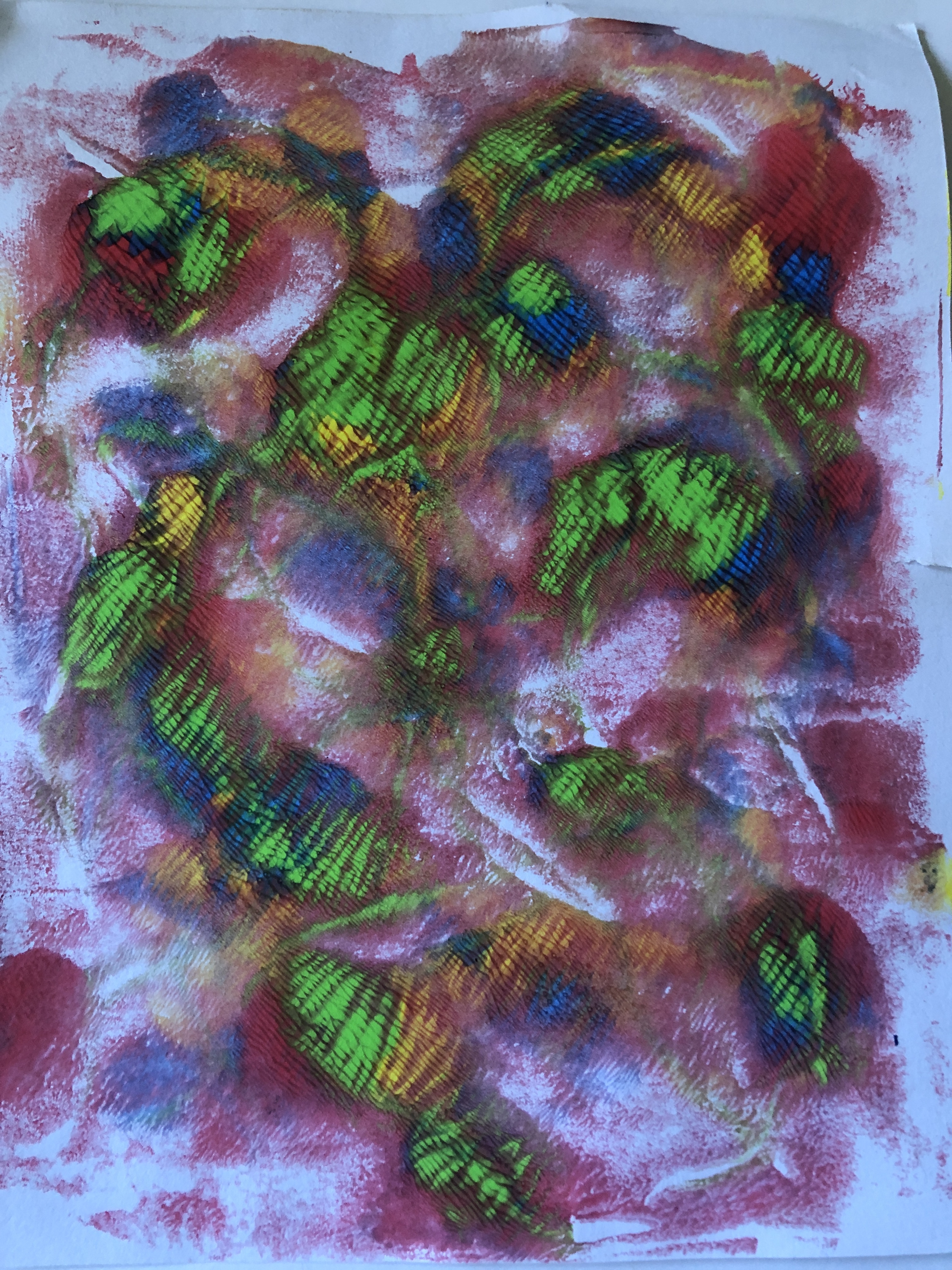
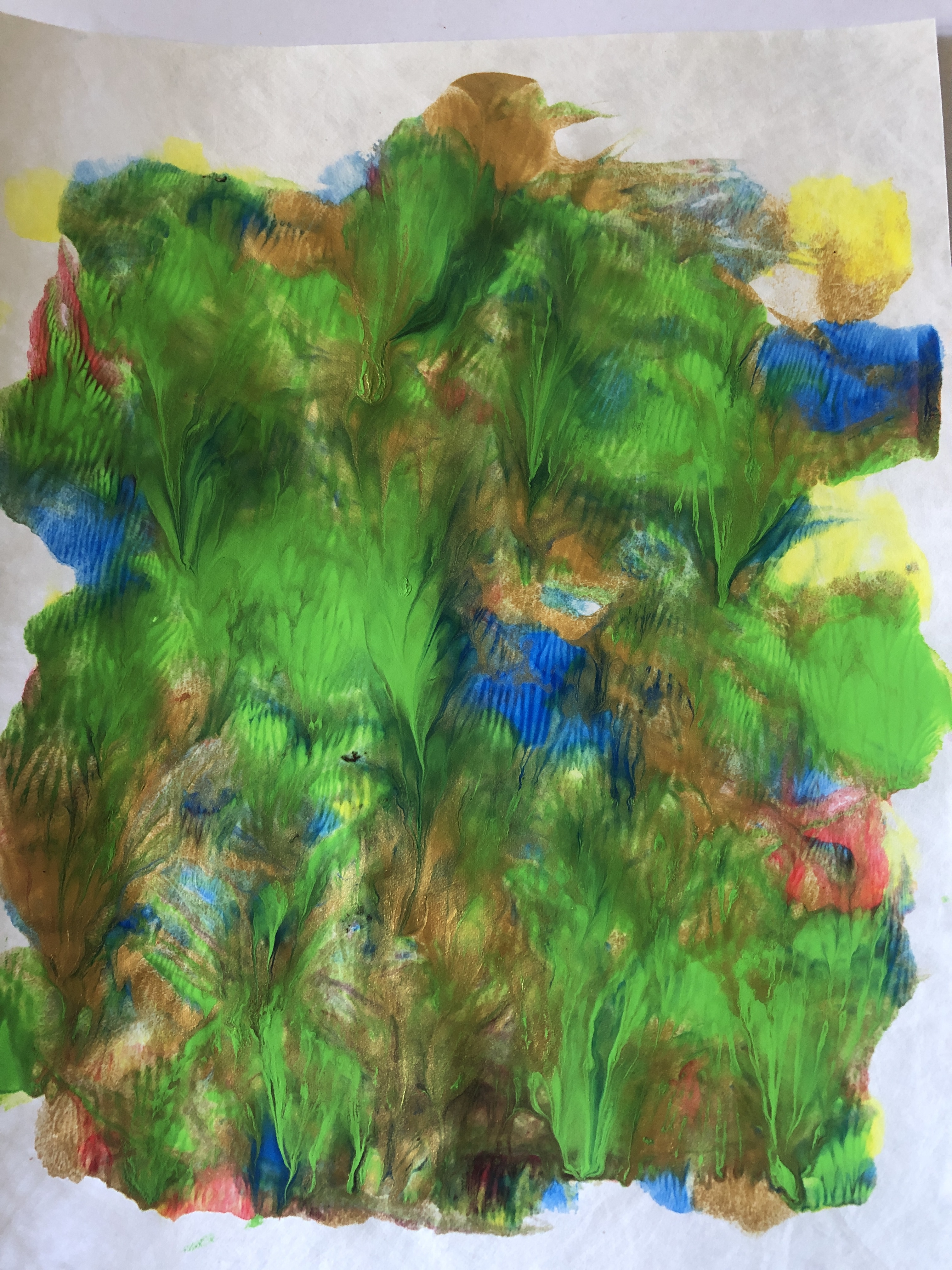
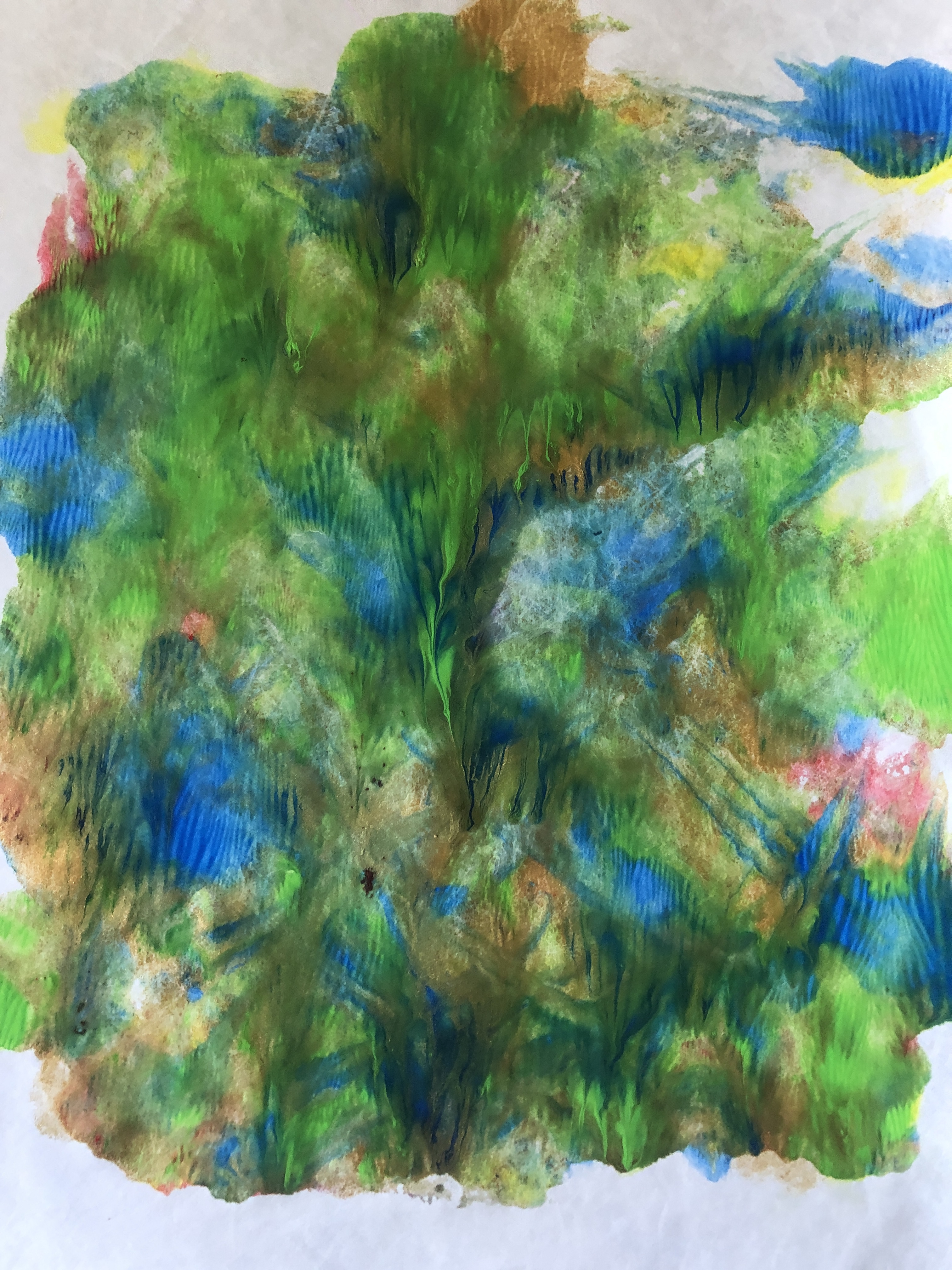
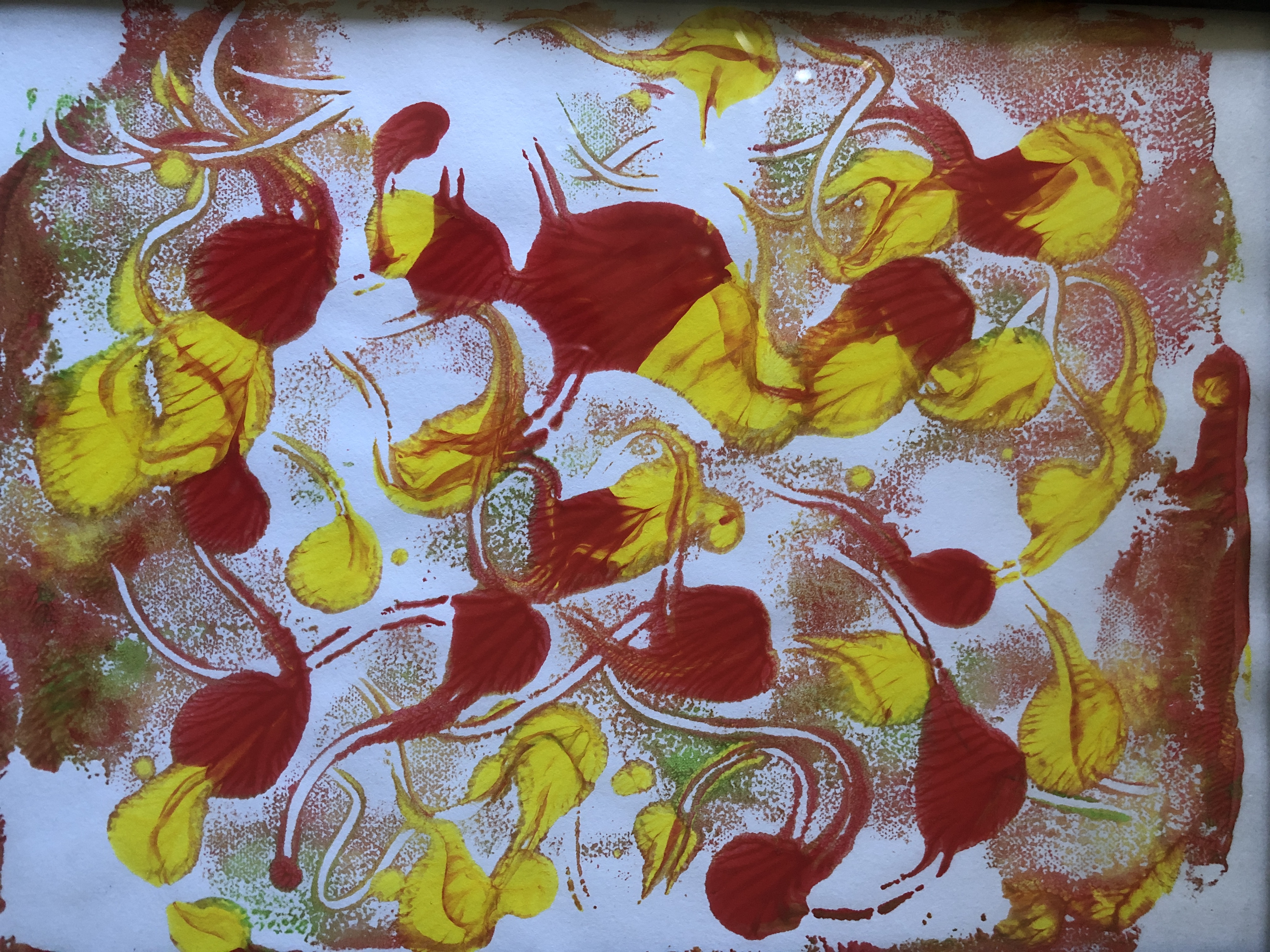
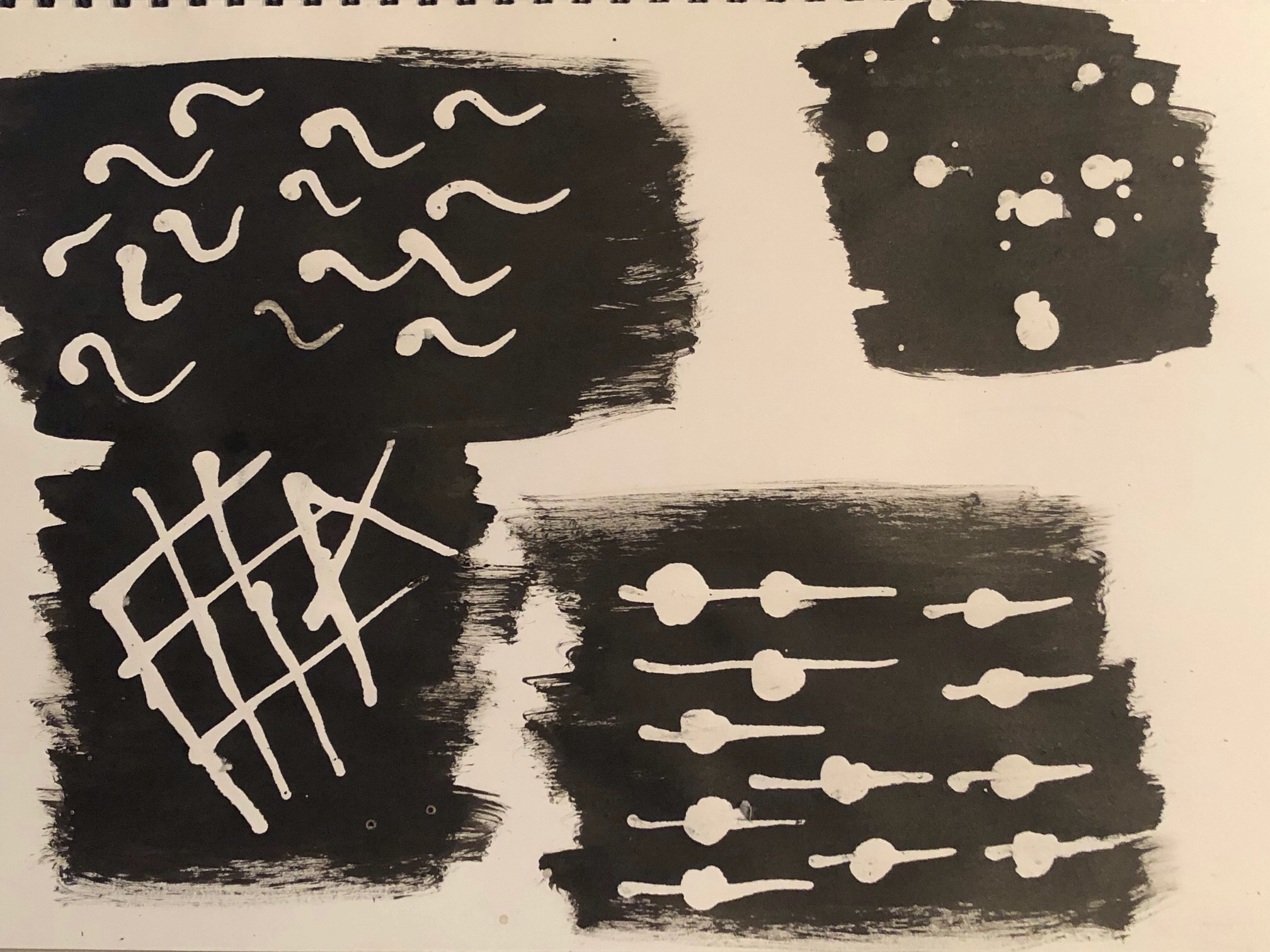
I moved onto using the paint in a different way and put random spots of paint on the plate and instead of using the roller I pressed the paper straight onto the plate to see what would happen. I really liked what it produced as it created new shapes and in particular some of the pages looked like abstract paintings of bushes and flowers.

The red and yellow image looked more like Noda’s knitted art and a better interpretation of the texture too. I had really enjoyed researching her work and the story behind it.

Part Three Materials

Reflection on feedback from tutor

Having completed Assignment 2 I received feedback from my tutor Lizzy Levy. I was pleased that my tutor has seen that ‘a strong development has been shown within research where you are interpreting artists’ works well with personal opinion alongside very relevant facts’. My tutor did advise that I had gone off the brief when I had taken risks as ‘there is a method within this brief to encourage playful experimentation rather than a narrative’ and so on this next assignment I will try and work to what the brief asks. I think I am perhaps taking too many photographs of my work but I had wanted to chart my progress. My tutor advised that ‘Taking elements of a kitchen appliance rather than the whole may have also led to innovative pattern and collage making”, something which I had not always done but now will take this on board and try and work from this perspective. I did agree with my tutor that I need to spend more time on my images and to crop and make them neater.

My tutor agreed that my reflection of a couple of my collages that “sometimes less is more” as the stacked bowl collage was too busy and should have been less complicated. I certainly understood more from my tutor’s feedback about ‘Consider working in series, such as making one and then extending this in differing ways to really stretch the parameters of an idea before moving on – think of a series of 3 to 5 versions. This will also promote your work having more cohesion such as a ‘collection’.’ 

I did feel that this made more sense as I think I was trying to make as many ideas as possible to fit the brief when this was not as necessary. I also need to consider using a colour palette. I had been using my sketchbook for development of ideas and my tutor suggested that I ‘explore building mini collage works within sketchbook pages to investigate composition and colour palette’. My tutor also encouraged me to continue with my research into the practitioners of the art world and their place with that world and their methodologies to then respond with my own thoughts, reflections and interpretations and to use this to inform my own ways of working.

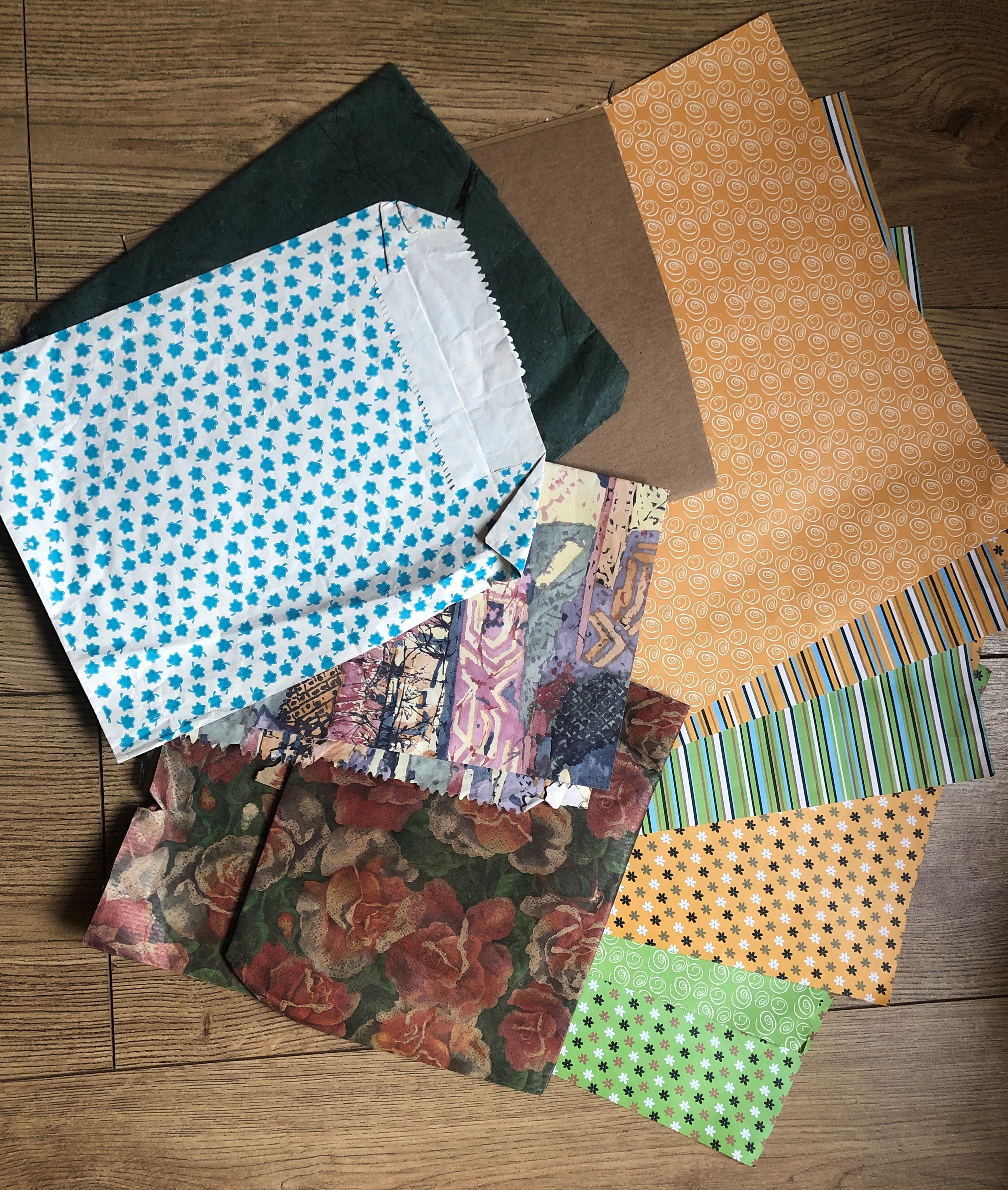
My tutor added links to websites for suggested reading and has chosen artists who I will be really interested in as I enjoy repurposing and finding new ways to do this. I can honestly say that I now view bits of used paper in a totally new way having done the collage assignment and that I am now adding to my existing stock for future use.

Exercise 3.1 Researching your theme

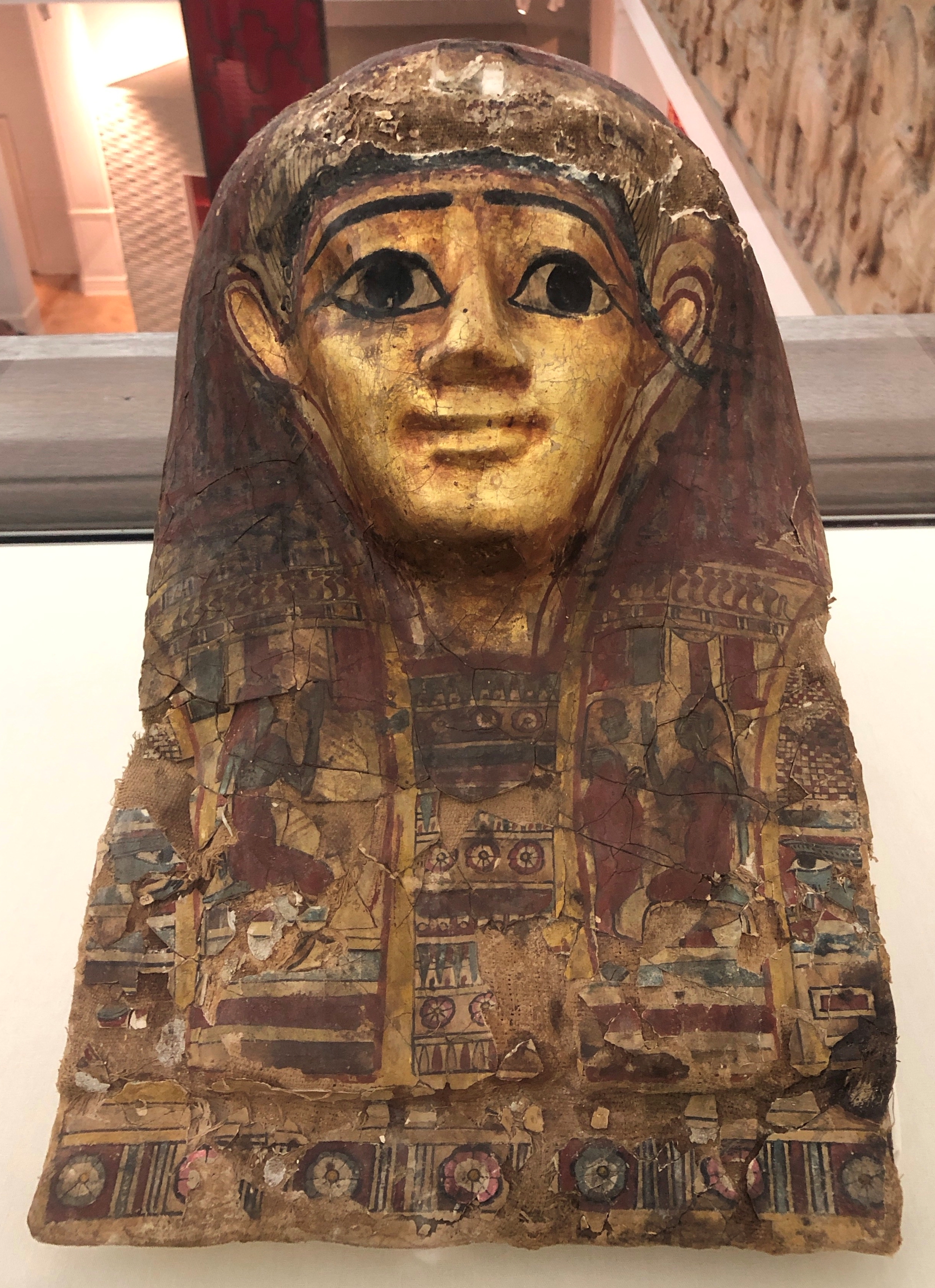
From the themes given in the course materials I chose ‘stacked and layered’ and my recent visit to Birmingham Museum and Art gallery had inspired my choice, in particular the beautiful mummy wrapped in layered bandages as well as a patchwork housecoat I also saw there.

Both examples gave me a better idea of how material can be manipulated into shapes and textures, repurposed and consciously used to make a diversity of imagery as well as an item of beauty. With this in mind I was keen to find out more about material manipulation and started my research on artists to further develop some of my themes.

Hsiao-Chi Tsai

I researched several artists to prepare for this assignment and began with Hsiao-Chi Tsai as I have a book entitled “Textile Designers at the Cutting Edge” by Bradley Quinn (p. 206-215, Laurence King Publishing Ltd, 2009). Tsai had studied textile design at the Royal College of Art in London and likes to work in large scale installations, having collaborated with a sculptor named Kimiya Yoshikawa who gave her knowledge of three-dimensional construction. This produced a set of sculptures called “Futuristic Flowers”. Tsai works with a wide range of media and in particular lycra, felt and polyester as well as foam, plastic, sheet metal and ceramics.

(left to right “Art Deco Collection” and “Futuristic Flowers”)

(source: http://www.tsai-yoshikawa.com/hsiao-chi_tsai/portfolio/)

“Walking on the Lake” (source: http://www.tsai-yoshikawa.com/hsiao-chi_tsai/portfolio/walking_on_the_lake).

I have always admired the work of artists who design three-dimensional art on a large scale as it interests me on how the pieces are put together and also how they stay in place, when I have visited art galleries and seen installations they convey so much from so many different angles, especially when combined with differing types of light.

Laura Moriarty

I happened on Laura Moriarty by chance when I was looking for Lauren Moriarty, I was really intrigued by her work and the collection entitled “Underworld”, the layers and colours used reminded me of volcanic rock layers and coral and flowed and ebbed just like live coral. Laura Moriarty used molten beeswax to produce her work and also ‘makes process-driven sculptural paintings and works on paper whose forms, colors, textures and patterns result from the same processes that shape and reshape the earth: heating and cooling, erosion, subduction, friction, enfolding, weathering, slippage.’ 

I enjoyed looking at the photos of Moriarty’s work and found the colours, folds and layering so inspirational. I would like to make a similar piece in felt and with beading so will add these concepts to my imagery file.

(Source: https://www.lauramoriarty.com/sculptural-paintings/)

Underworld 4
Underworld 2

Laura MoriartyUnderworld 5, detail

Machiko Agano

Machiko Agano is an Japanese artist specialising in master weaving artist and is known for her elaborately woven structures usually created to be installed in a specific space. Most of Agano’s works use translucent or neutral coloured materials to portray fragile and delicate themes. When I was researching for this part of the course it made me realise that I wanted to use colour for my fabric samples to give the creations more interest and depth.

I particularly liked the rippled piece below, it did remind me a little of the wired ribbon used in floral displays but I found it interesting and compelling to look at due to its complexity and size. To create each little circlet of fabric and twist each piece must have taken both extreme skill and patience.

agano machiko - woven installations-4

agano machiko - woven installations-3

The above piece was beautiful to look at as it is so fragile and delicate and also seemed to be almost antique. I have always found aged material fascinating, hence my large collection of vintage lace. Some of the lace is from the 1920s and 1930s and I like the imperfect nature of the older lace. I can imagine how imposing a large installation of this weaving by Agano would look and I would have liked to have seen how it looks in colour.

(source: https://trendland.com/machiko-agano-textural-installations/)

Exercise 3.2 Sample ranges

 Stage 1 Material tests

From the given list of materials I chose plastic and calico to develop as a sample range, I wanted to try two very different types of material and also as I had never experimented with plastic before and it sounded interesting. I had collected a good quantity of cellophane wrappers from chocolates at Christmas and also plastic bags and based my sample range on thinner plastics such as these as I thought they would be easier to work with.

I decided to begin with applying heat to the plastic pieces to see how they would react. I boiled a piece of a white thicker plastic bag in hot water but this made it floppy but did not change it in any way so I then held more pieces of plastic bag over the gas burner and I was interested as they curled up and scrunched closely, I then sewed them together in layers and the end result was a robust form which could have potential in a larger scale if also a mix of colours was used.


I then took a paint stripper heat gun and arranged the pieces of coloured cellophane and stuck them down with Sellotape and after applying heat, I liked how the cellophane changed shape and size to great effect in stacks and layers and how it became three dimensional, also that the Sellotape melted into strings and held it together. I wondered again how this could work on a much larger scale to perhaps depict a theme such as a portrayal of reducing waste and the effects of single use products. I tried mixing cellophane with blue plastic dress netting and again used the heat gun. The result was intriguing from a textural point of view as some of the netting melted into holes to reduce and take away and I imagined how this could look as a mixed installation but I did not feel it was as interesting as the first experiment.

Choosing calico as a background, I stapled cellophane pieces to it to layer and stack it and again used the heat gun. I saw the cellophane pieces reduce and change shape and liked how heat changed the colour, producing an almost tie dye effect. img_6562

Using the thicker plastic bag I tried ripping and tearing it as well as perforating it, it did not seem very interesting apart from when I used my fingernails to stretch the plastic which made little peaks and I liked how this made layers from flat plastic.

I wanted to look at interlace and interlock next and so tried weaving strips of plastic bag in the way that a friendship bracelet is made, I did not feel with worked very well so then made yarn out of long strips of black plastic bags and knitted with it. This gave a far more pleasing result and I particularly found it surprising as the knitted square was very strong. I would have liked to have tried this on far bigger needles and large sections as folded over into a tube gave many more possibilities into how this could be used as a construction.

I rolled plastic again and created a coil effect when sewn onto paper and again I could see that this could be taken further and might be able to be sewn into a coil pot. I tried cutting plastic insulation fabric into strips which gave a delicate fringed effect but I did not think this was worth further development. Machine sewing was difficult due to the plastic being thin and tearing easily but using the red thread gave a focal point and I think I may try this idea in the future.

I moved on to testing calico and wanted to create a colour palette rather than just use the fabric in its plain state as a mix of colours would create a more defined look layered or stacked and would make it easier to look at. I made natural dyes from rusty nails in a jar of salty water, nettles, avocado skins, beetroot, spinach, orange peel, white onion and red onion skins. I noticed that the orange peel, spinach and nettle dyes were far more sublime and so decided to use the bolder colours, especially as I wanted to have an overall theme of aged and distressed fabric.

I began by perforating the fabric and also using heat to see how this could work. Applying heat with the paint stripper gun made the calico shrink and bubble a little in shape and burning the fabric did not interest me enough to consider working further using heat. I used a lighter weight calico for the perforation and liked the idea as it distressed it a little but I wanted a more dramatic result.

Knotting and coiling thin strips of calico was unusual as was interlocking but again I did not think it was enough for me to want to explore further at present.

Slashing and tearing the calico did interest me and I felt I had successful results with this as I liked how it complemented the use of the range of colours I had. I tried stuffing a torn piece of fabric with lots of threads to make it puff out a little and it reminded me a of a barnacle. I also tried visible mending and sewed lines in a Sashiko theme which is a Japanese method of stitching which translates to “little stabs” and was used primarily to reinforce or repair worn sections of cloth, which then developed as a decorative stitch. Sashiko is often used with red thread, so I sewed with red thread also to bring a historical element to the samples. I felt these worked very well and I wanted to develop this further. I also sewed a net type effect on one sample to pull the slash detail back together.

I pleated and layered more calico and liked how the colours interacted when doing this and I wanted to look at this in more depth in the next few samples. I then tried machine sewing to try and gather the calico into pleats but this did not give the desired effect. I returned to the list of techniques and tried interlocking by weaving torn strips of fabric with cut plain fabric and it gave a nice checkerboard style.

I wanted to try some more three dimensional experiments and so made calico into thin pencil-like rolls and sewed them with visible mending onto a plain background of heavyweight calico, I really enjoyed this and so then stitched by hand stripes of fabric which I then sewed into to make a honeycomb type structure. This made me realise more that fabric does not have to be flat and I could see that this over a much larger scale could be very dramatic. With this in mind, I cut strips of heavyweight calico into strips and stapled them on a background piece with a stapler, it really gave a thick ruffled effect and I was surprised at how efficient and pleasing this was as it looked very vintage.

I wanted to look further into layering and so took heavily dyed calico to try out a few ideas. I arranged pieces of different coloured material into a stack and sewed them together into a bundle and was very pleased with the ragged appearance. I liked precise sewing for some of the items I make for my home and to sell but this was a chance to really experiment into some of the textile art I have admired on Pinterest.

The flat layered add/take away test piece looked very fragile due to the colouring and I decided that I wanted to carry these examples into further sample development.

I made a final sample using additional materials and items. I used the paint stripper heat gun again and melted a plastic fruit net onto calico to see what it would do. I found it fascinating as the net reduced in size, fused and pulled the calico closer together in a similar fashion to smocking.

img_6559

Stage 2 Sample development

I chose the theme of ‘stacked and layered’ for the main basis of my sample development as I enjoy working with textures as well as sewn effects and I decided to use calico in mixed weights giving more variety and ability to produce structured layers. I made a few sketches in my sketchbook for ideas for both calico and cheesecloth.


I began by cutting a piece of calico of the size needed and put covered dress buttons underneath and held them in place while I knotted thread around it from above. I repeated this over and over again and saw the fabric shrink, pleat and layer and the upper surface looked almost alien in pattern.

It was very interesting to see how the technique shrank the fabric and I liked the feeling of holding the piece as it reminded me of stacking pebbles from when I had visited Cornwall a few summers ago. I was delighted with this result and wanted to develop this further as it had ongoing potential.

img_7368

I chose a much bigger piece of calico and used flat buttons of varying sizes and again tied them using thin string. I liked the look of the stacks and thought I could develop this further by stacking the actual buttons.

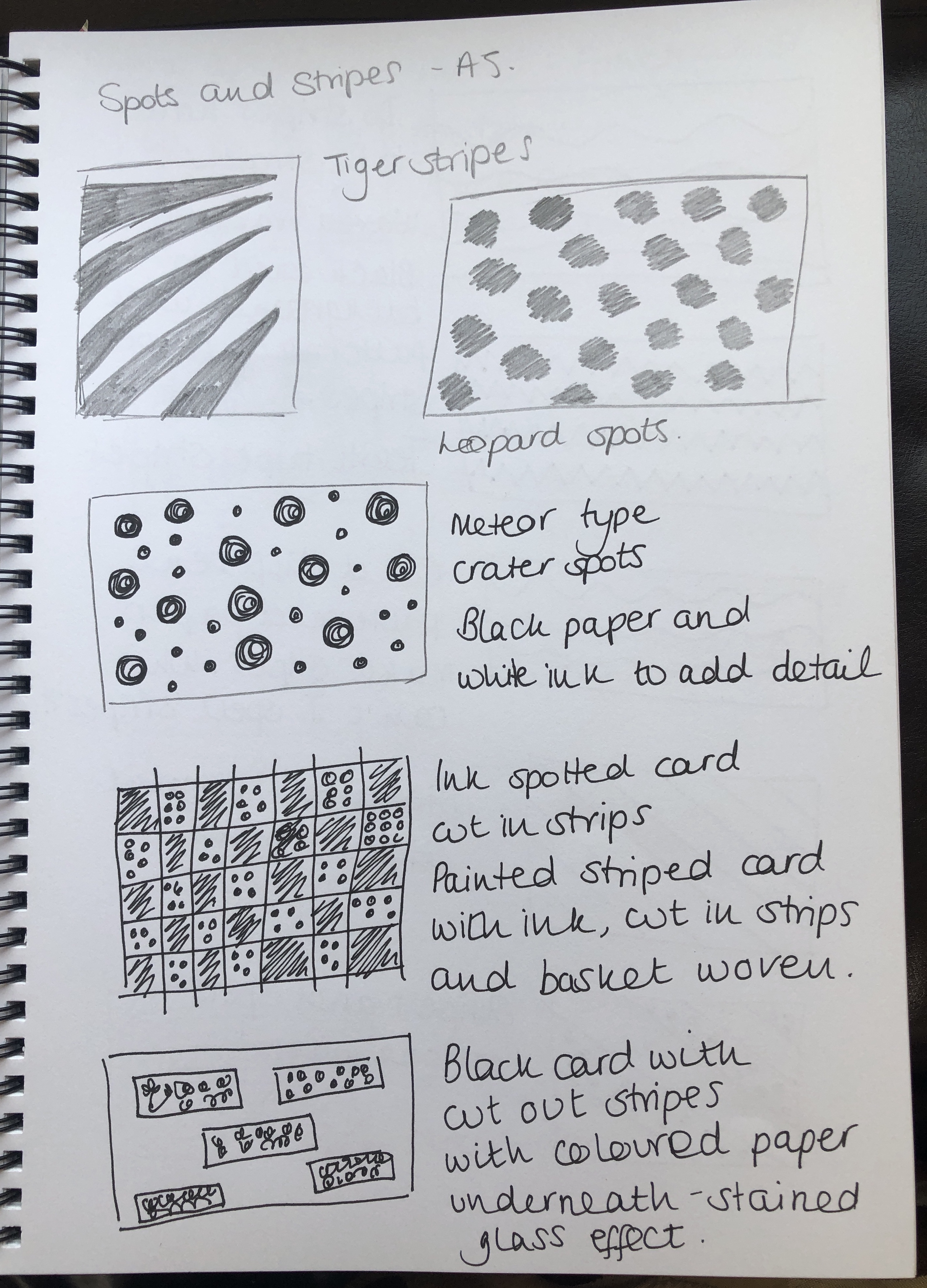
To follow this I repeated the button stacking and liked the way this gave the fabric more height as well as layers. The buttons have been successful in terms of the stripes and spots requirement in the course materials.

I wanted to try free motion embroidery and cut circles from heavyweight calico and layered them on a backing piece. I sewed onto some circles prior to attaching them onto the backing piece and left some not fully sewn down to give interest. I used a colour palette to give more definition as calico is such a neutral colour. What I did find from this sample was that both sides of the fabric worked well. My sewing machine is quite a basic model and was not too keen on the free motion sewing but I have another machine that I may set up to see if I can do more drawing with stitch.

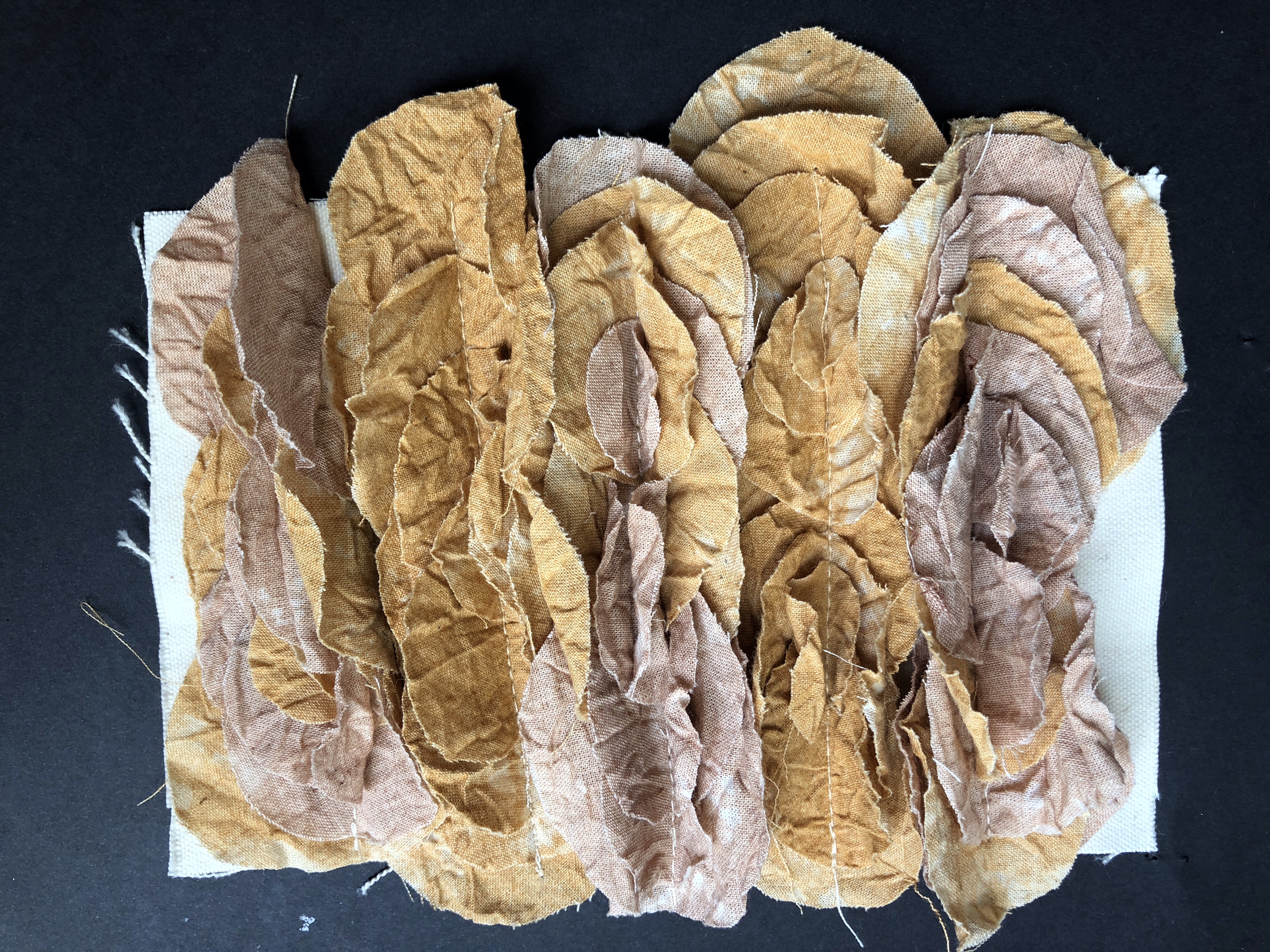
My next samples were again spots and I cut out many different sized circles and layered them onto a backing piece then sewed a single line through the middle of each set. I wanted this to be tactile and lightweight to resemble petals. Having completed the first sample with plain calico, I tried again with many more circles of varying shades of colours from my homemade dyes. This time the sample worked far better as the fabric was crumpled and the colour and shapes reminded me of fragile autumn leaves.

I wanted to experiment with stripes and ripped thin strips of calico and layered them onto a heavyweight calico background before sewing them with my machine using red thread. I liked the simplicity of the stripes but wanted to reflect back to Collage and so constructed a herringbone layered piece using the hand dyed fabric to help pick out the sections. I thought this piece was very successful and liked the distressed look it gave.

I wanted to try and build a similar structure of the Egyptian mummy’s intricate bandaging which I viewed at the Birmingham Museum and Art Gallery, so tried a piece in plain calico and machine stitched close to the edges to try and give definition and accuracy. This worked well and gave a crisp angular finish.

I decided to try this again but with dyed heavyweight calico to see if I could make something almost three dimensional as this was the effect given by the mummy’s bandages. I sewed folded sections of calico and slowly built up into a pattern and leaving the inner edges unsewn so they looked almost padded. The finished piece was heavy and very defined which I really liked. I did not feel that this effect could be gained as well if torn strips of fabric were used as the placement needed to be very precise.


I wanted to look further into pleats and layering and so took heavily dyed calico to try out a few ideas. I folded pieces of different coloured material into a stack and sewed them together into a bundled and also layered colours of calico in size decreasing order for add/take away and I thought I it looked of great interest and also very distressed and old looking which was something I had wanted to convey.

Having completed samples in calico I then moved onto a second set using cheesecloth which is a very fine net, often used in straining or removing the whey from cheese curds. I wanted to try this as a sample range as I did find plastic net difficult to work with and my sewing machine objects to any fabric that is very thin and delicate in nature. I found the course materials very difficult to interpret at this stage as they instructed to choose another material to develop a sample range. Having looked at other students blogs, I thought it better to adhere to this instruction rather than risk sending half an assignment.

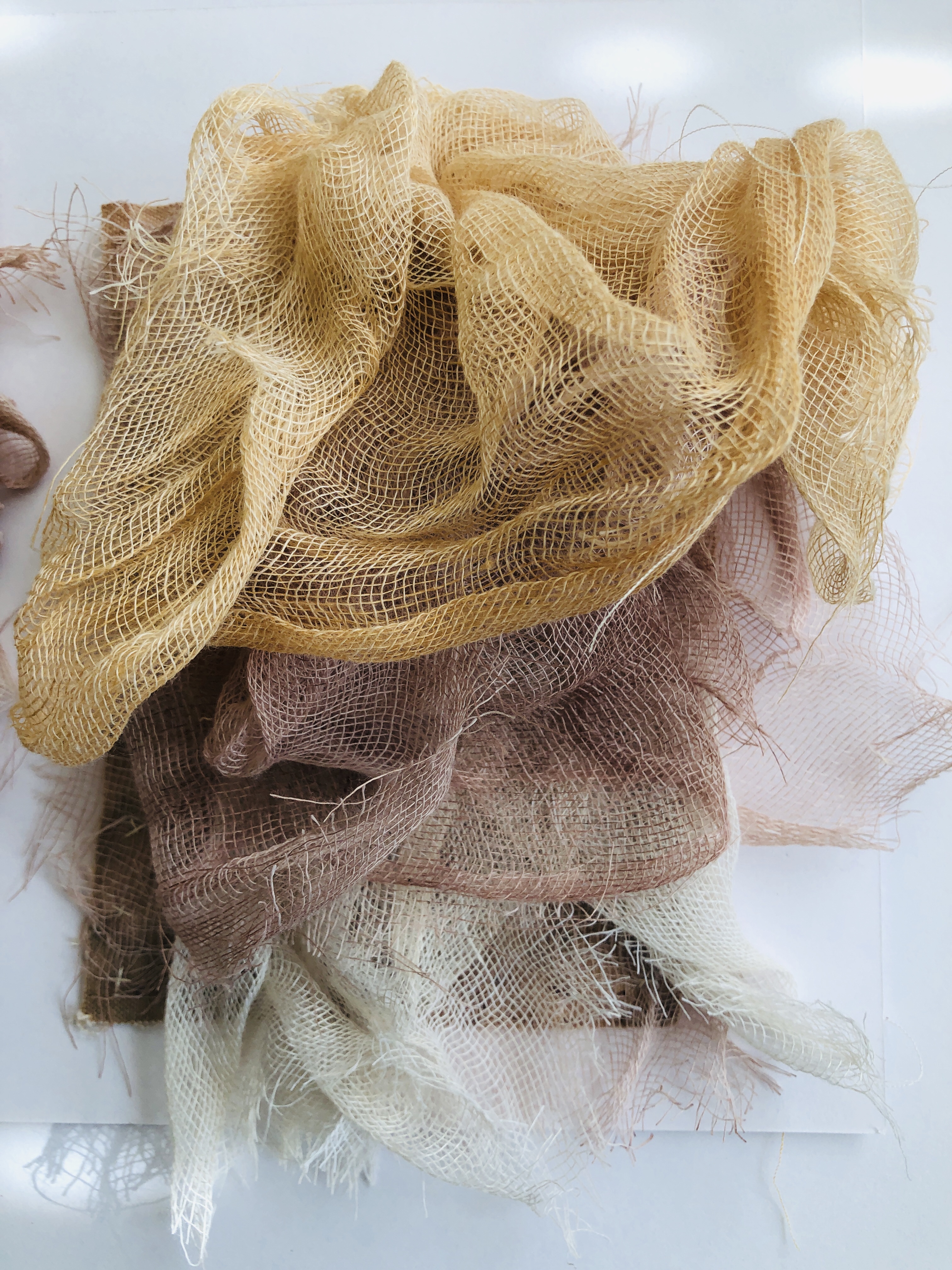
I wanted to dye the fabric I was using and so I used the nettle dye, rust dye, avocado and red onion dye to give more interest and I liked how the cheesecloth was less absorbent to liquid which is possibly why it is so useful when used in food preparation. I also wanted to try and make three dimensional samples whenever possible.

As the cheesecloth is so fragile I realised that I needed to use items to help sculpt it and so I took pipe cleaners and rolled fragments of different coloured cheesecloth over them to form mouldable tubes. With the theme of stripes and spots I sewed the whole tubes to a backing of calico to hold them in place and made a set of four rings and then a series of curved stripes which went in opposite directions.

As I worked I could see that I was mixing ‘fragile and delicate’ into my overall theme as well as ‘stacked and layered’ but felt they worked well together. I wanted to continue with this idea of using the pipe cleaners and develop a series, so I tried weaving the cheesecloth to create a stack and it reminded me of deep sea creatures although I did not want to label it as a jellyfish!

I liked how the delicate fibres were the main focus on this sample and felt it was a success due to the lattice I had created, plus the colours suited the sample well.

I still had to try another theme as I had an idea about ‘bulbous and inflated’ and wanted to see how this could work in a similar way to what I had made using the buttons and calico and so I made soft balls of calico and tied cheesecloth around them. This again reminded me of coral and underwater creatures and so this became my favourite sample of the series. It is difficult to see in the photos but the bulbous tubes are not sewn flat to fabric so they have movement when looked at and held.

I carried this on with a second sample where I had sewn the cheesecloth balls onto the calico to give a flatter and more arranged effect but I did not like this as much, although the ruffled effect of the three dimensional spots was interesting and side by side I thought the overall look was good.

I looked at some of my research for Assignment 3 and decided to try stacked and layered as this could work better with cheesecloth than it did with calico as cheesecloth can gather much more easily as it is so much thinner. I hand sewed cheesecloth to give a ruffled effect and then tried again with gathered pieces as a trio mingled together. The second piece reminded me of underskirts beneath an old fashioned wedding dress from centuries ago that had gently stained as it aged.

img_7561

For my final sample in the range I decided to mix calico and cheesecloth together and so I cut small slits in calico and added pieces of flat cheesecloth at the rear of the calico and then pushed buttons through it to give a spotted effect. The cheesecloth was very fragile under this kind of pressure and so the buttons did not hold in place very well but it interested me, however I preferred my other samples to this as this sample felt too simple.


Exercise 3.3 Presenting your work

Having presented my samples on white card, I tried to match them into similar themes and laid them out on a table to view them as a whole set. I had found that more fluid samples worked better with the cheesecloth and that the calico was good for defined and bold samples. The cheesecloth was excellent as a cover, such as the bulbous samples I produced but was too fine to use on its own as a three dimensional piece of great size.

I think I chose well with the two types of sample fabrics and also that I decided to move past the plastic test pieces as I think I would have exhausted concepts and ideas for this far more quickly.

Upon embarking upon Assignment 3, I thought it would be easier for me as I already sew and enjoy working with fabric however I found it very difficult. I don’t want to copy other people’s work and wished to come up with my own ideas but I almost felt that I genuinely had a mental block by the time I reached the end. I was disappointed by this but did enjoy working with the different fabrics and materials and finding that I was capable of making the three dimensional samples which I liked best of all. I think I am too used to working with set patterns and I found that I get more inspiration this way as to how to alter them or improve them. This however can lead to an approach that is perhaps too confined and less likely of achieving a really bold completed piece.

I think such samples could be used well within textiles for recycling fabric as I noticed straight away that once the calico was washed that it lost its stiffness and the waterproofing chemical and it had a new texture altogether. I believe this would be ideal for large scale art pieces or rugs and I think I had chosen the correct themes to match the fabrics I chose. The key things I would like to build on from this learning experience are to continue with material tests and to develop my liking for three dimensional work.


Visits to Birmingham Art Galleries 04/05/19

Having not yet visited any art galleries for research, I went to Birmingham city centre on 04/05/19 and intended to visit three galleries whilst I was there.

I began with the Birmingham museum and art gallery which I had not been to for years. As well as the many paintings, I wanted to see the “Too Cute!; Sweet is about to get Sinister” exhibition as well as the work of contemporary artists.  The “Too Cute!” exhibition was fascinating and I saw the use of various media and it was very inspiring.

img_5399

Some of the exhibits were certainly creepy and did provoke feelings of childhood nightmares.

I moved on to the exhibitions of contemporary artists and found it very interesting.

The above painting was by an artist named Patrick Hughes and is “Superduperperspective” (2002). The piece was an oil on board construction of paintings in a gallery, Hughes created thee-dimensional paintings which appeared to shift and move as your head moves to view it. At first glance from the right hand side where I was standing the painting appeared flat but as I slowly side stepped to look, the painting did move and it was such a strange sensation like the brain could not process what I was seeing. I liked how it was so clever and precise.

img_5414

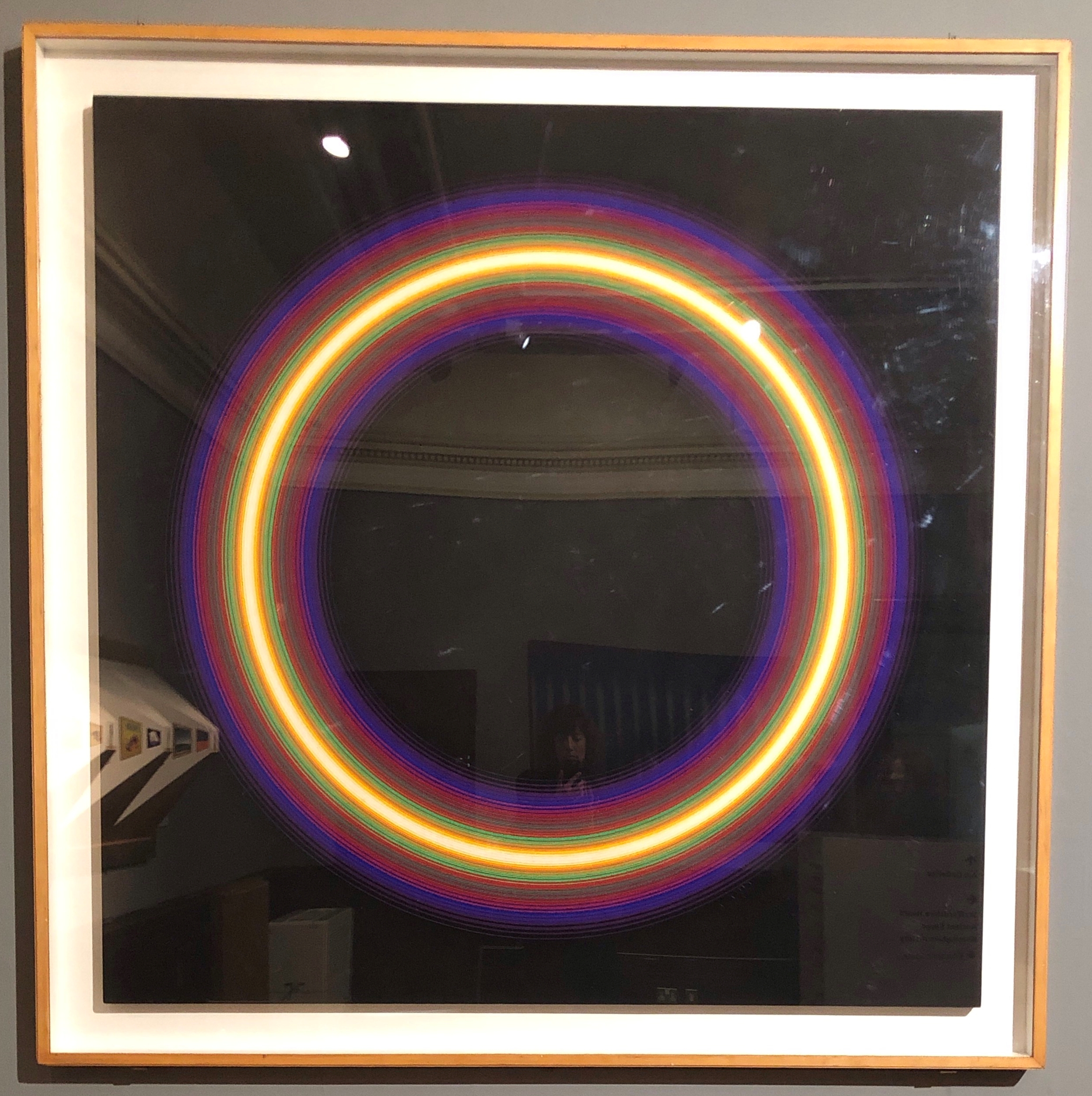
Peter Sedgley “Cycle” (1965)

This painting was done using acrylic paint and was created with the emphasis of the soft edged concentric circles pulsing with light and colour with the colours being main focus, again the effect changes when you move around it.

img_5416

Victor Vasarely “Permuatations” (1969)

The above screenprint again an optical effect piece, Vasarely was considered to be one of the originators of optical art, having begun experimenting with optical patterns in the 1930s, he was influential in the development of geometric abstract art. I particularly liked this piece as it reminded me of Assignment 2 Collage “Stripes and Spots” and what I was trying to create for the exercise. I could see how having a background of differing tones of the same colours could be used to great effect and I enjoyed looking at this screenprint.

I moved onto the museum section for Ancient Egypt as it is a time in history which has always interested me as I liked to see how advanced Egyptians were compared to other groups in  society.

img_5419-1

Nicoya ware vessel (750 – 1000 AD)

This tripod vase showed such beautiful marks and I liked the detail of the marks and the colours used.

img_5424-1

Funerary Mask (Late Period 664 – 332 BC)

This mask would have been used to be worn over the wrapped head of a mummy and was to protect the head of the deceased and also when the spirit of the deceased left the body in the tomb as believed by the Egyptians, then the spirit would be able to recognise its body from the face of the mask. The detail on the mask is incredible with the varying patterns and symbolic characters as well as the use of ancient language.

img_5427-1

Stone vessel of various types (Middle New Kingdom 2000 – 1000 BC)

This bowl had been carved out of stone and the surfaces on it were perfectly smooth, I loved the colours and texture which the bowl was made from as it really showcased the stone and again reminded me of mark making and collage.

img_5430-1

Arm from a wooden statue (New Kingdom 1500 – 1100 BC)

This arm was carved from wood and I was surprised how accurate the detail was and how well the arm was preserved. As good quality wood was so scarce in Egypt, large objects were often made in several pieces to avoid waste.

This mummy fascinated me and was possibly my favourite item on display in the museum as the bandaging was so intricate. Bandaging from the 21st Dynasty gave more emphasis on the elaborate full effect than preservation of the body within. The bandaging was held in place with gilded terracotta studs. I found the delicate bandages to be so beautiful and complex and it gave a three dimensional effect to the overall look.

I took a close up photo as I wanted this to be in my mind for Assignment 3 Fabric Manipulation of the course.

I moved upstairs to the exhibition of “Birmingham: its people, its history” as my father was born in Birmingham and was a small child when World War Two took place. The exhibition had artefacts from the war years and times of austerity. I particularly liked some of the vintage clothing on display as I really love dresses and clothing from the 1920s and 1930s and have a small collection of clothes from that era.

I like patchwork and in particular crazy patchwork where random shapes of fabric are sewn together. The hand stitching on the housecoat was both delicate and perfect and made a real feature of the coat.

The above dress is a tennis dress from 1910. I really liked the embroidery detail and it stood out from the rest of the dress as it was so bold in size and shape. The dress was very flattering in its shape but it must have been difficult to play tennis in.

I also viewed some pieces from the Industry section of the gallery and particularly liked the display of tile panels from the 17th century, handpainted and thought to be Syrian. The colours and styles made me think of pattern repeat blocks and I was drawn to the skill and detail of the tiles.

The next art gallery I visited was the IKON contemporary gallery which features artists from around the world, showing a variety of media including sound, film, photography, painting, sculpture and installation.

At the time of my visit the IKON was displaying the work of Hew Locke and the exhibition ‘Here’s the thing’ showed a variety of his work. The installation below entitled ‘The Nameless’ was comprised of cord and plastic beads and filled the room. The installation was of a marching band with part human and part animals playing instruments. The art’s theme was centred around death and the cliché of global conflict and did remind me of the Dada movement in its theme of portrayal of war.

In the same exhibition, Locke had his works ‘Souvenirs’ (2018-19) which consisted of porcelain busts of Royal family members which were adorned with found objects and materials, I found these fascinating to look at as they were so detailed and also represented the theme of the slave trade.

I also particularly liked another exhibit ‘House of Windsor’ (2002 – 08) which was a portrait encased with a variety of plastic toys and jewellery. The theme Locke was portraying here was a response to globalisation and the proliferation of cheap goods transported by sea in the 1990s. Locke quoted his observation of the piece as “I like how it looks. It is aspirational – in that I try to take out the cheapest thing that I can find and work with it to make it look precious. The irony here is that the material I am using – such as the golden plastic toy weapons and jewellery – are trying to look expensive.”

For me this was possibly my favourite piece as since having my youngest son I have been more aware of the proliferation of cheap single use plastics and also the amount of plastic childrens toys on sale, such as the currently fashionable LOL Surprise miniature doll sets which due to their popularity have spawned a whole host of other miniature toys and figures. I have often wondered what will happen to all these products when children tire of them as they will certainly end up in landfill as they cannot be recyclable in any way.

The final piece which I viewed was an installation entitled “Armada” (2019) and was an installation of ships either built or customised by Locke. The attention to detail here was incredible and fascinating as the ships were so varied to reflect the theme of the current refugee crisis and also the vast history of human migration. I liked the use of textiles in this installation and how delicate the stitching and fabrics used were, the whole piece was so dramatic.


The third gallery I visited was hosted by Birmingham library which was a building I had not visited before and was a exhibition by artist Ian Andrews entitled “The Sketchbook and the Collider: Collision Event” and the theme was about drawing links between fine art and particle physics. I was particularly interested to see this exhibition as I have been trying to learn more about sketchbooks.

I was very intrigued by the use of partially assembled boxes and screwed up paper which were also used as part of the sketchbook and this was highly effective and helped me see that a sketchbook does not always need to be a flat piece of work. There was a series of framed drawings entitled “Collapse of the Wave Function” which were created from layers of fine and delicate tissue paper, similar to the paper used in dress patterns. Each layer had fine ink details and was built up to portray movement and I liked this concept.

I thoroughly enjoyed visiting all three galleries and can see how important it is to conduct this kind of research as it is so relevant to the textiles course.


Part two Collage

Research

From the course materials for part two I was asked to begin by conducting research on three artists who have used collage in their work. I chose Hannalore Baron, Henri Mattise and Hannah Hoch. I don’t know much at all about art and do not consider myself to be an art critic in any way at all, but I’m going to write about some examples of art by the above artists, what I liked about their art and why I like those particular pieces. I have purposely not read other peoples own thoughts on the collages as I wanted to see what I came up with on my own.

Hannalore Baron (1926 – 1987)

Hannalore Baron was born in Germany and had escaped the pre-war Nazi regime in 1939, subsequently Baron and her family then settled in New York City. I read that in her adult life, Baron had experienced claustrophobia and depression and often had relapses in her mental health throughout her life.

Baron began making her first collages as a stay at home mother in the 1950s, she gave a one person art exhibition in 1969 at Ulster County Community College and then she began to make the box constructions that would become her signature work. Baron dedicated her time to creating artwork in the 1970s having established her own studio.

Baron’s theme was centred around personal and political statements, which she explained in her own words.

Everything I’ve done is a statement on the, as they say, human condition…the way other people march to Washington, or set themselves on fire, or write protest letters, or go to assassinate someone. Well, I’ve had all the same feelings that these people had about various things, and my way out, because of my inability to do anything else for various reasons, has been to make the protest through my artwork… H.B.

(source: https://en.wikipedia.org/wiki/Hannelore_Baron)

I felt an affinity towards Baron, she seemed a quiet rebel and also I think the 1950s perfect family image must have made so many women feel trapped in an endless cycle of domesticity. As much as I love my own children, I needed focus in my life and to have something to aim for and to learn, which oddly enough was why I chose to do this course. I think having a creative outlet is so important for mental health and when I looked at Baron’s box constructions, I felt genuine empathy for how she must have struggled during a mental health relapse and especially how the agoraphobia had reflected in her work, that she felt she was living in a box and unable to escape. Through using a physical piece of art, Baron was able to communicate in ways she may not have been able to verbally, plus to extend that almost secret code of art to try and reach expressively to other people who may have similar experiences.

(Untitled C. 1970)

(source: http://hannelorebaron.net/works.html

I know this is not a paper collage but the above piece interested me as I saw it as a cupboard of the mind with recesses where thoughts and memories were stored and I liked the construction of it with the different layers, almost like a treasure chest. I like the aged appearance and how each part of the box is fitted together and supporting those sections around it. It is very detailed and the lower left hand section resembles a dartboard and has holes in it. The top right section made me think of a person hiding in a room and only having one window from which to make sense of the world outside. When Baron and her family escaped persecution in Germany, her father had been beaten during Kristallnacht and their home was ransacked so I wondered if these difficult times in Baron’s life had contributed to this piece.

(Untitled, 1976)

(Source: http://hannelorebaron.net/works.html)

The collage above is Untitled (1976) and is made from paper, cloth and ink. I saw a rawness here and perhaps a silent scream by the red lines at the top. It felt like it was trying to convey order with the images side by side but then that Baron had almost scribbled on the page, possibly to release pent up angst and her own frustration at not being able to live her own real life as she wanted to as her mental health was a barrier.

The collage also features numerals and symbols in red ink, I was unsure if this could be a secret code or a mathematical formula. From what I could see there is found paper or cloth also used and the whole piece looks very fragile and delicate. I really liked the detail in this piece and that this isn’t seen until you look much deeper at it. I found the colours used complimented one another well and made the use of red stand out much more. I would love to look at this piece very closely in order to make further observations about the use of the red details but this one was my favourite out of the four examples I chose.

(Untitled, 1982)

(Source: (source: http://hannelorebaron.net/works.html)

The piece above is Untitled (1982) made from paper, cloth and ink. I thought this may have been made with found paper and fabrics. This piece in particular made me sad looking at the two little figures and they also looked almost childlike and vulnerable. Upon looking closer, I think the figures are mirror images of one another and almost like twins, I wasn’t sure if this was a block silhouette to ensure the figures would match. There seems to be a third figure to the right but in a deep red colour and a slightly different shape.

I liked the colours used in the collage in the middle and the different patterns as they light up the page and instantly draw the eye to that area. In 1973 Baron was diagnosed with cancer and I felt that the darker figures could represent her children and the more faded figure could be Baron’s concerns about her childrens lives without her and her own deep worries about the future and her own mortality. The collage tells a story which I found interesting to look at.

I found Baron’s work particularly interesting as her colour palette is similar to my liking for vintage and distressed fabric and paper. I have collected vintage lace over the years and the most faded and discoloured sections are my favourites as they reflect history and a different way of life when such items were not always the more common man made threads and produced in giant factories.

Hannah Hoch (1889 – 1978)

Hannah Hoch was a German Dada artist who gained recognition during the Weimar period, which was the beginning of an arts and sciences movement which occurred during the interwar time in between World War One and World War Two. Dada itself was an art movement which reflected the terrible consequences of war and represented it in an art form as nonsensical and to enable awareness of negative attitudes to such human suffering.

Hoch’s concept was using photomontage as a way of making a collage to raise awareness as discussed in the previous paragraph, Hoch was among the first artist who used the photomontage  to express Dada art and her own messages.  Hoch showed similar themes of feminism at times like those of Hannelore Baron.

Hoch said the following to emphasise her artistic direction:

‘I wish to blur the firm boundaries which we self-certain people tend to delineate around all we can achieve.’

(source: https://www.azquotes.com/author/75714-Hannah_Hoch)

Cut with the Kitchen Knife Dada through the Last Weimar Beer-Belly Cultural Epoch of Germany, 1919. Hannah Hoch.

Cut with the Kitchen Knife Dada through the Last Weimar Beer-Belly Cultural Epoch of Germany, 1919. Hannah Hoch.

(source: https://www.inthein-between.com/hannah-hoch/)

I chose this example of a paper collage made by Hoch as there is so much information within it. It combines both words and images to provoke thoughts of the influences Hoch was conveying. It has many images of men, some of men in army uniform and dressed in suits and top hats, possibly the same men who were wealthy and using that wealth to promote their own political views and allegiances, effectively those men at the top of the food chain and who had all the power. There are men working at desks, in queues, in groups and also an image of children, maybe this is the impact of the war upon children who may have lost family members or their own lives.

There seems to be machinery parts distributed throughout the collage, perhaps the infamous ‘cogs of war’. A female face is placed within one section of cogs, almost as if she could be ground up by them. There are also images of female forms with a man’s head on them, my particular favourite was the piece of a chubby baby’s body with a bearded man’s face on top looking the opposite way, perhaps reinforcing a childish attitude.

The other favourite image on the collage is of a woman reaching above her, seemingly to catch a man, this made me think that the woman is depicted as the reliable safety net when things all go wrong.

The collage has words cut out from magazines or newspapers with phrases in German and also ‘Dada’ several times, this could have been to explain the new art style and to help orientate the person viewing it with a clear message. ‘Leger die ihr geld’ in German translates as ‘relaxed her money’ and I’m not sure if this was money being invested into political parties and subsequent war or a message towards fellow artists within the Dada group as described in the quote below:

‘Hans Richter patronizingly dismissed her contribution to the movement by calling it merely “the sandwiches, beer and coffee she managed somehow to conjure up despite the shortage of money,” failing to note that Hoch was among the few members of her immediate artistic circle with a reliable income’.

(source: https://www.inthein-between.com/hannah-hoch/)

To sum up the above work by Hoch in this 1919 piece, it is so emotive of the feelings of both women in that time as well as showing the futility of war and its effects on the German people. I found it emotional to look at and would love to see a bigger print of it as there is so much more for it to tell.

Dompteuse (Tamer), Hannah Hoch. 1930

Dompteuse (Tamer), 1930. Hannah Hoch.

(source:https://www.inthein-between.com/hannah-hoch/)

I thought the background of this collage resembled an iron plate which reminded me of a ship’s hull. I felt this could emphasise the iron will and strength of women to cope with family life, work and change. The collage also seems to depict the woman with muscled hairy arms to convey the physical aspects required to meet the demands of work and the challenges of living in a time when women were very much viewed as the weaker sex and that a woman’s role was to provide a home and to be obedient towards their husbands. This collage was in the pre-war years of World War Two and there were many changes occurring in Germany where the society’s themes were dominated by politics with the growing undertone of antisemitism. ‘Dompteuse’ in English means ‘tamer’ and it made me wonder if the woman was trying to tame her husband or men generally.

The woman’s clothing was interesting to me, the top she is wearing looks almost military but the skirt is very soft and feminine and designed to emphasise the curve of a woman’s hips to reflect her sexuality and desirability.

I like the face of the woman as she reminded me of a statue of the Virgin Mary, perhaps this is the kind of theme Hoch wished to convey as the ideal values for a wife and mother. She looks downcast and her eyes are narrow and from what I could make out, the eye shape seems very similar to those of the seal emerging from the water in the lower right section of the collage. The top of the woman’s head appears to be empty as if she is not supposed to have a brain or perhaps be able to express her own choices and decisions.

The seal peering out of the blackness looks scary to me, I could not think of any possible meaning behind it but it did look malevolent.

What I really liked about this collage was the way that Hoch used torn edges to create a frame for the woman to sit in, I’ve always liked torn edges as they are more difficult to create and take time and often several attempts but it creates a softness to the whole image. This particular collage by Hoch was my favourite as it was simple yet effective in providing a message and I enjoyed researching Hoch’s work and it made me think about what I would like to achieve through a collage myself.

Henri Matisse (1869 – 1954)

Image result for henri matisse

Matisse was a French painter, sculptor and collage artist who ‘is commonly regarded, along with Pablo Picasso, as one of the artists who best helped to define the revolutionary developments in the visual arts throughout the opening decades of the twentieth century, responsible for significant developments in painting and sculpture.’ (Source: https://www.tate.org.uk/art/artists/henri-matisse-1593).

Matisse was a draughtsman and printmaker and his highly colourised style of painting gave him great notoriety, later in life due to ill health he began working with cut paper collages which I shall now discuss.

Matisse at the Hotel Regina, Nice in 1952.

(Source: https://www.moma.org/interactives/exhibitions/2014/matisse/the-cut-outs.html)

Matisse began with cut paper collages that he called ‘cut outs’ using paper that had been painted with gouache with some collages being murals and later room size. This form of expression was used until his death aged 84. Matisse coined the phrase ‘drawing with scissors’ and used varying sizes of scissors in his work.

( La Gerbe, 1953)  (source: http://www.henri-matisse.net/paintings/ex.html)

La Gerbe was a paper cut out of leaves to resemble a whole flower. Matisse created this only a few months before his death. From what I can see, there are different styles of leaf which some look like block silhouette pattern repeat. I really like the colours and the layout of the leaves as an abstract and it does remind me of a rose by the way it is possible to see petals of a rose by the similar colour leaf pattern. I like its simplicity and it reflects beauty to me rather than a series of hidden metaphors, although I could be wrong! From what I have read, this cut out was actually wall sized and so cutting gouache painted paper at this size would have been not only difficult but would have required extensive planning to maintain the equal sizes of the different types of leaves. See the source image

Blue Nude, Matisse, 1952

(source: https://www.henrimatisse.org/cutouts.jsp#prettyPhoto%5Bpaintings%5D/2/)

I really like this particular cut out as it has such clean and defined lines and that the lines are of the same thickness. The whole picture has such fluidity and the colour of the woman stands out against the background. The woman is in a relaxed pose and has one leg curled protectively around herself. This cut out has taken extreme skill in being able to cut out each piece in order for it to fit perfectly next to those adjacent to it. I also like from what I can gather is that the cut out pieces are not perfectly coloured as the effect is more textured than flat colour.

I have read that Matisse would direct his staff in how he wanted each piece placed and that many cut out collages were placed on a wall with pins and moved and pinned again until Matisse was satisfied with the result. Some of Matisse’s work was also traced with tracing paper as Matisse was concerned about the art pieces being damaged or ageing in any way. Matisse also liked the gouache brush strokes in some of his pieces and had designed his own colour palette.

Henri Matisse, Project for

Project for The Strana Forandola, 1938

(Source:http://artobserved.com/2014/08/london-henri-matisse-the-cut-outs-at-the-tate-modern-through-september-7th-2014/andola, 1938)

The above collage caught my eye and interested me as upon first glance I thought there were little dots on the cut out but when I looked closer I saw the dots were colour coordinated pins. From my research Matisse liked to try and create a three dimensional aspect to some of his cut outs and this does make this collage really pop. I could not decide whether the figure in white was resembling a peacock or Icarus flying towards the sun with golden wings, whilst the black coloured figure looks up in wonder.

I liked the colours, the combinations of which really made the white figure appear almost translucent against the blue background. The pose of the black coloured figure I think is very clever as it does give the air of great emotion which may not have worked as well had this section of the cut out been one single piece. I also thought the use of a contrasting frame was innovative, almost creating a snapshot in time with the yellow line to break up the orange and almost acting as a title. I found the whole collage very appealing and that Matisse brought a great deal to art through his paintings and collages which have certainly stood the test of time.

All three artists who I have researched have their own styles and signature of work and I have enjoyed learning more about Baron, Hoch and Matisse and also about collage. I have gained ideas and concepts from which I would like to influence my work in Part 2 of the course. I felt my favourite of the three artists was Baron as I could see her isolation and low mood and felt empathy with how she must have felt.

So with this research exercise completed I will now look into the next exercise on collage with found papers.


Part two Collage

Reflection from previous assignment

Having completed Part 1 Line, I read my tutor’s feedback which I found extremely helpful indeed. My tutor encouraged me to have confidence in my playful side and not to be afraid of being messy, also to use bolder mark making through the use of masking tape and other similar ways which I particularly enjoyed. My tutor also suggested that I continue to create mark making tools and that having a collection of such tools would help me in further studies. I had not thought of this at all and now I fully intend to develop more mark making tools.

I was pleased about feedback on right hand left hand drawing as I had genuinely been surprised that I could draw at all with my left hand as I certainly can’t write with my left hand and had so assumed that drawing would be impossible. Although I did not like drawing blind, I agree that my drawings are too controlled and I need to explore deviation and as my tutor suggested, to challenge myself to push the parameters by using less controllable mediums over expansive surfaces. I have always wanted to not be as precise and have the need for order and so I am going to listen to my tutor and start thinking in different ways regarding the practical work.

My tutor also encouraged me to use my sketchbook more. I admit all too often that I have an idea and will try and create it but will miss out on the sketchbook planning and recording. I can see how having concepts and thoughts not recorded to revisit are extremely important, even if I do not use them for that particular piece of work.

I am also quite slack on research if I am being honest. I will happily buy books and leaf through them looking at the photos and having a flurry of ideas of things I would like to try but then I put them to one side for a while. My new resolution is to properly read my textbooks, make notes and start recording this in my learning log. These changes may not happen overnight but I need to get into the habit of making time for research if I am able to go onto the degree level Textiles with OCA.

Exercise 2.1 – Preparation and research

I have posted a separate learning log for my research on collage artists so will go straight into preparation. I am a collector of things that may be useful and so I had a good amount of found papers at home. I have also been collecting packaging paper which was in abundant supply following Christmas. I had a mix of patterned papers, paper bags which I had liked and kept (some for years!). I really like paper with texture and I do have papercraft equipment. I enjoy using embossing folders as they can change a piece of paper and give it a whole new look, especially when mixed with a variety of other embossed papers.

img_4173.jpg

My found paper collection.

img_4178

In my pack of found papers I had also sourced old sheet music, a vintage map, an old picture book of natural history and a broken book that I had found dumped outside an independent bookshop. I did have to get over my fear of cutting up literature but I thought of it as repurposing something that could be kept.

img_4171

I did a few sketches of my chrome kettle as the brief in the course material specified kitchen related subjects. I thought my kettle was a good way to start as it is has a simple and basic structure and working on A2 cartridge paper I chose a floral paper bag for the main section of the kettle and more coloured unpatterned paper for the handle, lid and base. I quite liked it but felt it needed something else and so I decided to add some torn up music sheets to provide “steam” and as I’m old enough to remember when kettles were heated up on the gas stove to provide a lively whistle.

img_4827

I tried the kettle again in plain paper working on A2 cartridge paper to see what it would look like and stuck to two colour combinations to see how it would look in bolder colours. I used red again for the steam to emphasise heat as an add on but to me this looked too simple and like a series of elongated bubbles. I wasn’t happy with either of these collages as I found them too basic but I thought it was a good start as I had a better idea of what I did want them to look like.
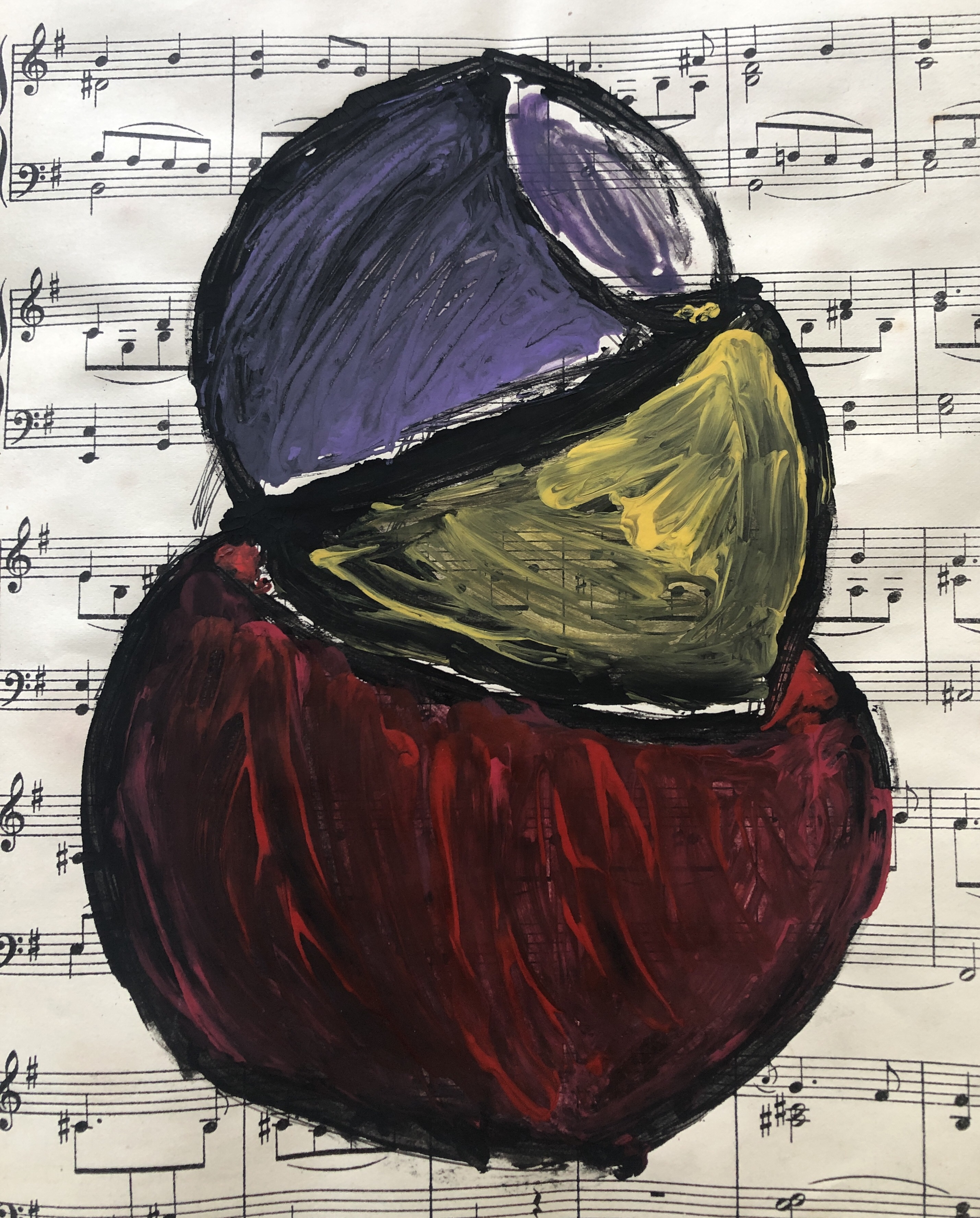
img_4829.jpg

I felt disappointed by the two versions of the kettle in colour and so thought it better to start on a more basic level in order to learn more about how to use the paper and backgrounds and how to cut out paper more effectively.

I used black cartridge paper to cut out a block silhouette of my kettle and teapot in order to get a better idea of the shapes and to simplify them to see if they were more interesting in this way than colour. I worked straight onto packing paper of A3 size.

img_4803

Teapot in black cartridge paper with brown packing paper as the background.

I was pleased with the look of the teapot when compared to the kettle.

img_4804

I liked working with flat plain paper upon a textured background as it made the image as a whole more interesting. With this in mind I tried again with a colourful background. working in A5 for a change. I found this collage to be more fun and the spotty background reminded me of a tablecloth.

img_4798-1

I wanted to experiment with soft edges as I would have far less control over the paper than when drawing with scissors. I chose to use torn plain paper sections to make a teapot and cupcake, working directly onto A2 plain cartridge paper.

img_4779-1

I liked this collage as it was very different from anything I had tried before but I did not feel the cupcake was a success, out of the two I much preferred the teapot as I liked the almost 3D effect with the handle and spout being added separately and on top of the collage.

For my next attempt I chose my cafetiere as I felt it had more complex lines and may be more of a challenge. I used black cartridge paper and some Christmas kraft wrapping paper. I tried to think of the object as a series of shapes rather than just the whole so I could assemble it like a jigsaw. My first mistake was buying Pritt Extra strong glue as once it was stuck down it would not allow any movement at all, so I used a regular glue stick so I could move pieces more if necessary.

I could see why Matisse used pins to hold sections of his cut outs in place and allow changes to be made, It did make me realise why collages take so long as it was not just a case of cutting and sticking. I found it frustrating at times as I worked out the positioning of parts of the collage, photographed it so I had it as a visual plan and then it would never look right when glued.

img_4807.jpg

I was happier with this collage then with the kettle ones, I felt there was more to it and although it was abstract I thought I was getting a little more confident. I was trying not to make it look perfect and an accurate representation of the object and to ‘go with the flow’.

I decided it was time to return to a more familiar object from Assignment 1 and so it was time for my Nan’s teapot to take centre stage again.

img_4290

This time I wanted to try something different and I used old book pages and simply cut with scissors into the shape that I wanted. I worked with a bigger piece of paper for the main shape of the teapot and kept trimming until I was happy with the shape and then made the spout and lid. I really liked the teapot and added details and the handle in black paper.

I didn’t know what would work for a background and I had a look at the teapot presented on brown packing paper and it looked dull, so I took plain coloured paper and ripped it up to create soft edges and used this as the background and finally I was pleased with the result. img_4809

img_4359

Little teapot made with old book paper.

The photographs are not great due to bad lighting and I think I may have to invest in some LED lights to get a better record for my work as I don’t want it to be badly portrayed at degree level. I was proud of my little teapot and felt I was getting better on this learning curve.

I had some parchment paper in my hoard and I don’t think I had ever known what to do with it so after some preliminary sketches I had a better idea about construction of my cafetiere collage.

img_4175

I wanted to try and get a better idea of the shapes the cafetiere created and so I drew it on A3 paper and also decided to try drawing with masking fluid on a patterned background and also with black ink and a brush on A3 paper.

img_4813

I loved experimenting with this.

img_4806

Right hand drawing.

image_576075920755299

Black ink with a brush painted onto A3 paper.

I wanted to use packing paper for the background as I needed a more textured feel to the collage, so with this in mind I began cutting. I pasted tinfoil onto cartridge paper and carefully cut out the shape of the chrome section and also the steel inner separately. I embossed with a pencil the workings of the inner press which would be seen through the parchment. Upon putting the parchment over the press I found it turned it white which I was not pleased about but I carried on.

I had done a test of parchment paper and found that glue distorted the image and left visible marks and so I had to construct this collage by gluing only sections which would be non visible when completed. At this point I did think that my attention to detail was too much!

img_4811-1

Layered parchment, tinfoil, black cartridge paper on a background of brown packing paper.

I was really pleased how the whole collage turned out and thought the background paper gave more depth when the collage was so flat plus the soft edges complimented the straight edges of the cafetiere. I enjoyed building up the layers with this collage and it made me think about how layers can be important.

I then looked at the painted line drawing I had done of the cafetiere and had an idea. I took a risk and ripped it into pieces and screwed the pieces into balls.

image_576075966496522

I wanted to try something completely different with this collage and for it to have texture and depth, so I then opened the sections and glued them like a jigsaw onto red plain paper. It reminded me of the Japanese Kintsugi way of mending broken crockery where liquid gold is used to mend the piece and then it becomes even more lovely than before.

img_4775.jpg

I chose the red background as it would really show off the cracks of this collage and make them into a feature and I was happy with how it looked, especially as it was so far removed from the way I would normally think of making a collage and was very imperfect for a change.

For my next collage I chose a china teapot that was given to me as a wedding present. It was colourful and patterned and I thought this could be an example of something more complex. My tutor had advised me to practice drawing and so I did a sketch of the teapot in pencil and also a continuous line drawing in pen so I could look at the most important aspects of the teapot to try and represent it. I really wanted to show detail and worked directly onto the A2 sheet of cartridge paper.

img_4268

I wished to capture a different angle of the teapot and so did a side view and a view from above. I used map paper, music paper, patterned paper and a postcard of a bar in Prague (where my husband had been!).

image_576075215163011

image_576075319661049

The side view of the teapot in pen.

image_576075352608493

I tried to replicate the shape and details of the teapot in this collage and to use a mix of paper.

img_4767

I went into much more detail here and made zig zag edges by cutting flower patterned paper with pinking shears, I was happy with this collage and felt it was accurate in representing the item.

Whilst on this part of Exercise 2.2 I found I wanted to try a couple of collages which did not fit the brief totally. I thought of the collages I had researched and how the artists used the collages to send a message and so I chose to try a couple of images inspired by the work of Hannah Hoch. I was trying to listen to my tutor’s advice on taking risks with Part 2 of this course.

Working onto A2 green paper, I created a teapot and saucer collage entitled “Prescription”. I wanted to raise awareness of one of the challenges of mental health as a combination of the phrase “a cup of tea solves everything” along with the harsh reality of the medication someone is prescribed actually being the way that a person may be able to attain mental wellness. All too often in Great Britain we reach for the kettle as a panacea, we see it in culture such as on soap operas where a person in crisis would be offered a cup of tea and we see it on mugs and posters which depict “Keep calm and have a cup of tea”.

img_4400

I collected found papers related to medication and a paper bag for the teapot.

img_5052

This was the full collage after I had spent time on cutting and arranging the pieces.
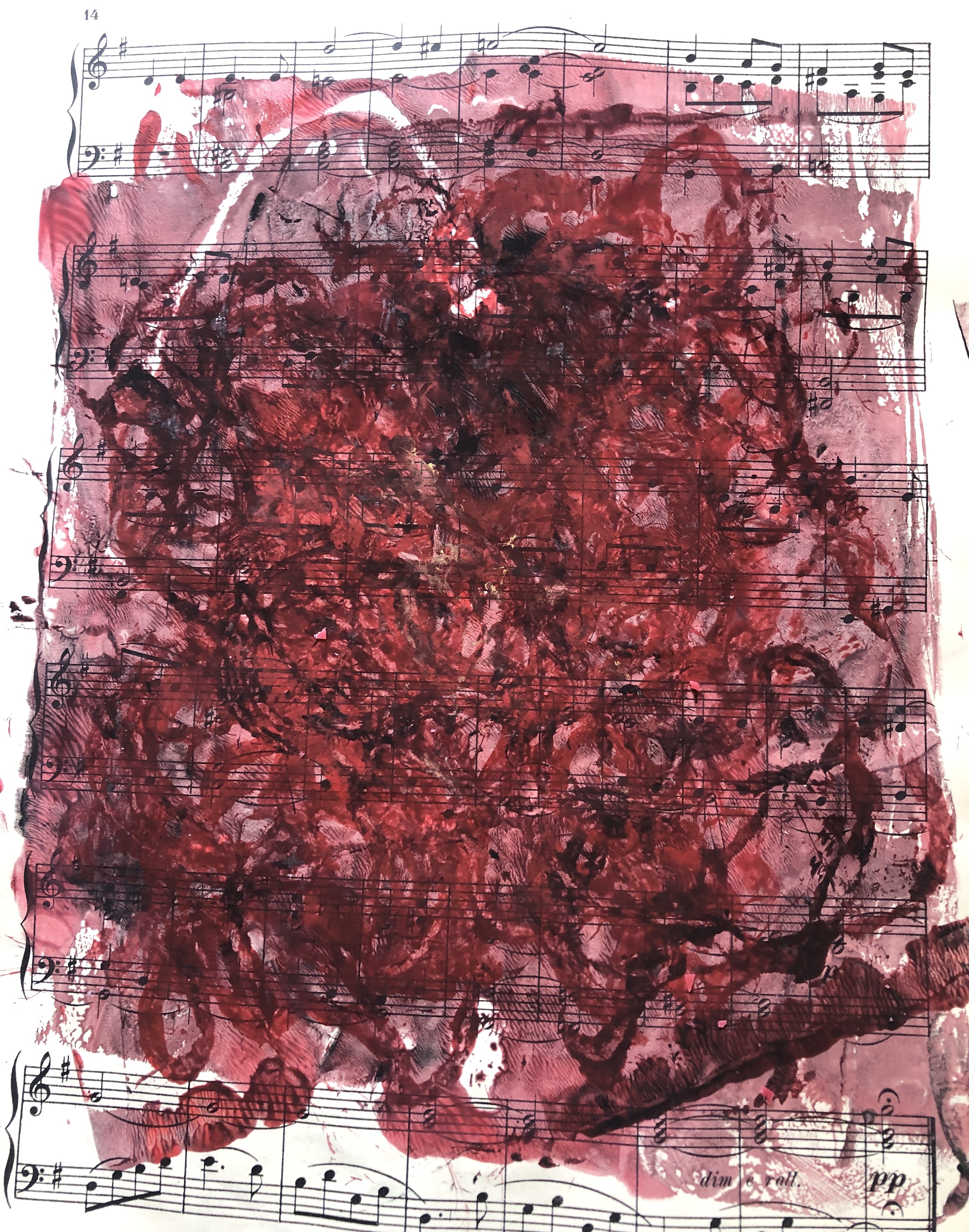
img_4405

This collage however shows the crisis “SOS” in the form of a teabag, the teabag itself is made from an patient information sheet which are readily found in packets of medication. The teabag is about to be put into the teapot which is gaping open like a mouth, so giving the idea that the tablets themselves will help that person. The teapot is about to contain the tablets and has NHS on the lid as a marker from where that medication has come from and the warning of “medicines with care” underlying that the tablets can affect the person willing to take them, which I used directly from a prescription paper bag.

img_4771

The teapot symbolises NHS mental health services in providing the actual medication laced tea.

The teacup has tea in it, the saucer providing support and the liquid in the teacup is a section from the patient information sheet giving the list of side effects.

img_4406

The teacup offers a possible solution to mental distress, yet it is a poisoned chalice due to how that person could be affected. Someone could be able to cope with anxiety better but could experience headaches, insomnia and tremors in their hands if they drink the tea. So to sum up this collage, a cup of tea may not solve everything at all.

I then decided to look at another Hoch inspired collage when I was about to throw away the cardboard box from a jar of black ink. I looked at it and wondered if I could use it and thought of the natural history book I had in my stock of found paper. As I looked through the book I thought of Noah’s Ark with all the animals being contained in it and sailing upon the sea. Then I realised what I wanted to make as a collage and so I cut out various animals and coloured them with pens and ink to show the variety of animals through colour also whilst working directly onto an A2 sheet of cartridge paper.

img_4520

As I coloured the animals I could see how I wanted them to be bursting out of the cardboard ink box, almost like their release from the Ark when the water had finally receded.

img_4522

I had the insides of envelopes and also blue craft paper and used them to make waves. I mixed the cut out waves with torn paper to create soft edges also, plus I tore the paper to try and represent the crests of the waves to help with the feeling of movement.

img_4830

Once the whole collage was together I kept looking at it but it didn’t look how I wanted. Then I realised in my opinion that the waves being blue were not right, as the animals were bursting out of the ink box that was depicting black ink. With this in mind I created an overlay using black craft paper and I tore the paper again, making sure with each wave that it had a white edge to break up the blackness and so the pieces could easily be seen as waves.

img_5055

I felt this version worked a lot better and was more fitting to the journey of colour that the animals had when released from the Ark and it also depicts energy, especially the little frog at the top who is leaping up towards the sky.

My next two collages were a bit tongue in cheek as I didn’t quite stick to the brief and felt like bending the rules again. A friend who I have met on the course and who shall remain nameless had got me a bit competitive by collaging a glass of Absinthe and so I tried to raise the stakes a little for two more unusual objects. I chose my e-cigarette and a can of lager, not strictly a kitchen object per se but can often be found in a kitchen.

img_4881

Working directly onto an A4 piece of old music paper, possibly aptly named (!) I used patterned paper, foil and inner envelope paper to produce this collage. I used the torn black paper to act as a bold background so the inner parts of the collage were not lost in the sheet music and it also worked well as I assembled the inner coil using the background black paper to frame that part of the e-cigarette. I felt this was my best collage work as I liked the light and shadow which the mix and positioning of papers created.

My next risk taking collage was the can of lager and I tried to do a unique take on it. img_4411

I wanted my sense of humour to shine through on this one and as my friend and I celebrated with a cheeky “tinnie” when we finished Part 1 of this course, then I needed this to represent it also. I replicated it in A4 size using plain craft paper, a monkey cut from my natural history book and foil which I had glued onto card which I then cut into shapes. I even made the ring pull separately so it had a bit more detail.

img_4800-1

A bit of fun!

I added one last couple of collages as I couldn’t decide the criteria they would fit in and I thought they possibly fitted in best with block silhouette. I had an old copy of a supermarket magazine and was flicking through it and had a couple of ideas. I worked directly onto A3 paper.

Using a mix of shades of deep blue torn from different food adverts I constructed a soft edge collage of a cup and saucer and then tried a Hoch inspired collage after reading another magazine advert for “Tasty by Nature”. I cut a bowl shape out of the advert ensuring the words were kept and then selected varying herbs and vegetables to put in my bowl. I wanted a balanced effect and the arrangement took some time but I thought the whole bowl and contents worked well, the images were delicate and hard to cut to get the detail but I enjoyed doing this.

img_5060

I had the idea of a wine bottle block collage and so made this on A3 paper but I couldn’t decide on what would go with it so I thought of Matisse and so chose to add an unusual twist to the collage with different coloured and patterned blocks. I’m not sure if it worked but it was something different and I enjoy experimenting, I’m finding that I learn so much more this way.

img_5129


Having exhausted my mental supply of ideas, I felt it was an appropriate time to begin the next section.

Exercise 2.3 Line

As I had never worked with line in collage before, I wanted to stick to shapes which I was more familiar with. I was struck straight away by how difficult it was when doing larger shapes in one go. I think I went wrong at times as I was almost trying to peel the apple in one go and a couple of collages went very wrong and had to be rejected. I found it easier to “anchor” parts of the line with a spot of glue whilst trying not to twist the remaining line into the wrong shape.

I began with the kettle again to see how I could replicate it and was surprised how long the positioning of the cut out lines were. The slightest mistake changed the look of the entire drawing!

img_4812-1

I had this collage carefully planned working directly onto A3 cartridge paper joined with another piece to give a full A2 pieced and was really unhappy with the top section of this collage as it came out so crowded. I wanted it as more abstract but to me it was not as good as I hoped. The cut out lines were so delicate and my fingers were caked in glue and so lines were too fragile to be moved.

I tried again with my cafetiere next to the kettle working directly on A3 paper and found this to have the similar issue of the top section being crowded. If I tried again then I would try with working from the bottom upwards where the less complex sections of the drawing could act as a guide for the rest.

img_5062

One discovery I did make was that pieces in the trash pile were often the most useful, particularly regarding curved lines. But the spout on this item was not correctly positioned and so I felt this aspect meant the cafetiere looked disjointed and not fluid like I had hoped.

The brief then asked for an A4 study and an A5 study, I was unsure working on a smaller scale but firstly tried with the A4 and chose a bright yellow background for a change from white cartridge paper.

For this collage I wanted a study of a half full glass of water with a straw. I really liked planning this one and I used black cartridge paper for the lines, blue craft paper for the straw and patterned paper for the liquid within. I wanted this to be simple but effective and to try and work with different shapes to give an overall effect. img_5063

I spent time working on the placement of the contents of the glass and where the straw should sit. I decided that the water within would be transparent and so the straw placement should reflect this. I glued the patterned paper first and then the straw and practiced where the lines needed to be, taking photos on my iPhone to act as a visual aid.

This time I started at the bottom of the glass and worked upwards but yet again despite me being careful, the top was overcrowded and not what I wanted to achieve. I was now fully aware of my mistakes and that much more practice was needed. I did feel the collage was a semi success as it was still a line drawing of a glass but just not how I wanted it to turn out.

I moved on to an A5 study and worked out how big the collage needed to be. I decided to try something with more fluid lines and a different way of creating it. I chose to draw a cupcake on a patterned background. This time I cut out the block silhouette of a cupcake to begin with and then cut into the cupcake to create outlines without breaking the frame of the cupcake. Although this could possibly be deemed cheating, it was interesting how different it looked when placed on patterned paper as one solid outline rather than lots of lines arranged near one another. I liked this one best of all the line drawings so far.

img_5066

The brief asked for my thoughts on the different approaches of line and backgrounds. I have to say that I was going to partially sit on the fence with this one as since doing Part 1 Line, I have found that I really have a passion for negative mark making and working in just black and white. Certainly the black line on white paper did make the exact details of the drawing stand out more but the patterned paper almost “filled in the blanks” and gave the whole drawing a different dimension, I particularly found this in the cupcake drawing and I really thought that although it was the simplest of all the line drawings I had done, that it stood out more than the others.

From the questions in the course materials I evaluated my work in Exercise 2.3 and found I had chosen to work with line mostly from a forward facing angle as I found this easier but I could see that I needed to try working from a more experimental angle. I think this had a lot to do with  low confidence in trying something new. I found curves would work better if I used thicker paper or card as it was so difficult to glue down thin paper lines without them getting twisted. The drawing of my kettle would have looked better in a darker colour or a change of background as I felt the white background was too harsh and didn’t help define the lines and the mood of the collage looked boring overall. If I redid this collage then I would have torn strips of patterned paper as a background and used black paper for the lines.

The lines of all my collages in 2.3 are all sharp but the curves do help soften the edges a little, I had difficulty with torn paper soft edges in block silhouette and I didn’t think I could have done line collages with torn edges but this could be something I need to consider for the future. I did like working in negative with my A5 cupcake study and I felt this was successful but again I am trying to be too neat and careful.

I could not see a particular era in my line drawings and I found this question in the course materials an unusual one. To me I think it would depend on the subject chosen to make a collage of as most of my kitchen related appliances are modern. One question I would like to see in the course materials would be a timed collage where I may have 30 minutes to make the line drawing as I spent so long trying to get details that a faster approach may have had interesting results.

Exercise 2.4 Collage Studies

For this part of the exercise I had to work with both block silhouette and line, I was uncertain as to how this would work to begin with and so began with an idea inspired from the questions from the previous exercise about the differences in approaches.

As previously mentioned, I really do enjoy working with black and white and with this in mind, I revisited the line drawing of a glass of water. Working on an A4 sheet of card, I tore black craft paper to act as a background and then did a negative line drawing of the water, using a red straw made of red craft paper and the water from the inside of a large envelope. I spent more time than before on the lines of this collage as I knew what I wanted it to look like and did not want to rush it and get it wrong. I kept measuring and checking the lines were further apart to ensure the glass did not look closed in.

img_5071

This time I felt I got it right as the lines were evenly matched and the outline could be seen through the water (blue envelope paper) which gave it a more realistic feel than just cutting two ends of white paper and sticking them on. I thought the red straw was eyecatching and effective in its simplicity. Again, it reminded me that less is more and that negative studies can actually say more than black lines on white paper.

img_4908

My next collage was to be of this china gravy boat that I had picked up some time ago in a charity shop. I liked the lines of it and thought it was quite complex, so gave it a try. Working on A3 paper, I used green as the colour for the lines to make them stand out and to try something different than using black lines in a drawing. I was trying to get out of my comfort zone more.

The construction of the lines took time and then I added detail using painted paper from my collection of found papers and I worked at trying to replicate the lines I saw both outside the collage and inside which were picked out in gold on the china boat. I didn’t want this collage to be perfect but to flow more. I also chose colours which complimented one another.

img_5069

I used brown parcel paper to try and depict the curves and shadows of the gravy boat, next to the lines to outline the shape. The painted paper acted as the patterned band of the gravy boat and all together I found that this collage had worked well. I was interested in how the colours and pieces interacted with one another and found this pleasing.

My next collage was something I had wanted to try having found a small milk jug in my china cabinet that I hadn’t paid attention to before. img_4648

I wanted to convey movement again here and so decided to have a different approach with the milk jug having fallen over, spilling its contents. I used a mix of plain and patterned paper here to try and express the curves of the jug and I used music paper for the “milk”. I coated the music paper with PVA glue so it would have a slightly glazed appearance like the spilt milk. This collage was much more difficult as I was thinking outside the box more as how to show the curves and circles of the jug but felt the overall outcome was acceptable.

img_5070

I did find that trying to work with both block silhouette and line was difficult as I was trying to get the line right first before adding the additional details and I am not sure that the colour combination here was right as the body of the milk jug lying in the milk was almost lost in it. You would have to study it quite closely to see this section and I think varying shades of blue for the jug itself would have made it stand out more than the beige and brown colours I had chosen.

When putting crockery away in my kitchen I noticed how bowls do not stack straight and so thought I could make a collage in a similar way. I cut out bowl shapes from patterned paper and also had a matching outer rim cut out so it would show the viewer that the bowls were sitting in one another. I chose a fairly neutral background as I wanted to try a mix of line and block collage and so made two of the bowls just cut out line so they would pick up the background as a feature.

img_5282

It took a while to assemble the collage as I had to almost plait the bowls in a line, so the outer rims gave the idea that the bowls were sitting in the middle of the bowl underneath. I kept the background plain but interesting with torn edges of kraft paper and some packing paper that I had used under a painting I was doing. I used some of the stripy paper from the bottom bowl to add detail to the line cut out bowls and tried to keep the whole collage as minimalist as possible. There was a lot of overlap involved and I did have to plan out the collage and keep taking photos of the process to refer to as I glued them down.

I don’t feel this collage worked as there are too many bowls and some of the bowls are too heavily patterned. Three bowls would have been better than a whole stack and I would have chosen two block collage and one line drawing for the smaller stack of bowls. I liked the background as it showed up the bowls well and fitted in with the colour palette. I should have stuck to ‘less is more’ with this collage.

I had one final collage for this section and chose the Japanese Kintsugi concept from looking again at my torn up painted line collage. Working on A3 paper I took a piece of white card and cut a block silhouette of a bowl on it and then tore it into large pieces. I began by thinking that I wanted the bowl to be white to symbolise purity as I coloured the edges red to look like they were bleeding. I had a section of gold foil from an Easter egg which I used for the Kintsugi gold flowing between the broken sections of the bowl. The background was a reproduction page of a newspaper about the Second World War and how this affected the city of Lichfield where I was born. I had found it and kept it and decided it would be the ideal background to show the pain and suffering caused by the war and how a broken Britain was mended and healed after some time.

img_5228

I spent some time looking at the bowl in white and it looked too spartan and simple and so I painted a pattern on it with blue watercolour paints. I felt it made the collage more interesting and it had more impact, plus I was able to capture the fragility of the bowl with the pattern I painted as I tried to make the pattern feathery and delicate. I was much happier with the end result and decided not to add the opposite edge of the rim of the bowl as I wanted the viewer to be able to read the information on the newspaper page as much as possible. I like the overall effect but I think the bowl could have been better in black with the gold showing through alongside the red effect. The white card looks too clinical even with the blue flecks on it and white paper would have been better than card, the shape of the bowl is too spiky.

I found with collages that I perhaps paid too much attention to the outline and it could have been interesting to see if I could collage the inside of an subject like my kettle to see if it would still resemble a kettle but I may have needed a more complex subject which to draw. I was observing the shadow a lot and with my spilt milk collage I think I had the colours I used the wrong way round as the details sort of melted into the white background. This would have looked a lot better on a black background and I should have tried having the outline of the milk jug in white and the outer detail in red or another bold colour.

Exercise 2.5 Stripes and Spots

The course materials here intrigued me as I was not sure if I needed to do a kitchen object collage set or something completely different. Having thought about it and actually used my sketchbook to draw some ideas out, I could see a clear theme coming though and decided to ‘go with the flow’.

img_5131

img_5133

img_5135

My chosen theme was going to be stripes and spots but I wanted to base this on punctuation marks. The other aspect I wanted to try was collages in black and white as I saw on some of my sketches that you can either see the white or the black as the main shape, almost like the pictures that were popular in the 1990s which looked like a pattern until you were able to make out that in the pattern was a ship or an animal.

img_4991

I like angular shapes and buildings, I got married at Titanic Belfast which is a museum of Titanic as well as a centre for events and I remember being fascinated with the building as it was so modern. It was designed to reflect the stern of the Titanic and the texture on the outside of the building is to represent waves. Amongst the waves are slotted windows which are the lifeboats full of survivors found on the sea after Titanic sank. I recently went back to Belfast and since beginning this course, it is like seeing things with new eyes. I looked at the building and took this photograph of part of the main atrium and I imagined if I could ever manage to create a collage like this photograph.

img_4985

The Titanic exhibition has sections on walls of the Morse code used when the wireless operators were sending distress messages and on the walls they were both poignant and effective. So with this in mind, I began the exercise with a more simple form of communication, the comma. I was unsure if this was too basic and so tried both ways with the commas.

img_5074.jpg

img_5073

I thought the commas on the black background worked better out of the two and used a red base behind the white background commas to show up better on the photograph. I liked how the backgrounds of both collages could also be the focal point.

My next collage was worked in black and white and I wanted more angular definition so I chose an exclamation mark. I cut out the black line and circles for the dots and it was only when I was arranging them that I saw something interesting.

img_4673-1


The black lines stood out well against the white background, but it was hard to tell if the background was white or black with a white overlay as the pattern looked geometric to me and reminded me of 1960s style wallpaper. I wasn’t sure if adding the dots would be as good but I gave it a go.

img_5077.jpg

This looks like steps at second glance.

I really was happy with this collage but preferred the first version as this version looked too crowded although the pattern repeated well. I wanted to try another of my designs from my sketchbook which again was angular and cut up strips of white paper and arranged them in a crosshatch fashion on a black card background.

img_4790-2


I was wanting this collage to also have depth and not be ‘flat’ and I added very thin strips of black paper on some of the white strips.

img_5079-1

This was my most favourite collage yet of this theme and I felt the most successful. It made me think that there was so much more to learn and to test, plus I was going back to my sketchbook for ideas which could be reworked or used as a springboard for other ideas, reinforcing that I have to use my sketchbook for every part of the exercise. I also bought a small field notes book to have with me if out and about.

I wanted to then try full stops but I didn’t want just circles on paper, I again wanted to add definition. Using a white card background I cut larger circles of black card and smaller circles of red card. I tried various ways of positioning the red circles until I saw the right place and again I thought it had a 3D element to it. I’ve just begun practising sewing not just on fabric and so I sewed zig zags on the collage to break it up a little. When I looked at the finished image it reminded me a bit of a Lego brick or a masonry brick as the dots are almost holes.

img_5075

For my next collage I wanted to try something completely different and very simple, I chose a ~ symbol which according to Google means ‘approximately’. I cut wavy lines from patterned paper and arranged them on black A5 card. I didn’t trim the edges off as it would have not distinguished them as the ~ symbol. I liked the black lines in between but found this collage dull overall.

img_5086

I was about to put my collage papers away when I happened to see a scrap of paper with an ink blot on it and I wondered if I could incorporate ink blots into a collage. My tutor encouraged me to be “messy” and although it was on a small scale I did.

I took my coloured inks and made stripes on one piece of A5 white card and with another piece of A5 card I made ink blots in rainbow colours. I loved being messy!

img_4690

When fully dry, I cut the cards into strips lengthways and then wove them into a basket style collage which was fiddly but the overall effect was befitting to the exercise title as I had stripes and spots.

img_5082

I tried a red background also to see how it would make the collage stand out.

img_5084

Conclusion

I did really enjoy this part of the course and again I could certainly see a development in terms of improving my work as I went along. I revisited some themes of Assignment 1 with the mark making and my favourite collages were again the black and white in negative. I found that the simpler collages were the better ones in my opinion and I was not as successful with line drawings with long lengths of paper. I was learning more about using backgrounds which I had not paid attention to as much at the beginning of the assignment. One aspect that I really liked was being environmentally conscious as the course materials encouraged the use of found paper and not necessarily bought. I had a lot of patterned paper from craft magazines which I had kept and I tried to incorporate as much used and found paper as I could.

I liked the pattern repeat exercise most of all as it was good to work on a smaller scale and it made me see things that I had not expected that I could do, such as the “Lego brick” pattern repeat which did look three dimensional which was a complete accident. It made me realise that I need to spend more time looking at the positioning of paper and how this interacts with the rest of the collage.

I did find the assignment hard to understand at times due to lack of direction from course materials and I was concerned about going down the wrong path as there was not enough information or clear steps and I know I was not the only student who felt this way. I also found the theme of kitchen items repetitive having already done this in Assignment 1 but I recognise that kitchen paraphernalia is something that every student will have in their home so is therefore an ideal subject choice. I did want to test out other themes of collage which could be wrong as my “Noah’s Ark” and “Prescription” collages do not fit the brief but were done on impulse when seeing the related found papers.

I have certainly been taken out of my comfort zone with Line and Collage and I am very much looking forward to Part three Materials as I’m hoping I will have a lot of ideas to try and also to make notes on in my sketchbook!

Beginning with mark making

Exercise 0.1 Marks with conventional tools

Having read the beginning of the OCA textile design foundation course, I began by making marks in an A4 sketchbook using different grades of pencils. I followed the descriptive words to channel the marks and help me experiment more.

I found that I liked the bolder softer lines more and they were easier to make marks. I filled several pages of the sketchbook to test out the marks before using large cartridge paper to design my favourites and try them out in a larger format.

I began by getting used to the grades of pencils and tried to see how they would interact with the descriptive words.

I loved the shading and blending as it created different effects.

I moved onto my bigger sheets of paper and began seeing how the marks changed when larger. I know I was supposed to start on the larger paper to begin with but my sketchbook worked better for me. I found I preferred holding the pencil as I would if writing as it gave me better control but liked the squiggles I made when holding the pencil right at the end. By holding the pencil right near the tip I could make very bold and heavy marks.

I enjoyed making marks on a bigger scale and using charcoal and pens.

I like making patterns and trying different shapes to try and convey texture and movement in a drawing.

Mark making with pens and ink

Exercise 0.2 Making tools

Having experimented with different pens, pencils and conventional media, I moved on to creating unconventional mark making tools. I wanted to use found objects but as natural as possible to see what kind of marks they could make. So I collected a pine cone, a cork, a stick, old string, acorn cups, a piece of bubble wrap, a wooden toothbrush and a mascara brush. I used the stick to try and make a stamp with the bubblewrap and the acorn cups, using surgical tape. I started with a bottle of black ink that I had had for some time and unfortunately it had lost its pigment and I was left with brown marks when it had dried.
Having got a new pot of black ink I decided to go over the marks I had already made and actually was really pleased with the results as I saw negative marks as well, even though I cheated somewhat. It gave a different depth to the marks, especially where I had tied string around some plastic pipe and rolled it in the ink and then on the paper. I need to remember this for a future project or assignment as it reminded me of tree bark.
I really enjoyed this part of the assignment and it was fascinating to see what the different tools could do.
I also used a candle to make negative marks and also marks using the sooty candle wax to darken the wax and I saw several of the descriptive words. String dipped in ink gave flowing marks, the mascara brush made agitated marks and the bubblewrap gave bold marks.

I found that using the bubblewrap stamp and acorn cup stamp limited the marks I could make but did make an interesting pattern. The string dipped in ink gave a good flowing line but I couldn’t have drawn anything complex with it as it was messy to use and the lines were too fluid. The cork also restricted line drawing but it did give me ideas for tools I would use to fill in areas of a collage or drawing as it gave a nice textured imprint.

The best unconventional tools of the set I made were certainly the mascara brush, the end of the toothbrush and I found a thin wooden coffee stirrer which gave more accurate lines when used with black ink.

Exercise 0.3 Negative marks

I used some of the unconventional tools to make marks on A3 paper and found the masking fluid needed to be applied thickly rather than a light wash. The stick and end of a paintbrush worked well to distribute the masking fluid, the opposite end of the mascara brush was good as it was smaller and I could draw with it. My first attempt with the masking fluid did not work as I hadn’t left the ink wash long enough to dry and the paper tore. My second attempt was much better and I enjoyed making patterns with the masking fluid and upon removing the dried fluid I liked the way the negative mark looked so white against the black ink. The spots of white did not look as good as the actual lines and shapes as the bigger the shape or pattern, the more effective the colours seemed to look together.

When I was a young child my parents took me to the Tate Modern in London. There was art on canvas and paper as well as installations and I recall looking at one giant canvas which on first glance appeared to be just painted black. However, upon concentrating and looking deeper into the painting I could work out that there were rectangles and other shapes under the top layer of black paint and once I could see them then I could not unsee them. It made me understand depth and to try and look at the layers involved and to break down sections rather than just evaluate the image as a whole.

I decided to try using masking tape as it is a particular favourite of mine, I tore up sections of masking tape and covered an A2 sheet with tape before then going over the sheet with pencil strokes, graphite stick, pen and charcoal. I tried gentler pencil marks and then harder and upon removing the tape, I was really interested in the results.

I spent time going over the masking tape using different media before removing the tape.

By going around the edges of some of the tape, a bolder outline was created which interested me. I had used watercolour paper and I liked this as a base as it made the negatives look more three dimensional.

I decided to try another sheet and used masking tape and surgical tape and then did a black ink wash over the top. Once the ink had dried I removed the tape and I loved the starkness of the white against the black and the neat edges. The surgical tape is different as it usually tears in straight lines and has pores so there are tiny black dots in the white areas. This reminded me of pop art comic style where the tiny dots make up the bigger picture.

I then tried a black ink wash on paper and when it had dried I tried drawing on it with white ink. I did not expect the white ink to show up as well as it did and I enjoyed using conventional and unconventional tools to make marks. Using the ink meant that I could create more flowing marks and a variety of styles. Using candle wax also interested me but I found it to make more of a texture and gentler effect than some of the other media I had used.

I have learnt that there are a great many variations of black and white and using different tools and ways of thinking can produce textures and a variety of designs. I would like to develop this further, perhaps as part of a collage and to use the masking fluid on patterned paper and then follow up with a black ink wash to create a kind of negative stained window effect. I definitely want to draw with a black ink wash and white ink as I found that fascinating.

I think using the mark making techniques will help me with drawing and will add depth to work when I’m in the planning and research stage. Having completed the warm up exercises, I am now ready to begin the next part of the course.

Read More

Part one Line

Exercise 1.1 Right hand, left hand

Stage 1

Having read the line drawing brief I collected some items to begin drawing. I selected a utensil pot, knife, fish slice, pasta server, mini teapot, glass lemon squeezer and a handbag to use to practise drawing with. I’m not confident with drawing at all and I was concerned that my efforts would be embarrassing but after a telephone call with my tutor Lizzie Levy I felt a bit more rational about drawing.

img_3456

First go at drawing and I tried making the subjects solid to see if I could get an accurate result.

I began to feel a bit more comfortable and relaxed so drew a few more from my selection of items, I tried to convey what I was seeing and not all were successful but I persevered.

My Nan’s glass lemon squeezer (circa 1940s)

I tried to look at the objects from different angles and draw those to see if I could capture them better.

The handbag was a very basic outline that I felt more able to draw and it had minimal detail on it.

Stage 2

I started trying to draw with my left hand and I was unsure if I could even draw a single line, let alone a whole object but I was quite surprised with the outcomes.

I found that although I had less control with the pencil I was able to make coherent marks.

I also found that I had less control of the pencil on larger and less complex drawings but did better with smaller details and that the work did slowly improve, but I didn’t expect to enjoy drawing with my left hand as much as I did and that I could actually draw the object rather than make a mess of pencil. I’ve tried to write with my left hand in the past and it had always ended badly so I felt I had learned something about myself by doing this exercise.

Stage 3

For stage 3 I chose to draw the lemon squeezer on A2 paper and I spent around 45 minutes to try and show the detail of the object. I also looked through the glass to see behind the middle and the shape it made from the front view. I enjoyed the challenge of this and although it is somewhat basic, I did think that I was improving.

Stage 4

For stage 4 I decided to draw the lemon squeezer again using a pot of black ink and a wooden lollipop stick as my unconventional tool. I found this very difficult as the ink was hard to work with and the lollipop stick did not distribute the ink evenly at all. I liked the flowing strokes of the tool but did not like the lack of control for the more detailed areas. It was a striking image when completed and it did give an entirely different perspective, I think I’m too governed by wanting accuracy!

Exercise 1.2 Continuous line drawing

Stage 1

For this exercise I wanted to have a bold outline rather than pencil so the lines were easier to see. I chose an ink pen and began and was surprised by the end result. Initially I thought it was a ‘spiky’ drawing but then I tried a few more and found that I really liked the pace and style that the continuous line gave.

It looked so different and not what I expected at all.

A selection of continuous line drawings.

Stage 2

I tried using some of the words from the warm up stage but I really struggled with this one. I had attempted to use the descriptive words in previous drawings but I felt these drawings were unsuccessful and I didn’t think they were of a good standard.

I felt that using pencil did not look as good as the ink pen as it was hard to see the continuous lines and I liked the bolder effect as the image leapt off the page more and was easier and more interesting to look at.

Exercise 1.3 Drawing blind and from memory.

Stage 1

Using A2 paper I attempted drawing blind by using kitchen utensils as subject matter. I could understand how this would give complete freedom with drawing but I did not feel this was a style that I would choose for formal work.

I tried again with the handbag but drawing ‘blind’ made me feel awkward and frustrated as none of the drawings resembled the object. This is just my personal experience and opinions as I’m sure many people use this technique to see the object from another way.

Stage 2

For drawing from memory I chose to draw something completely different as I was becoming too used to the shapes of objects previously drawn. I chose to draw a tin opener and drew from memory from different angles.

I didn’t feel these drawings were very good as despite looking at the tin opener for one minute, I had difficulty recalling the details of it and there was only one drawing that I felt reflected the object in accuracy. It did make me think that I’m better drawing an object that is in front of me, so in a way it did build my confidence a little as I think other work I’ve done was of a higher standard than this, although I have a lot of room for improvement.

Out of the two stages, I did prefer drawing from memory as it did feel that I was representing the object more on paper. Drawing blind simply annoyed me and I didn’t feel it had any relevance to what I was trying to produce and I couldn’t see how this would work or help with future projects. At least with drawing from memory, I could assess the importance of the lines which I had drawn and what was missing and needed adding.

Exercise 1.4 Final drawing selection

Having looked through my previous drawings from mark making and line drawing I saw a definite progression of learning and confidence, along with the need to practice drawing as often as possible. There were stages that I felt I wanted to revisit in order to try and improve and also experiment further.

I decided to attempt to draw something more complex to see if I could and chose to draw a peacock feather. I chose the feather as when I looked at it, it was a succession of lines of varying sizes.

I tried to add as much detail as possible using only lines to try and keep to the assignment brief and I was pleased with the result.

It was difficult to capture the frond like spears at the top but I concentrated on the barbs lower down to try and add texture.

As I enjoyed continuous line drawing so much, I thought I would draw the peacock feather again using a fine line pen. This would mean less formal detail but more interpretation.

When I compared the drawings side by side I realised that I preferred the continuous line drawing as it looked more interesting and drew my eye to that section of the page more. I don’t know if this was because it was bolder than the pencil but I liked it, it reminded me a little of a stem of bracken from my walks in the woods.

I also wanted to try negative mark making again and used masking fluid and the opposite end of a paintbrush to draw out the shapes of the lemon squeezer and the teapot again.

I found it much easier to have a fixed purpose in mind rather than randomly distributing the masking fluid and that I needed to relax more and use the unconventional tool more slowly. I was able to get much cleaner lines and felt I would get a much clearer image after removing the dried masking fluid. After a thick coating of black ink, I removed the masking fluid and was happy with the finished images.

I did still ponder about how using coloured pastels under the masking fluid and then black ink as the topcoat could really give a thought provoking effect and I intend to try this out but due to having now run out of ink, I will try this in my sketchbook with black acrylic paint.

I wanted one final set of drawings and chose to draw the peacock feather again using my left hand and using an unconventional tool which was a thin stick of charcoal. The charcoal was really difficult to hold as it was so light and fragile and I did not feel the drawing was successful. I then tried the peacock quill to test out a few lines and it was really awkward. Although the general look of the peacock feather was rich in colour and soft, I’ve no idea how people centuries ago managed to write with a quill as it would not carry ink and was scratchy to use. As a result I abandoned the attempt and tried negative mark making of drawing the feather with white ink and a conventional tool which was a paintbrush.

To sum up my first part of the Foundation Textile Design course, I feel I have learned a great deal about drawing, how to produce different effects using a mix of tools and I have certainly discovered what I do and do not like. I’ve also found my areas of weakness and that I need to practice drawing more.

If I were to repeat this whole section of the course, I would make more time and make more effort. I don’t feel that I produced enough work and so I want to improve on this on assignment 2.

I have found it difficult at times to try and understand what the course materials are asking me to do and so I’m not sure I’ve always got this right. It was sometimes awkward drawing on A2 but I realise this is also where I need to practice more on working on a bigger scale.

Research and reflection part 1

As I hope to do the full OCA Textile Design degree, I have purchased some literature to help me learn more about textiles and to help me understand some of the concepts and designers. I looked for as many as possible on the course reading list but some were out of print. I did visit Waterstones bookshop in Birmingham and was disappointed by the lack of books on textiles so used Amazon instead.

When the books arrived I was absolutely fascinated to read them, especially about the fabric sketchbooks as I had never thought of using thread as a pen and means of drawing. I started to make sense of using threads, fabric textures, colours and other media such as paper to create something meaningful and expressive when I had only thought that this could be done with paper and pen or paint brush.

One issue that I have to try and overcome is my need for perfection and precision. I was raised to do my very best, to be competitive and to excel and so when I am trying to make something and it isn’t quite right then I feel disappointed in myself. If a seam is crooked, then I will focus on that one seam rather than look at the rest of the sewn item which is fine. For ideas to flow, the compartmentalised system I have always used will have to learn to be flexible and adaptable to change.

My drawing skills are limited and I don’t want this to spoil my enjoyment of the course as from what I have read in the books so far and the course materials is that drawing is an interpretation, it does not have to be as perfect and accurate as a photograph or famous painting but rather to give a unique sense of what I am seeing and how it makes me feel and think.

I’ve often felt that when handling fabric as it is a multi sensory experience to touch and see and also hear the fabric when it moves. From the crunch of raw silk, the swishy drool of satin and the rasp of hessian, fabric gives more than just being pleasing to the eye. I often close my eyes and run my hand down the rack on which I keep my fabric stash and love to identify each, the velvet and the cotton, the linen and cheesecloth, the brocade and calico. All giving a different flavour and I can often recall when and where I bought pieces and then when meeting with other sewing friends, we quietly admit that we bought certain pieces without a specific project in mind but just simply to own it.

So I need to cast aside ‘you must’ and ‘you should’ and consider using ‘perhaps’ and ‘maybe’ and learn to float ideas rather than stick to rigid thinking. To think of layers beneath instead of the top coat and to try and convey texture instead of gloss.

One thing that we do well as a family is to Womble. We make use of things other people may cast off. My father would nimbly vault into a skip to fetch out treasures and I grew up with this theme. The earliest one I recall is my father coming home with a car boot crammed with books. He was Head of Science at a local school and there had been a fire in the library, the books that did not burn were badly smoke damaged and were deemed useless. The idea of throwing books away is alien to my father and so he amassed as many as possible and proudly brought them home. Even years later the books still held that smell but I loved them and read the encyclopaedias, the science and biology books and the books about animals.

My favourite wombling moment was when a work colleague and I had begun sewing together and found a local curtain shop was downsizing. They had a large skip outside which we gleefully got in and began investigating, just as our area manager walked past. The shop owner was intrigued but let us carry on and so we dove to the very depths of the skip and found many varieties with which we were delighted and also that they would not go to landfill. My other moment was when I was poking about in the woodpile at home and found the perfect round piece of dowel rod which fitted just right in my hand. From that piece I was able to plan and make my own wedding bouquet from fabric flowers I created with vintage brooches and a piece that I am still proud of today.

That is the theme that I want to try with this course, to reuse and repurpose as much as possible and to reduce waste.

Although not on my reading list, this book gave some good information on mixed media ideas.

I will post more about each book but the cover of this looks three dimensional. It’s such a beautiful piece of work.

I cannot wait to try and make a fabric sketchbook!

Such a wealth of information here, will write more later.

Some of the concepts here are incredible, I hope to visit a gallery soon.

Starting out on OCA textile design foundation course

Having had my course materials from OCA, I have been reading through and collecting various materials and art media to use on the course. I think the course is very well set out and began working on the mark making activity in a large notebook to try out different media and grades of pencil. I found that I loved bolder marks most of all and that they were easier to draw with. Using charcoal and smudging the lines gave it a more delicate feel and I also liked patterned marks.