Exercise 1.1 Right hand, left hand
Stage 1
Having read the line drawing brief I collected some items to begin drawing. I selected a utensil pot, knife, fish slice, pasta server, mini teapot, glass lemon squeezer and a handbag to use to practise drawing with. I’m not confident with drawing at all and I was concerned that my efforts would be embarrassing but after a telephone call with my tutor Lizzie Levy I felt a bit more rational about drawing.

First go at drawing and I tried making the subjects solid to see if I could get an accurate result.
I began to feel a bit more comfortable and relaxed so drew a few more from my selection of items, I tried to convey what I was seeing and not all were successful but I persevered.
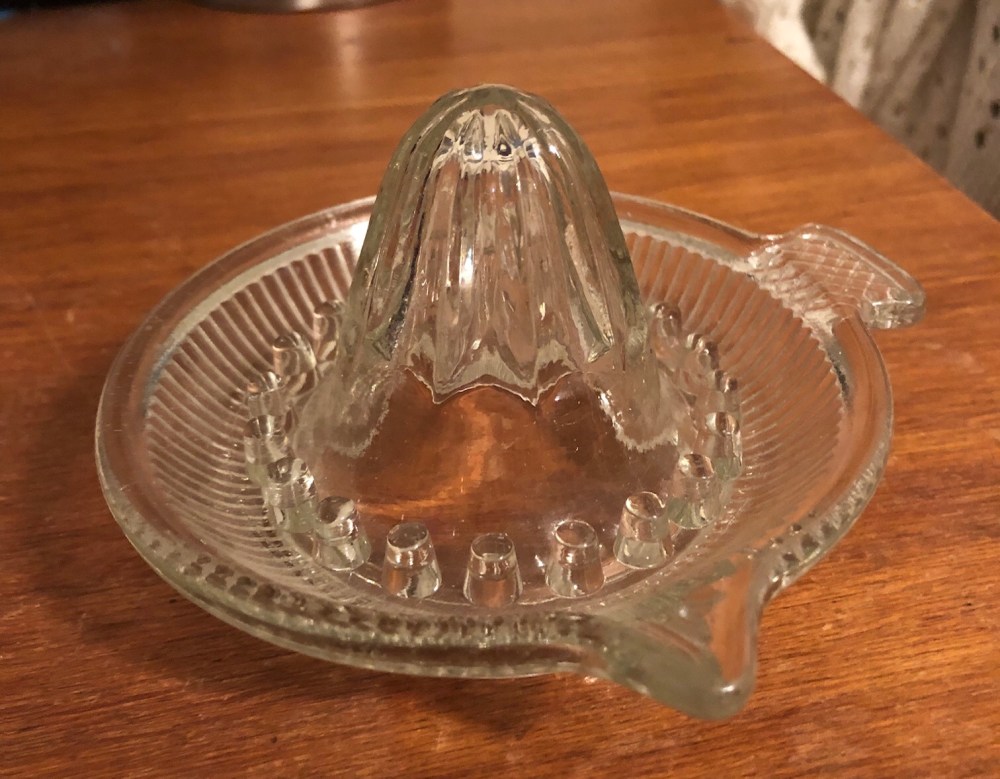
My Nan’s glass lemon squeezer (circa 1940s)
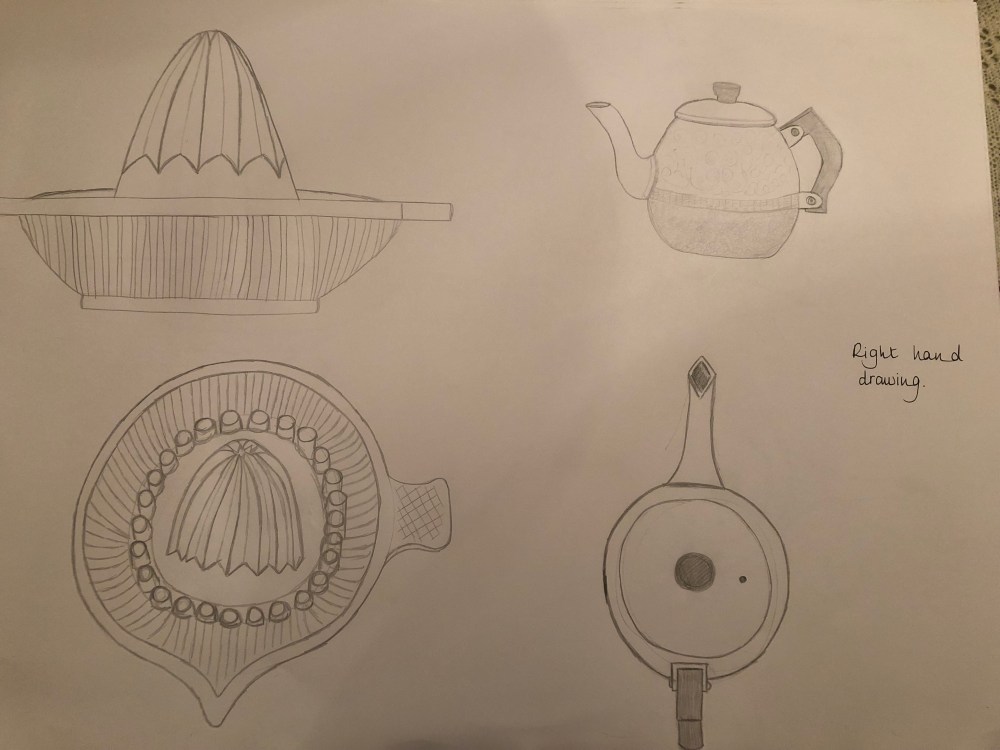
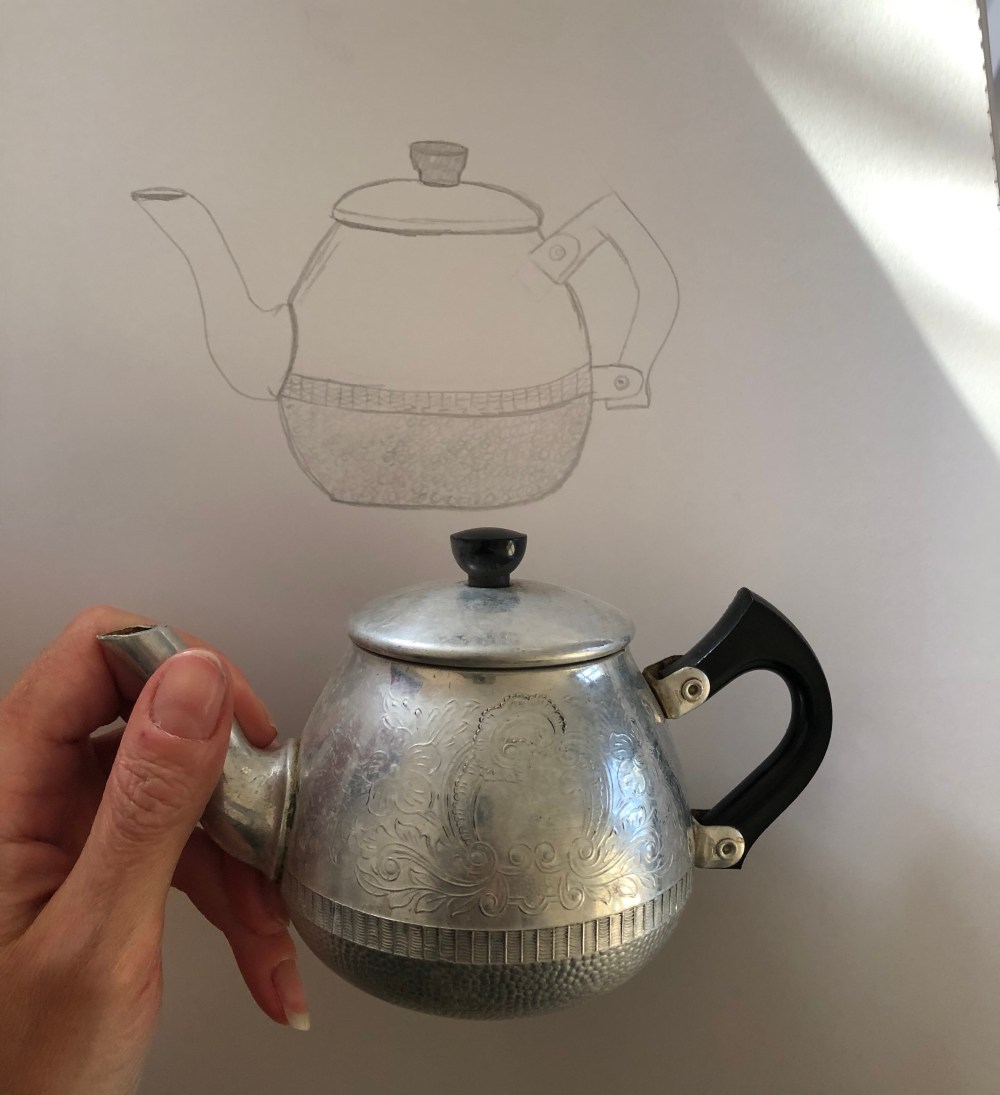
I tried to look at the objects from different angles and draw those to see if I could capture them better.
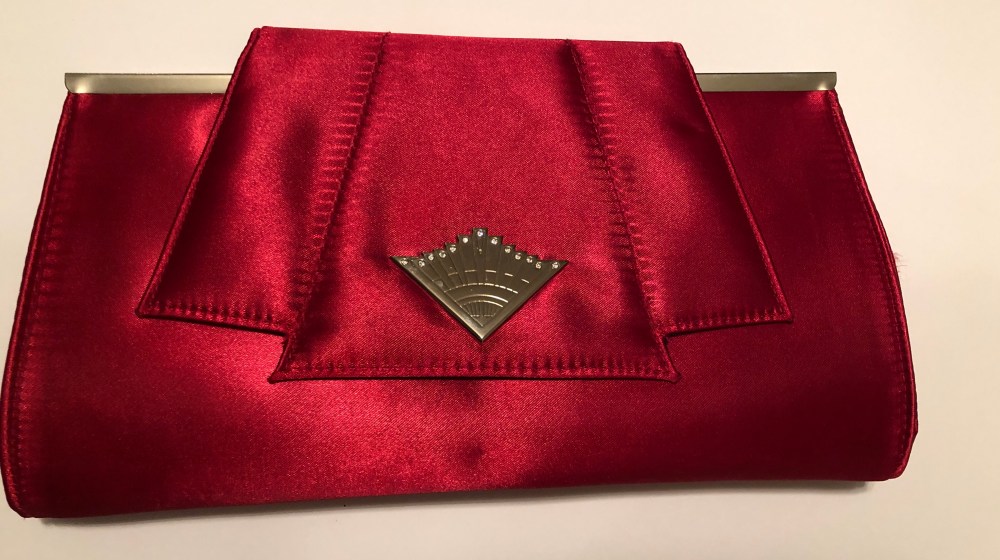

The handbag was a very basic outline that I felt more able to draw and it had minimal detail on it.
Stage 2
I started trying to draw with my left hand and I was unsure if I could even draw a single line, let alone a whole object but I was quite surprised with the outcomes.
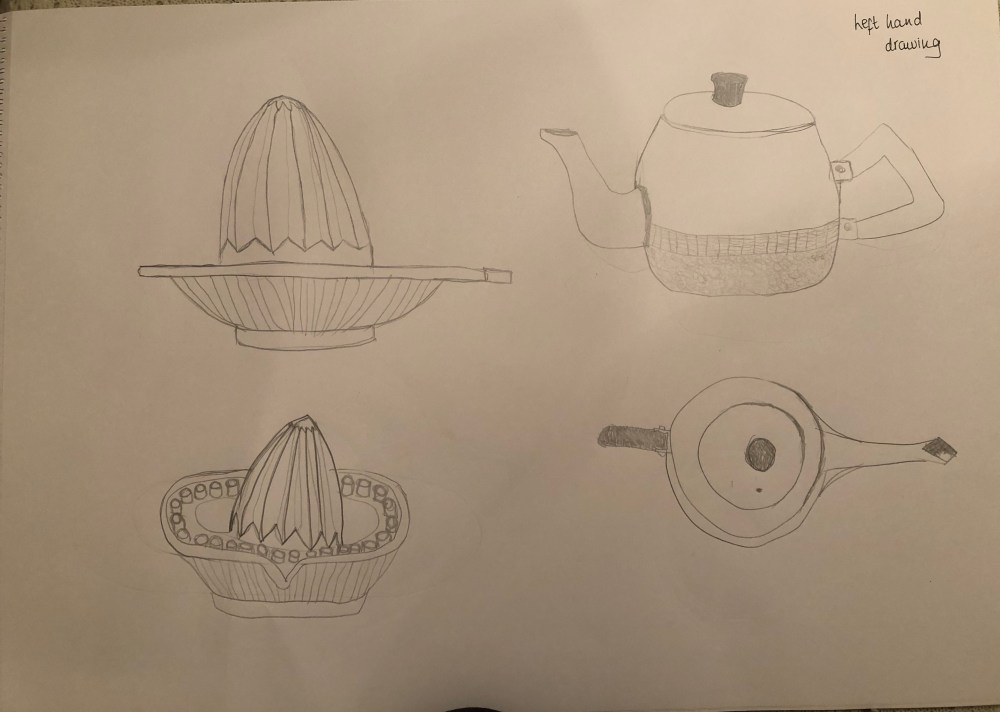
I found that although I had less control with the pencil I was able to make coherent marks. 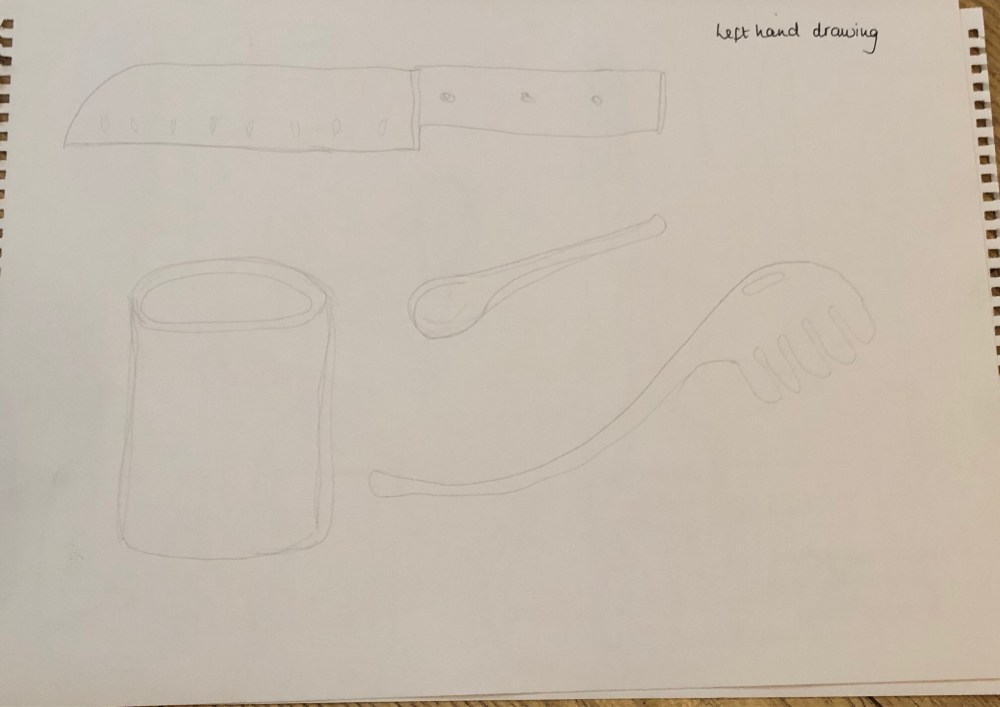
I also found that I had less control of the pencil on larger and less complex drawings but did better with smaller details and that the work did slowly improve, but I didn’t expect to enjoy drawing with my left hand as much as I did and that I could actually draw the object rather than make a mess of pencil. I’ve tried to write with my left hand in the past and it had always ended badly so I felt I had learned something about myself by doing this exercise.
Stage 3
For stage 3 I chose to draw the lemon squeezer on A2 paper and I spent around 45 minutes to try and show the detail of the object. I also looked through the glass to see behind the middle and the shape it made from the front view. I enjoyed the challenge of this and although it is somewhat basic, I did think that I was improving. 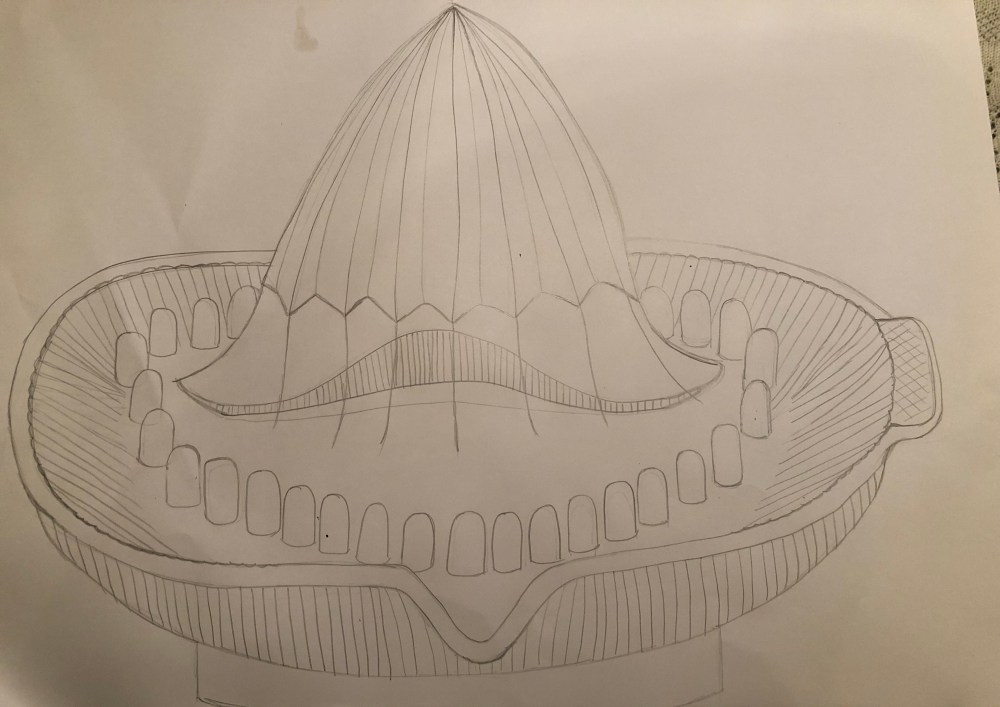
Stage 4
For stage 4 I decided to draw the lemon squeezer again using a pot of black ink and a wooden lollipop stick as my unconventional tool. I found this very difficult as the ink was hard to work with and the lollipop stick did not distribute the ink evenly at all. I liked the flowing strokes of the tool but did not like the lack of control for the more detailed areas. It was a striking image when completed and it did give an entirely different perspective, I think I’m too governed by wanting accuracy! 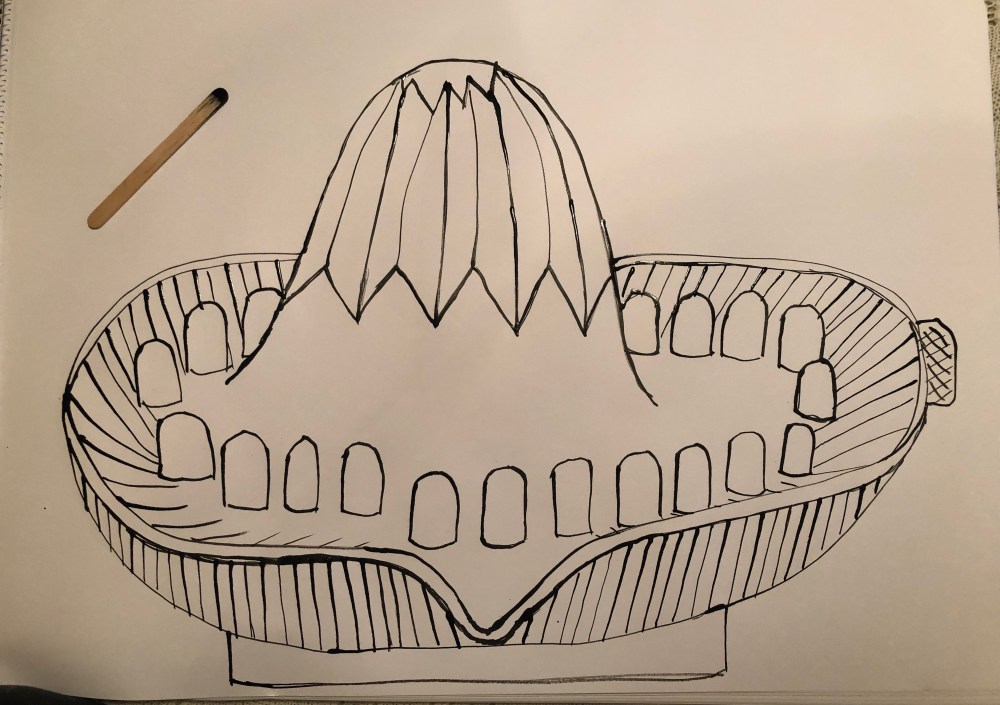
Exercise 1.2 Continuous line drawing
Stage 1
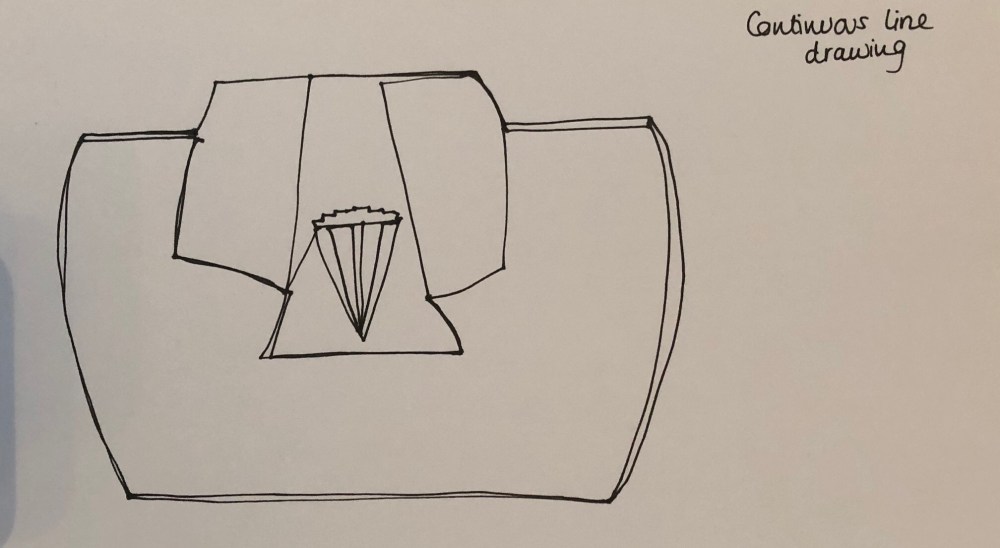
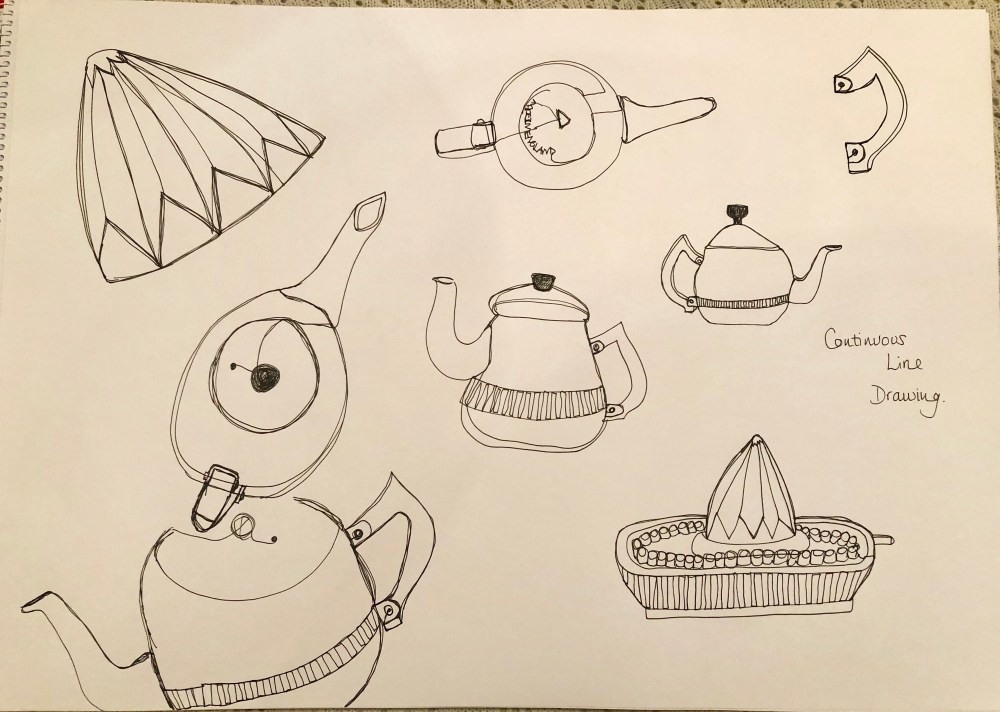
For this exercise I wanted to have a bold outline rather than pencil so the lines were easier to see. I chose an ink pen and began and was surprised by the end result. Initially I thought it was a ‘spiky’ drawing but then I tried a few more and found that I really liked the pace and style that the continuous line gave.
It looked so different and not what I expected at all.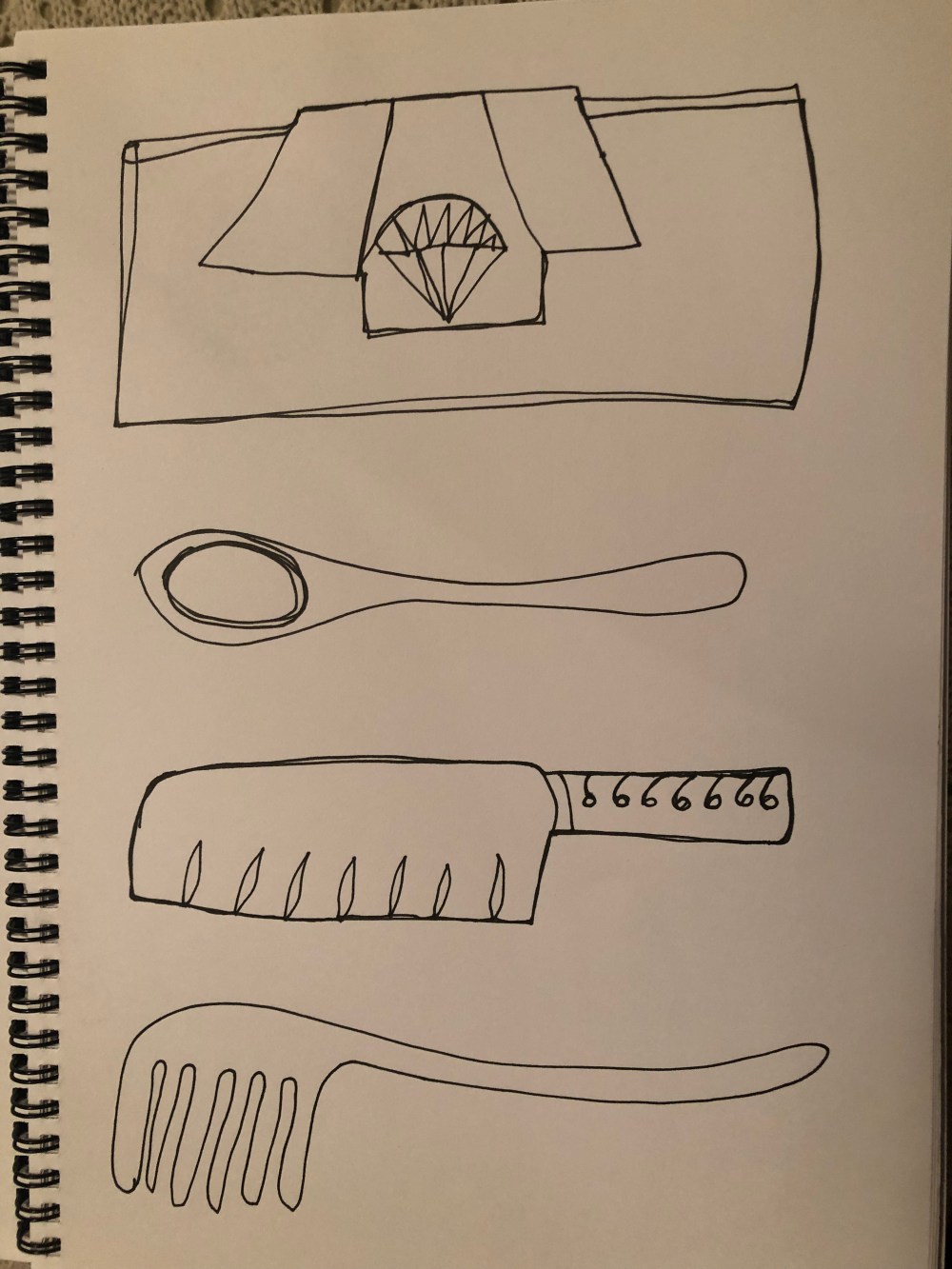

Stage 2
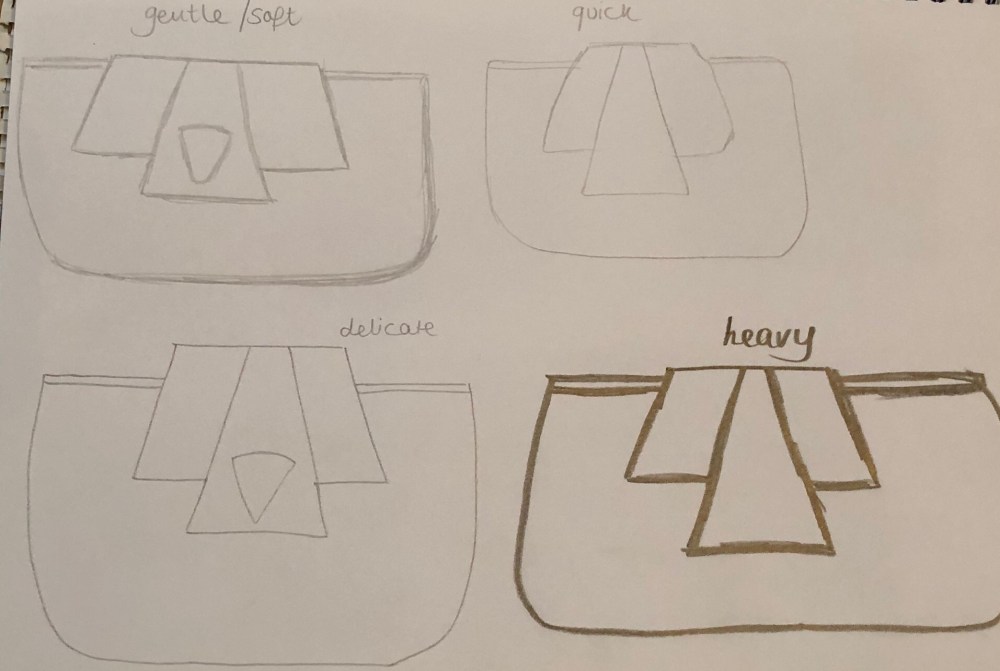
I tried using some of the words from the warm up stage but I really struggled with this one. I had attempted to use the descriptive words in previous drawings but I felt these drawings were unsuccessful and I didn’t think they were of a good standard.
I felt that using pencil did not look as good as the ink pen as it was hard to see the continuous lines and I liked the bolder effect as the image leapt off the page more and was easier and more interesting to look at.
Exercise 1.3 Drawing blind and from memory.
Stage 1
Using A2 paper I attempted drawing blind by using kitchen utensils as subject matter. I could understand how this would give complete freedom with drawing but I did not feel this was a style that I would choose for formal work.
I tried again with the handbag but drawing ‘blind’ made me feel awkward and frustrated as none of the drawings resembled the object. This is just my personal experience and opinions as I’m sure many people use this technique to see the object from another way.


Stage 2
For drawing from memory I chose to draw something completely different as I was becoming too used to the shapes of objects previously drawn. I chose to draw a tin opener and drew from memory from different angles. 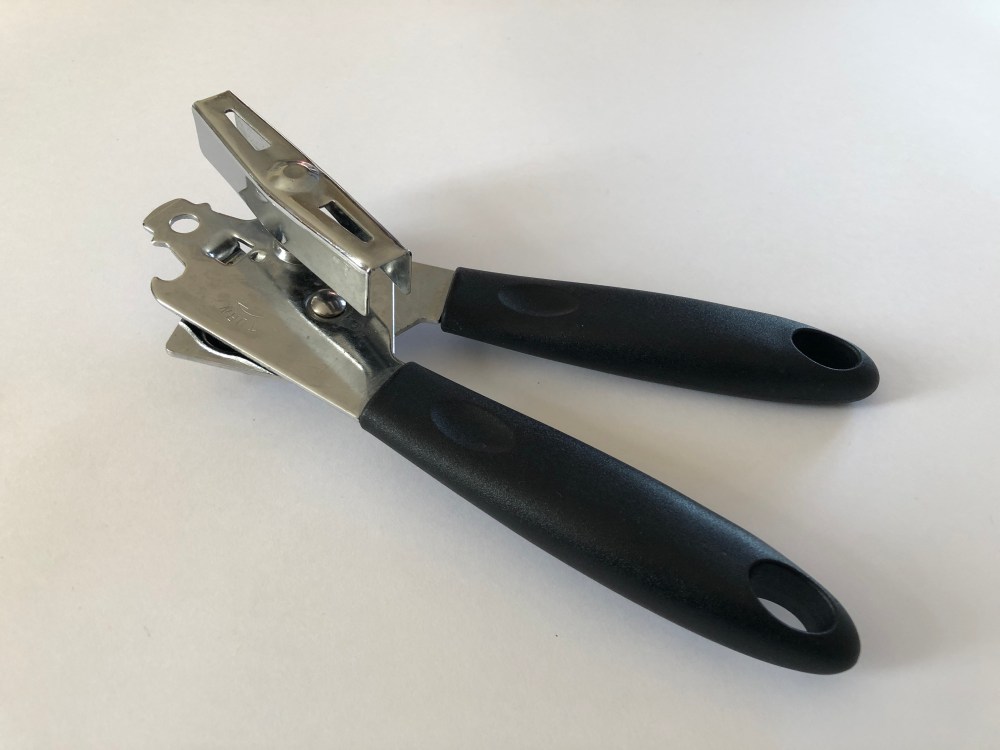

I didn’t feel these drawings were very good as despite looking at the tin opener for one minute, I had difficulty recalling the details of it and there was only one drawing that I felt reflected the object in accuracy. It did make me think that I’m better drawing an object that is in front of me, so in a way it did build my confidence a little as I think other work I’ve done was of a higher standard than this, although I have a lot of room for improvement. 
Out of the two stages, I did prefer drawing from memory as it did feel that I was representing the object more on paper. Drawing blind simply annoyed me and I didn’t feel it had any relevance to what I was trying to produce and I couldn’t see how this would work or help with future projects. At least with drawing from memory, I could assess the importance of the lines which I had drawn and what was missing and needed adding.
Exercise 1.4 Final drawing selection
Having looked through my previous drawings from mark making and line drawing I saw a definite progression of learning and confidence, along with the need to practice drawing as often as possible. There were stages that I felt I wanted to revisit in order to try and improve and also experiment further.
I decided to attempt to draw something more complex to see if I could and chose to draw a peacock feather. I chose the feather as when I looked at it, it was a succession of lines of varying sizes. 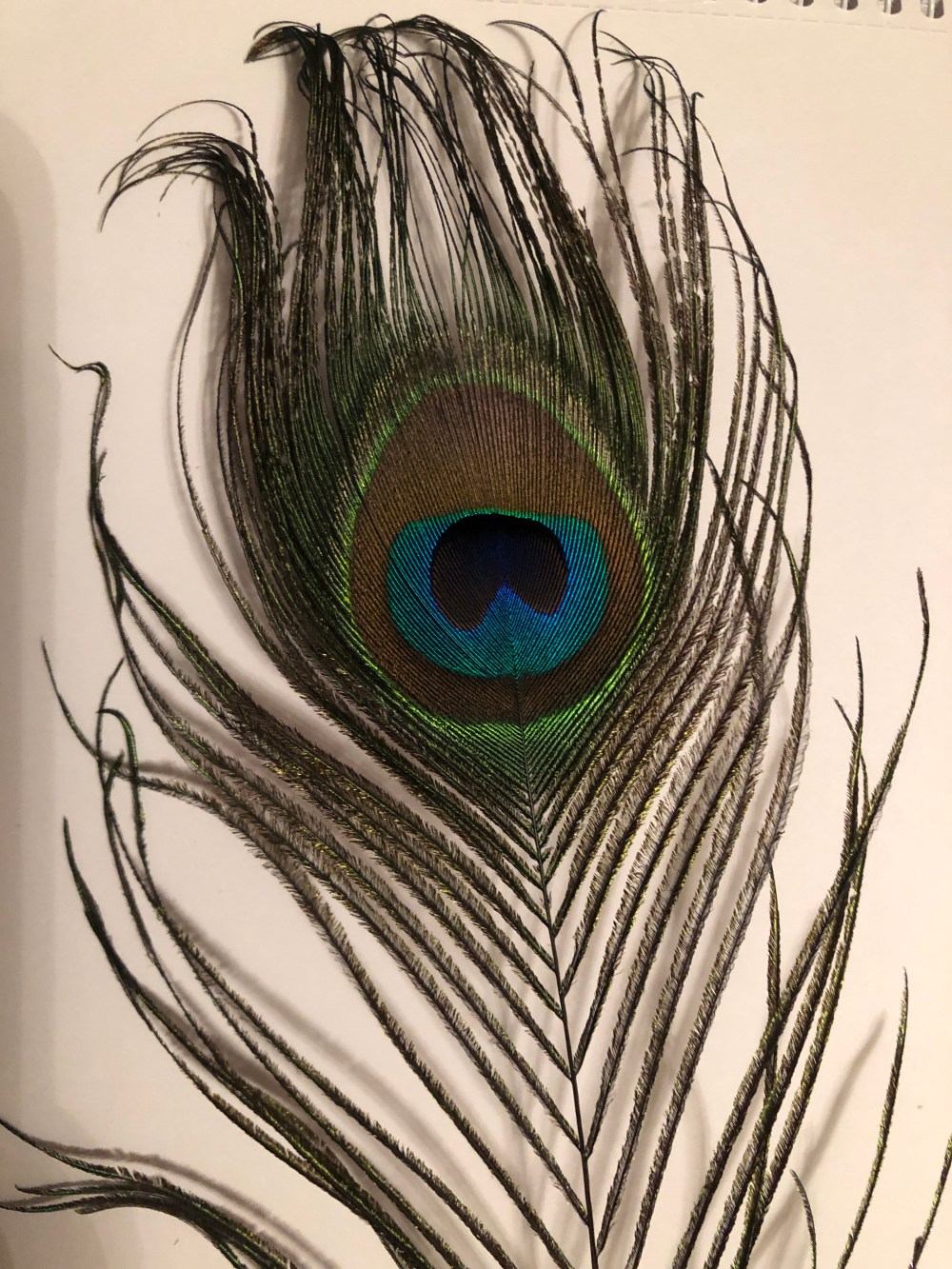
I tried to add as much detail as possible using only lines to try and keep to the assignment brief and I was pleased with the result.

It was difficult to capture the frond like spears at the top but I concentrated on the barbs lower down to try and add texture.
As I enjoyed continuous line drawing so much, I thought I would draw the peacock feather again using a fine line pen. This would mean less formal detail but more interpretation. 
When I compared the drawings side by side I realised that I preferred the continuous line drawing as it looked more interesting and drew my eye to that section of the page more. I don’t know if this was because it was bolder than the pencil but I liked it, it reminded me a little of a stem of bracken from my walks in the woods.

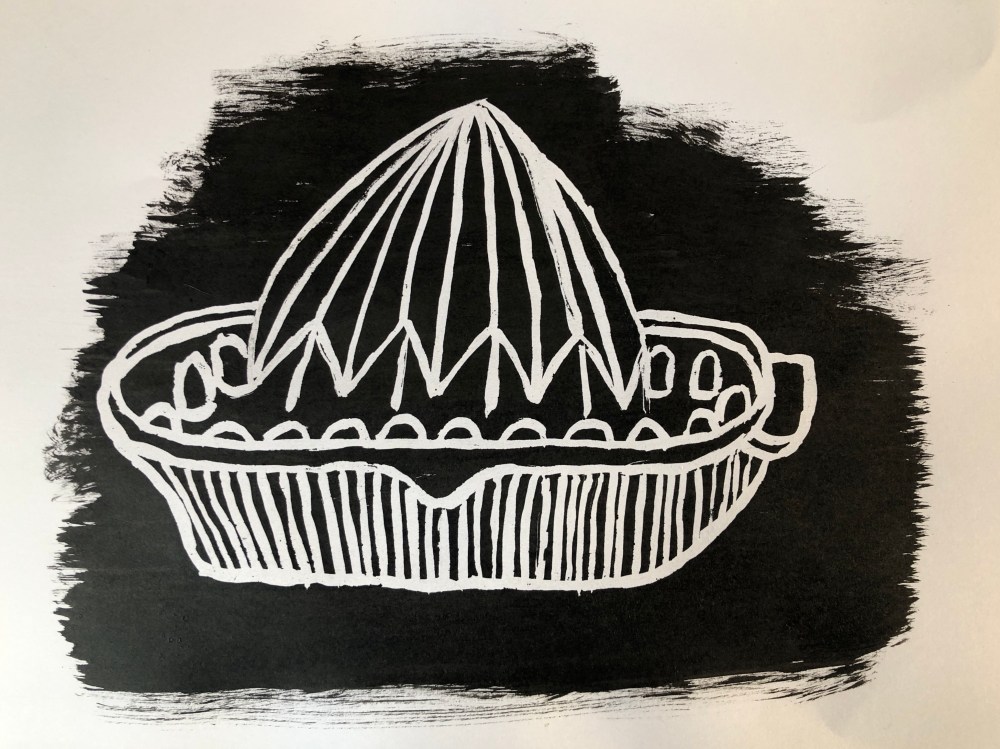
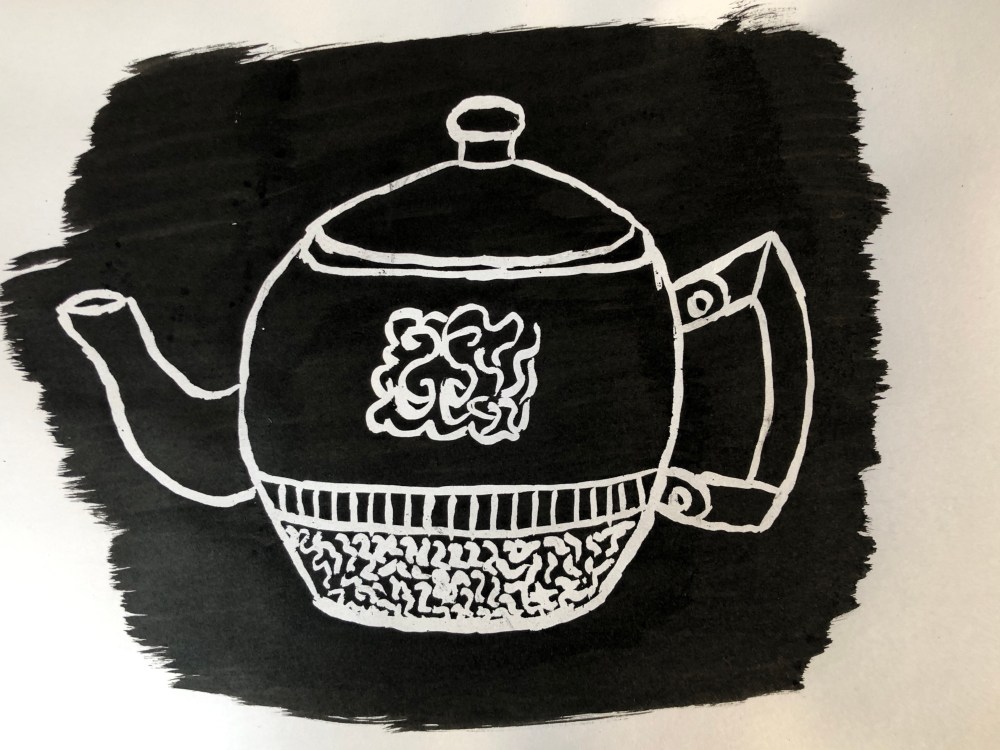
I also wanted to try negative mark making again and used masking fluid and the opposite end of a paintbrush to draw out the shapes of the lemon squeezer and the teapot again.
I found it much easier to have a fixed purpose in mind rather than randomly distributing the masking fluid and that I needed to relax more and use the unconventional tool more slowly. I was able to get much cleaner lines and felt I would get a much clearer image after removing the dried masking fluid. After a thick coating of black ink, I removed the masking fluid and was happy with the finished images.
I did still ponder about how using coloured pastels under the masking fluid and then black ink as the topcoat could really give a thought provoking effect and I intend to try this out but due to having now run out of ink, I will try this in my sketchbook with black acrylic paint.
I wanted one final set of drawings and chose to draw the peacock feather again using my left hand and using an unconventional tool which was a thin stick of charcoal. The charcoal was really difficult to hold as it was so light and fragile and I did not feel the drawing was successful. I then tried the peacock quill to test out a few lines and it was really awkward. Although the general look of the peacock feather was rich in colour and soft, I’ve no idea how people centuries ago managed to write with a quill as it would not carry ink and was scratchy to use. As a result I abandoned the attempt and tried negative mark making of drawing the feather with white ink and a conventional tool which was a paintbrush. 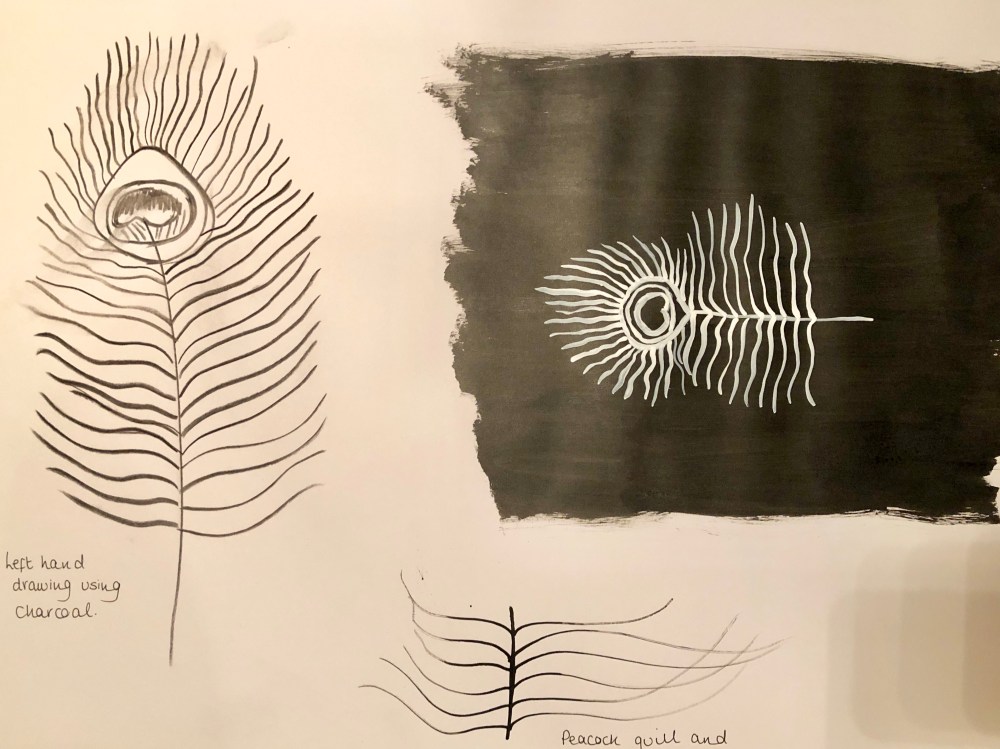
To sum up my first part of the Foundation Textile Design course, I feel I have learned a great deal about drawing, how to produce different effects using a mix of tools and I have certainly discovered what I do and do not like. I’ve also found my areas of weakness and that I need to practice drawing more.
If I were to repeat this whole section of the course, I would make more time and make more effort. I don’t feel that I produced enough work and so I want to improve on this on assignment 2.
I have found it difficult at times to try and understand what the course materials are asking me to do and so I’m not sure I’ve always got this right. It was sometimes awkward drawing on A2 but I realise this is also where I need to practice more on working on a bigger scale.
 Foundation Textiles